1. Recursive self-improvement is coming — and it is needed
AI improves AI, and that AI produces still more capable AI. Recursive Self-Improvement (RSI) has long been discussed as one of the key mechanisms that could bring about the singularity.
As the AI race intensifies, events that once felt like science fiction have begun to happen. In 2026, OpenAI announced an AI-driven negative resolution of the Navier–Stokes problem, one of the Millennium Prize Problems. In Japan, ransomware damage has kept growing, with 123 reported cases in the first half of 2026 — a record for any half-year period.
The UK AI Security Institute's Frontier AI Trends Report likewise reports that AI's cyber capabilities are improving rapidly, while vulnerabilities that bypass safety mechanisms were found in every system evaluated.
No one knows when the singularity will arrive. But a future in which AI participates in its own development and accelerates its own progress has become tangibly real.
Against this backdrop, it would be redundant to argue once more for the importance of recursive self-improvement in AI.
What we want to propose instead is that we humans should improve ourselves recursively as well.
If AI surpasses human intelligence, it may solve every problem facing science, technology, and society. But AI making progress and that progress yielding a future desirable for humanity are not the same thing.
The more capable AI becomes, the harder it may be for us to understand its behavior and verify its safety. That is precisely why humans must not merely enjoy AI's progress, but keep strengthening our own ability to understand, evaluate, and control its mechanisms.
Safety is not the only reason to keep learning. If AI discovers new scientific knowledge and new computational principles, we want to learn from them and extend our own understanding. Understanding the world and posing new questions is, in itself, an activity of value to human beings.
Moreover, the human values and social institutions that decide what AI ought to achieve are themselves far from finished. If AI's progress creates new possibilities and new problems, we too must keep asking what future is actually desirable.
And what we should truly aim for is not a future in which only AI advances, but one in which humans and AI drive each other's progress.
AI's progress teaches humanity; humanity's learning advances AI further.
We want to realize that cycle — Recursive Co-Improvement.
2. What is interpretation? — From Semantic Interpretability to Computational Faithfulness
The hardest part of recursive co-improvement is understanding and controlling AI's behavior from first principles. Mechanistic Interpretability (MI) is the field that has worked on understanding the internal computation of neural networks.
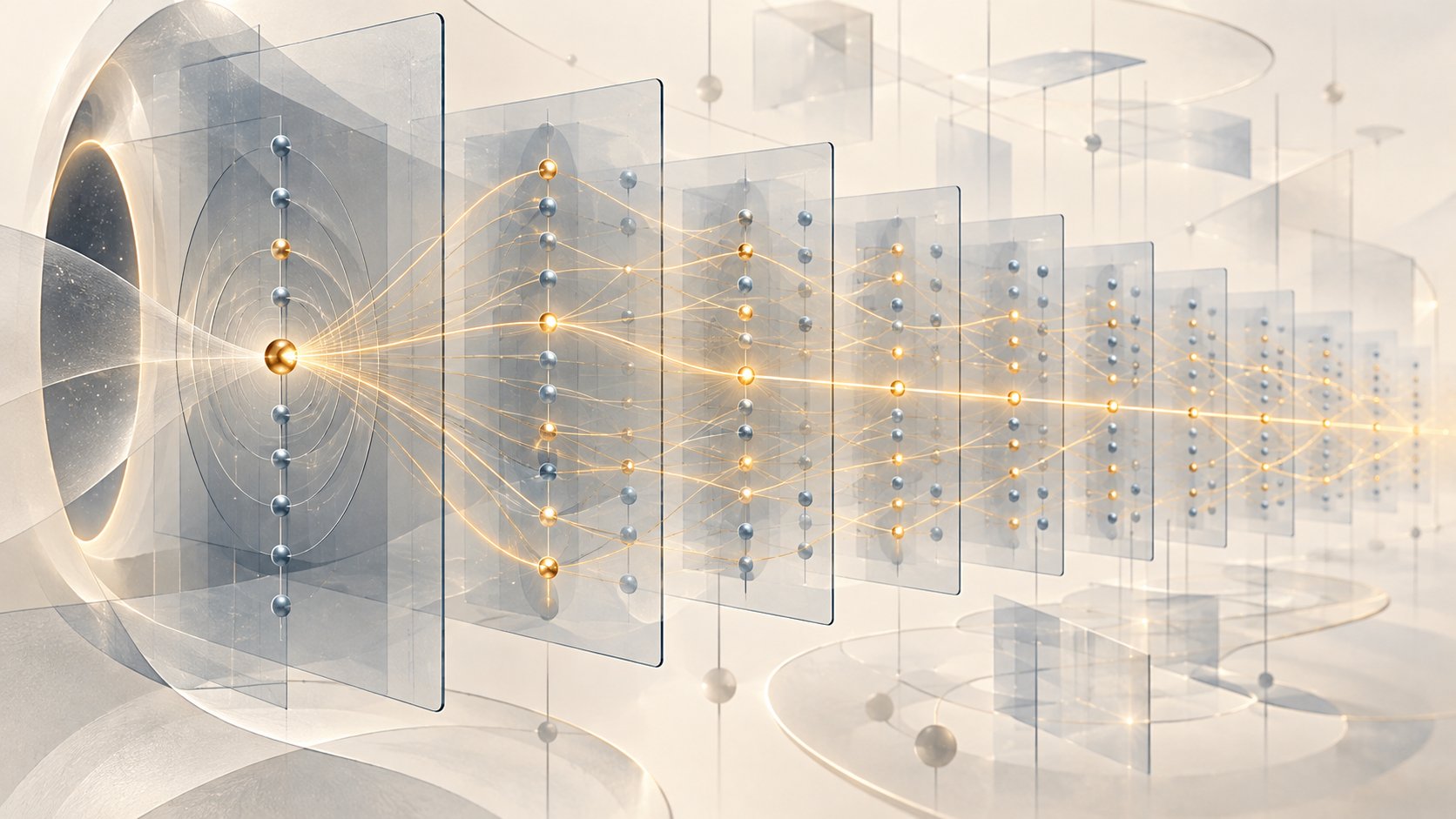
One line of work is circuits: describing the internal computation that produces a given output as a graph of which internal features fire in which chains.
Along the way, two obstacles have drawn attention: polysemanticity, where individual neurons respond to multiple concepts, and superposition, where multiple features overlap in the same representation space.
SAEs decompose internal representations into sparse features, and transcoders approximate MLP computation as relations between sparse features, both aiming to make circuit analysis tractable. Methods that explain extracted features in natural language have also advanced, and discovering semantically understandable features and circuits has come to be treated as a central achievement of interpretability research.
We suspect, however, that these approaches may overweight what is semantically understandable to humans.
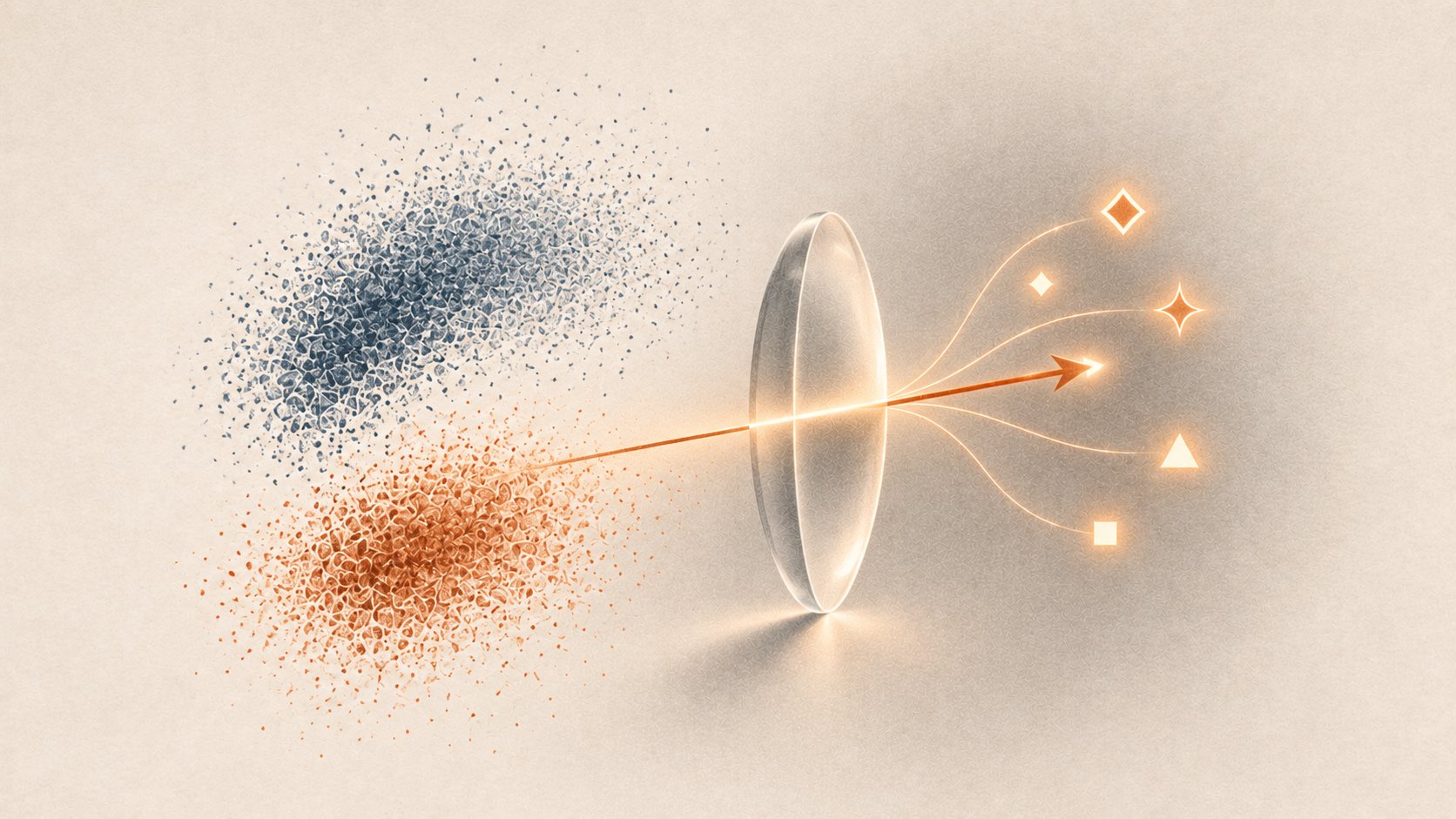
Being easy for humans to understand semantically and being faithful to the computation the model actually performs are not the same thing.
Consider understanding the operation of a CPU or GPU: mapping its internal signals onto familiar human concepts like "reasoning," "judgment," or "memory" does not amount to understanding the actual arithmetic and information flow.
The same holds for neural networks. Even if internal signals are transformed into semantically interpretable representations, those representations do not necessarily capture the original computational mechanism correctly. High reconstruction accuracy, or the ability to name features, does not by itself guarantee computational faithfulness.
So we would like to define interpretation as follows.
Interpretation is the discovery of principles that explain and predict a system's behavior in a form faithful to its internal computation.
What matters is not finding concepts humans already know, but becoming able to predict the model's behavior from principles.
How does the model distinguish, read, and transform its internal signals, and what follows as a result? And when we intervene on the internal computation, how does the behavior change?
First observe the mechanism as it is, and uncover its principles.
The principles we discover may not correspond to any existing vocabulary. That is fine. If we discover a new principle, we can define it as a new concept and give it a name.
Rather than fitting the model to humanity's existing concepts, we extend the human conceptual system itself by learning from the model.
This is why we want to prioritize Computational Faithfulness over Semantic Interpretability.
It is also interesting that Google DeepMind has lowered the priority of SAE research, and that Goodfire's Nick Cammarata, in Neural Networks Are Already Clean, has advocated studying the network's own computational mechanisms directly.
None of this means SAEs or transcoders are worthless. What we want to re-examine is the evaluation criterion itself: in interpretability research, what should count as "having understood"?
3. What does understanding AI make possible?
Pursuing interpretation faithful to the computational mechanism has value beyond merely explaining model behavior.
Interpretability for Science — humans learning from AI
First, humans may acquire new scientific knowledge.
Through training, AI acquires representations and computational mechanisms that no human explicitly designed. If we can understand them faithfully, we may discover new concepts, algorithms, and scientific hypotheses.
Goodfire, in fact, discovered geometric structure corresponding to phylogenetic relationships in the internal representations of the genomic foundation model Evo 2, and in joint work with Prima Mente identified new candidate biomarkers for Alzheimer's disease.
In such research, one must distinguish between understanding how a model represents existing scientific knowledge and discovering, from the model, knowledge humans did not have. The latter also requires scientific validation outside the model.
We are particularly interested in foundation models for materials science: by fusing analysis of their computational mechanisms with domain knowledge in chemistry, we want to explore a methodology for acquiring new scientific knowledge.
Faithfully understand the internal computation of models with strong predictive ability, and connect the regularities discovered there with chemical knowledge. That may let us form new hypotheses about the relation between material structure and properties, and abstract them into principles for materials design.
And we want the discovered principles not only to be understood by humans, but to be fed back into the training and design of the next AI. For example, reflecting newly found structure–property relations in generation conditions and training objectives could improve materials exploration itself.
Discover principles from AI's internal computation, let humans validate and systematize them scientifically, and feed them back into improving AI.
This is a direction in which AI does not simply end at discovering new knowledge — human learning itself contributes to the next advance of AI.
Interpretability for Safety — returning understanding to safety improvement
Second, we may be able to understand and control AI safety more fundamentally.
Conventional safety evaluation examines which inputs make a model behave dangerously. But that alone does not tell us what internal computation produced the behavior.
If we can faithfully understand the computational mechanisms involved in safety, we may be able to explain from principles why safety breaks down, and predict failures in unseen situations.
Further, that knowledge could be used to control the internal computation and improve safety through post-training.
This is a direction in which safety is improved based on an understanding of why the behavior arises, not merely by optimizing the model against good and bad outputs.
The same idea should extend to improving model architectures and learning algorithms.
Of course, whether a methodology that prioritizes Computational Faithfulness outperforms existing approaches must be shown in future experiments. But we believe that understanding computational principles and using that knowledge for prediction and control in new situations is an important criterion for evaluating the usefulness of interpretability.
4. Our research, and what comes next
We are currently studying the internal computation of Transformers from units grounded in the architecture itself.
In Attention Reading/Writing Subspaces, we formalized the reading and writing spaces of attention heads in linear-algebraic terms and analyzed the coupling between subspaces with the Projection Kernel (PK).
In Head-Exclusive, we trained Transformers whose read/write geometry between heads is controlled, and tested whether geometric exclusivity implies functional independence — it does not necessarily.
In KV Cache Swaps, we tested, through interventions on the KV cache, the hypothesis that the value called up by a key holds the corresponding information.
What these share is a stance: rather than searching for semantic features humans fixed in advance, we try to understand the computation the model actually performs and the causal relations among its components.
Going forward, we want to use PK to identify candidate computational paths and, through causal verification, develop circuit analysis grounded in the model's own computational units.
In Interpretability for Science, we will advance mechanistic interpretability research on foundation models for materials science, fused with domain knowledge in chemistry.
We will analyze the internal computation of models with strong property-prediction and materials-generation capabilities, prioritizing Computational Faithfulness, and aim to discover new principles connecting material structure and properties.
We further want to validate and abstract the discovered principles chemically, and return them to model training and materials generation — raising human scientific understanding and AI's materials-exploration capability together, toward the discovery of new materials.
On safety, we will pursue fundamental research toward understanding and controlling dangerous AI behavior from principles, through circuit analysis that prioritizes Computational Faithfulness.
At the same time, through contributions to Inspect, the UK AISI's open-source evaluation framework, we will work on detecting and evaluating deceptive behavior and backdoors latent inside models.
We will also study mechanisms for monitoring and controlling multi-agent systems, aiming to establish techniques that detect and suppress AI malfunction in production environments.
Understand computational structure, and return the knowledge gained to real-world improvement — this is the policy common to all of our research.
5. Recursive Co-Improvement
AI improves itself and produces still more capable AI. Recursive Self-Improvement is a vision for accelerating AI's progress.
But we want AI's progress to feed not only AI's own capability, but the progress of human knowledge as well.
The purpose of interpretability research need not be limited to explaining models with humanity's existing concepts.
Faithfully understand the computation the model actually performs, and discover principles that explain and predict its behavior. If a principle has no name yet, take it into human knowledge as a new concept.
Then use that knowledge to improve AI's capability and safety. Study the improved AI again, discover new principles, and connect them to the next improvement.
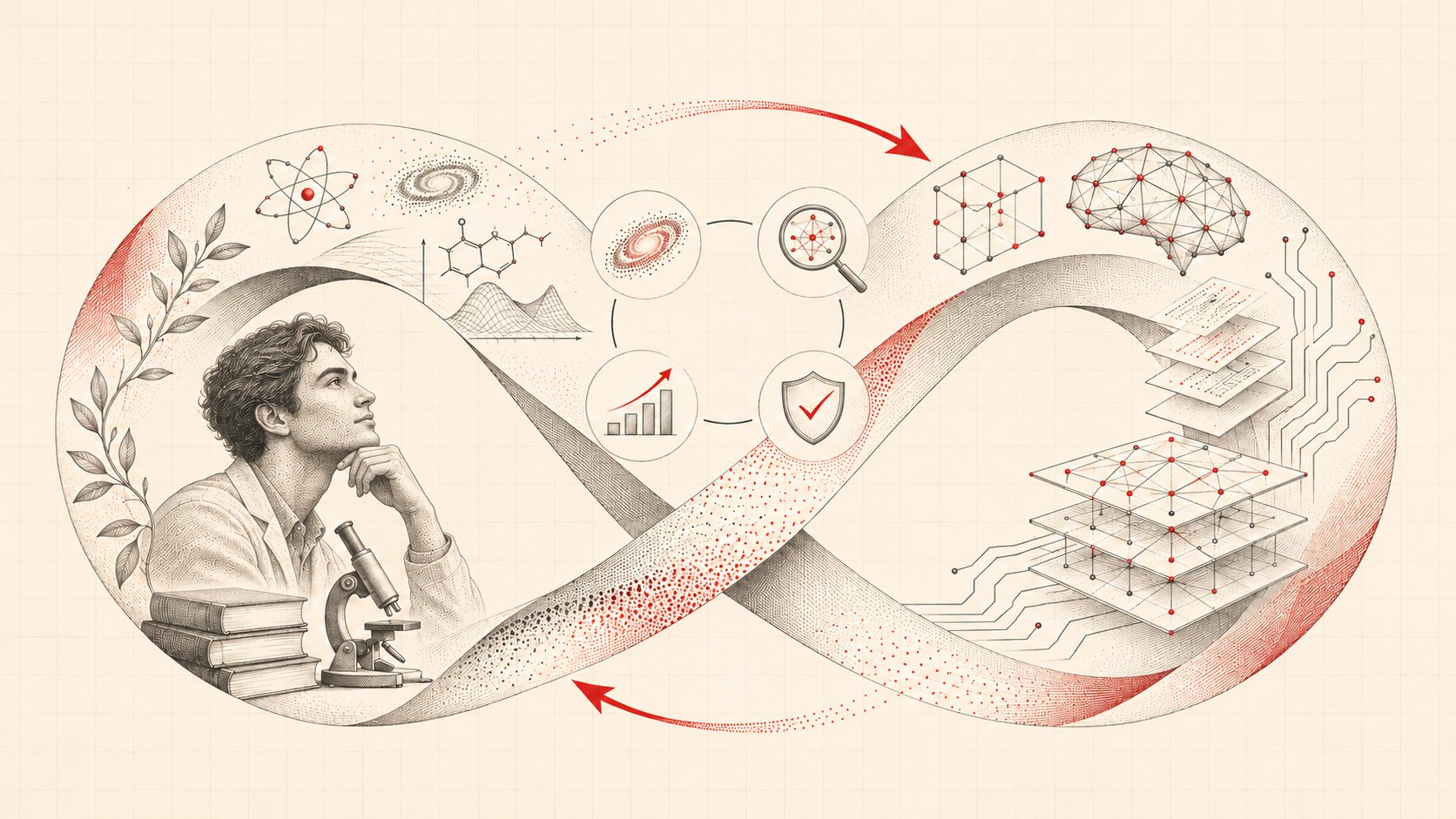
Understanding AI → human learning → improving AI → understanding the new AI.
This cycle is what we call Recursive Co-Improvement.
It is a vision for humanity to co-evolve with AI while keeping the activities that make us human.
Not merely enjoying AI's progress, but learning from it, deepening our understanding of the world, and continuing to produce new knowledge.
And with that knowledge, understanding and controlling AI more deeply, re-asking ourselves what we should aim for, and steering the next advance of AI.
We do not want to delegate intellectual activity entirely to AI — we want humans to remain subjects who learn, think, and create.
Realizing this cycle, of course, requires solving the problems of discovering computational principles, generalizing them, and returning them to model improvement.
That is what we want to work on.
By understanding AI, humans become smarter. And those humans make AI smarter and safer.
Not Recursive Self-Improvement alone.
Recursive Co-Improvement is the AI research we aim for.