Abstract
Attention heads are widely used as units of interpretation and intervention. Yet an intervention at a single head need not remain confined to a channel exclusive to that head, so its effect need not reflect that head's computation alone. To evaluate head-level interventions more precisely, we take an intrinsic approach that controls the overlap between heads. We train Transformers whose read/write geometry fixes how heads' subspaces overlap, patch every head on three tasks, and ask whether making heads exclusive concentrates their effects. Three findings emerge. First, head-level interventions are not exclusive: a head's perturbation reaches every later head, most strongly the task-relevant ones. Second, exclusivity reallocates rather than removes overlap: when writers decompose the residual stream orthogonally, the overlap each reader receives is conserved, and in the exclusive design effects shifted from heads to head indices, spreading over the layers within an index, rather than becoming consistently more concentrated. Third, geometry shapes organization: shared write subspaces align task-relevant heads into same-index lanes, and heads' value reading spaces align with their own writing spaces. Head-level concentration, in contrast, did not increase consistently across tasks in our single-seed comparisons, and where it appeared, it tracked restricted readers and lost capacity. Geometric exclusivity and functional concentration therefore need not coincide.
1 Introduction
Attention heads are commonly treated as meaningful units of Transformer computation. Individual heads and sparse sets of heads have been associated with syntactic relations (Clark et al., 2019; Voita et al., 2019), induction (Olsson et al., 2022), copying (Wang et al., 2023), task representations (Todd et al., 2024), grammatical number (Ferrando and Costa-jussà, 2024) and truthfulness (Li et al., 2023). This view has produced a matching intervention methodology: identify an important head, modify its activation, and attribute the behavioral change to that head. Steering methods such as Inference-Time Intervention (Li et al., 2023) and function vectors (Todd et al., 2024) make this attribution consequential, because a head-level intervention appears far more localized than an intervention on the whole residual stream.
There is, however, a distinction between where an intervention is applied and which computational channels the resulting perturbation occupies. In previous work we showed that head reading and writing subspaces are generically disjoint but non-orthogonal (Uehara and Santo, 2026). A vector written through one head therefore generally has a nonzero component in subspaces read by other heads, although no nonzero vector belongs to both. An intervention can be unambiguously located at one head without being exclusive to a channel associated only with that head. Our concern is therefore not that a head's patching effect includes downstream computation, which is compatible with attributing the effect to the intervention site, but whether the localization of an intervention licenses conclusions about the exclusivity of the channels it uses.
The natural hypothesis is that this non-exclusivity is what spreads functional effects across heads, so that removing non-orthogonal read/write coupling between heads should concentrate the effects of head-level interventions. We test it with an intrinsic approach: rather than analyzing the geometry of trained models, we treat it as an experimental variable and build it into training. We train models in which writing spaces, reading spaces, or both are frozen to designed subspaces, including one model in which no head can read the attention writes of heads with another index. We then measure where three tasks place their causal effects.
Our experiments do not support a simple link between geometric exclusivity and functional concentration. Table 1 summarizes the properties we distinguish and measure in testing this link. Our contributions are:
-
Measurements of the directional leakage of actual head-patching perturbations, showing that in learned and
write-common-axismodels they project onto the folded reading spaces of every later head, most strongly onto the queries of other task-relevant heads, beyond what the subspaces predict. -
Evidence from 21 trained configurations that geometric exclusivity does not imply functional concentration. In our single-seed comparisons, an allocation of overlap exclusive across head indices did not consistently increase concentration relative to uniform allocations, and on corpus S freezing writers with free readers spread effects on all three tasks in the model with the same number of heads. Head-level and index-level concentration diverge: on SVA and quote, the exclusive design concentrates effects on fewer head indices than within-layer permutations give but spreads them over more layers within an index, so similar head-level values hide different structures.
-
A positive organizational effect of geometry. Shared write subspaces align task-relevant heads into same-index lanes that form after the task is learned and were not preferred relays under single-head clamps, although a joint lane clamp was in one model and task. The effect recurs across independently trained shared-writer models on two corpora and is clearest on SVA; most models have one seed.
-
Evidence that value read/write self-alignment arises in all eight free-reader models we evaluated, forms early under gradient descent and is strongest with learned writers.
-
A framework that separates the site of a head-level intervention from the reading subspaces its perturbation can reach. Its conservation identity (Proposition 1), a trace identity for orthogonal decompositions, makes explicit the quantity our designs manipulate: when writers decompose the residual stream orthogonally, the total overlap a reader receives is fixed, so overlap with heads of other indices can be reallocated but not removed.
2 Related Work
Head-level interventions and functional attribution. Attention heads have long served as units of mechanistic interpretation. Early work identified specialized linguistic functions and redundancy among heads (Clark et al., 2019; Voita et al., 2019; Michel et al., 2019), while subsequent studies used head-level interventions to identify circuits and steer model behavior (Wang et al., 2023; Li et al., 2023; Todd et al., 2024). However, the location of an intervention does not establish that the affected computation is exclusive to that component. Makelov et al. (2024) showed that subspace interventions can activate dormant pathways, and Vaidyanathan et al. (2026) showed that activation-patching effects can include interactions with other components. Nam et al. (2025) found that head roles depend on interactions with other heads, while Christensen et al. (2026) demonstrated that independent computations over orthogonal representations need not be assigned to independent heads. These studies challenge simple interpretations of component-level effects. Our question is complementary: whether controlling the geometric coupling between heads during training changes the concentration of their intervention effects.
Read/write geometry and inter-head communication. The residual-stream framework describes Transformer components as reading from and writing to a shared representational space, with attention heads interacting through Q, K and V composition (Elhage et al., 2021). Merullo et al. (2024) identified low-rank communication channels between layers and predicted head interactions from weight matrices. Yamagiwa et al. (2026) used the projection kernel to measure relationships between attention-head subspaces and recover known interactions. Related analyses of OV operators have identified structured orientations and approximate scaled-idempotence (Trockman and Kolter, 2023; Feng and Li, 2026). These studies characterize geometric relationships in learned models. Building on this perspective, we treat read/write geometry as an experimental variable, measure the directions reached by actual head-patching perturbations, and examine how the resulting coupling relates to task effects.
Designed geometry and computational organization. Several approaches impose structural constraints on Transformers to make their computations more interpretable. Tracr compiles human-readable programs into Transformers with known computational structure (Lindner et al., 2023). Transformer Programs and Adaptive Transformer Programs introduce constrained representations and modules that support interpretable computation learned through optimization (Friedman et al., 2023; Lai-Dang et al., 2025). Other work has encouraged diversity among attention heads (Li et al., 2018; Yun et al., 2021) or studied the emergence of multi-layer head circuits (Muşat, 2025). Our objective differs from constructing interpretable programs or encouraging head diversity. We train Transformers with deliberately assigned read/write subspaces, compare exclusive and distributed allocations of cross-layer coupling, and evaluate both the concentration of single-head intervention effects and the alignment of task-relevant heads across layers. This distinguishes geometric exclusivity, functional concentration and cross-layer organization as separate empirical properties.
3 Framework
Read and write spaces at three levels. We use column vectors, with and . For head in layer , let for and . The writing space is . Because each head reads the residual stream through a LayerNorm, we distinguish three objects, and every result states which one it uses. The first is the weight-space reading space
The subscript indicates that normalization has not been folded in. Designed geometry (Figure 1, Table 2), the PK–edge analysis and the self-alignment measurements use this level.
The second is the folded reading space , following the convention of our previous work (Uehara and Santo, 2026). Suppressing the layer and head indices, let be the centering projector and the normalization-folded read map. Then
The leakage measurements of Section 5.1 use this level. Writing , , LayerNorm is . With the Jacobian of , the reader's Jacobian is
The scale does not change a subspace. The rank-one term is input-dependent and is not represented in the folded space; we did not measure its size. For block readers with a per-head LayerNorm, the same definitions apply in the 64-dimensional block coordinates: centering acts within that block, so the folded reading space has at most 63 dimensions (exactly 63 when the map and the gains are non-degenerate).
The third is the actual response, the exact change of a reader's input under an intervention, measured by running the network (the direct and total changes in Section 5.1).
Overlap is not intersection. We say overlaps when ; overlap never means . For generic head subspaces, while . For the projection-kernel definition, we denote two subspaces by and their orthonormal basis matrices by . With principal angles and ,
Here is the orthogonal projector onto . Outside this basis-matrix formula, and denote subspaces.
Proposition 1 (Overlap is conserved). If are mutually orthogonal and , then for every subspace .
Proof. , hence .
In the twelve-head models with frozen block writers (the frozen-writer models of Table 2), () and the writers of a layer form an orthonormal decomposition of the residual stream, so Proposition 1 applies. It does not apply to the routed controls, which write 16 heads into 768 dimensions. In the models where it applies, a -dimensional reader receives exactly units of overlap (in weight space) from the writers of each earlier layer. Exclusivity in this sense is between head indices, not between heads: a common basis can remove overlap with heads of other indices, but a head stays coupled to the same-index heads of other layers. We call this cross-index exclusivity. For a reader of head in a later layer , the overlap with all other head indices is
Here is the same-index writer in layer . The overlap with other indices can be reduced, even to zero, but only by concentrating it on that one partner (), as in all-common-axis. The total cannot be reduced. Our manipulations therefore change how overlap is allocated: concentrated on the same index, or spread approximately uniformly ( with every writer, the expectation for a random subspace).
Site versus channel. Let be a source head and a later head, with . For a fixed read kind , write and . Patching head injects , which head reads through the projection onto along the linear path. If , some perturbations written exclusively through reach directly. For a concrete perturbation we define the directional leakage
pooled over examples and positions, with the read kind suppressed in . If the perturbations were isotropic in , the corresponding population energy ratio would be . In the models where we measure leakage, both spaces have 64 dimensions, so this equals , the isotropic expectation used below. Measured leakage tells us whether actual intervention directions are more or less exclusive than the subspace geometry implies.
Properties examined in this study. Table 1 summarizes the intervention site and the geometric and functional properties examined in our experiments. These distinctions specify what each measurement establishes; they are not an exhaustive classification of localization or a claim that the properties are mutually independent. Modularity in the stronger sense of separable sub-computations would require joint interventions, interaction effects or selectivity across tasks. We do not measure it, and none of our conclusions concern it.
| Property | Meaning and measure | Finding |
|---|---|---|
| Intervention site | Which head is manipulated. Fixed by implementation. | --- |
| Geometric exclusivity | The injected perturbation has no component in the reading spaces of other heads; in our designs, of heads with other indices (cross-index exclusivity). Measured by leakage and PK. | Absent in the five models measured (learned, write-common-axis): every patch projects onto the folded reading spaces of every later head about as geometry predicts, and pairs of important heads project onto each other's queries at the isotropic expectation (Section 5.1). |
| Functional concentration | Few heads carry the effect of single-head patching on one task. Measured by and the summed absolute single-head effect . | At the head level, not consistently increased by cross-index exclusive allocation of overlap; at the index level, concentrated beyond within-layer permutations in all-common-axis on every task and in some other models on some tasks, often with effects spread over more layers per index; spread by frozen writers on corpus S; co-varies with lost capacity and weaker task margins (Section 5.2). |
| Basis concentration | Few residual coordinates carry the effect. Measured by the top-10 coordinate share, after vs. before . | Depends strongly on the representation in which it is measured (Appendix B.2). |
| Organizational alignment | Important heads share an index across layers. Measured by the lane score . | Appears with write subspaces shared across layers; single-head clamps did not show same-index pairs as preferred relays, but the one joint lane clamp (all-common-axis, SVA) did (Section 5.3). |
Table 1. Properties examined in this study, their operational definitions, and the experimental findings.
4 Experimental Setup
Models. The models of the main analyses are 12-layer pre-LayerNorm Transformers with heads of width (), the GPT-2 tokenizer and context length 512. The routed controls use 16 heads of width 64 written into 768 dimensions, and two further controls use a softmax-free architecture with 21 layers of 16 heads (Appendix A). They are trained for 65,536 steps of 16,384 tokens with AdamW (peak learning rate decayed to , weight decay 0.1). Two corpora were used, both drawn from FineWeb-Edu (sample-10BT; Appendix A): R, 200M training tokens sampled with replacement over training, and S, 1.07B tokens read once. All models share one validation set, and comparisons are made within a corpus. Frozen bases are not trained. Let embed coordinate block , and let be frozen orthogonal matrices built from Kerdock sets so that blocks of different bases have ; a rotated writer for head is , block of the rotated basis (construction, member assignment and scale in Appendix C). Model names state the cross-layer property of whatever is frozen: which side is frozen (write, read, or all) and whether the frozen subspace is common to all layers or rotated from layer to layer. Why rotated. In both kinds of design, the heads of one layer get different blocks of a single orthonormal basis, so heads within a layer are always orthogonal; what we vary is how layers relate. Using the same basis in every layer (common) makes each head's subspace overlap only the same-index head of other layers ( for that partner, 0 for the rest). Rotating the basis from layer to layer by a different orthogonal matrix spreads that overlap approximately evenly over all heads of other layers (, , for every pair), the isotropic value. The two names thus mark the two extremes of how a fixed amount of cross-layer overlap can be allocated (Proposition 1). Table 2 lists the models used in the main text, Figure 1 shows their writer geometry, and Appendix A lists all 21 configurations with their clean task performance.
| Model | Writer | Readers | Corpus | Params | Val. loss | |
|---|---|---|---|---|---|---|
learned |
learned | free | R | 124.05M | 3.604 | --- |
write-common-axis |
(all layers) | free | R | 116.97M | 3.643 | |
write-common |
(all layers) | free | R | 116.97M | 3.648 | |
write-rotated |
(one basis per layer) | free | R | 116.97M | 3.654 | |
learned |
learned | free | S | 124.05M | 3.508 | --- |
write-rotated |
free | S | 116.97M | 3.563 | ||
read-common |
learned | block | S | 104.58M | 3.610 | |
all-common-axis |
block | S | 97.50M | 3.698 | ||
all-rotated |
block of another basis | S | 97.50M | 3.751 | ||
all-rotated-self |
block of | S | 97.50M | 3.753 |
Table 2. Models used in the main text. "Free" readers are ordinary learned . "Block" readers apply maps to one residual block (the same block for Q, K and V) after a per-head LayerNorm. is a fixed scale matching the learned map's initial output RMS. Validation loss is in nats; is relative to learned on the same corpus, computed from unrounded losses. One seed each, except that learned and write-common-axis have two seeds on corpus R (s42 shown).
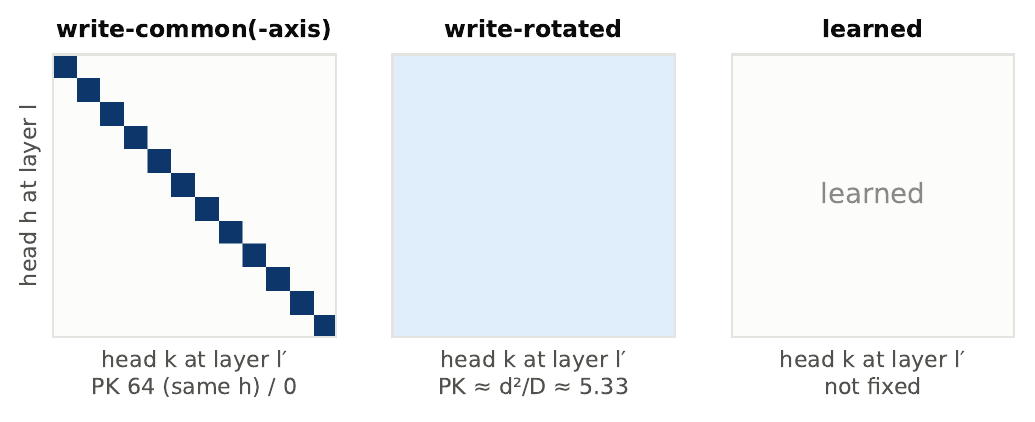
Figure 1. Designed cross-layer geometry of the writers (weight space): PK between head 's writing space at layer and head 's at layer . In all-common-axis, shared writers are combined with block readers, so each head reads and writes only its own lane. Its weight-space read/write PK is 64 with the same index and 0 otherwise; after folding the per-head LayerNorm's centering, the reader has at most 63 dimensions, still orthogonal to every other lane. all-rotated sets every cross-layer read/write PK to approximately 5.33.
Tasks. Each task is a binary next-token choice. Clean and reference prompts have equal length and differ in one token. Each task has four balanced conditions and disjoint lexical splits: discovery 300, validation 240, evaluation 240 and holdout 32 examples. In SVA, The [subject] [prep.] the [attractor] is/are, and the reference prompt flips the subject's number. In Quote, prefix = "red"\n note = ’blanket poem ’ vs. ", and the reference prompt swaps the target opening quote. In Plural, She bought two cats and one small red cat/cats, and the reference prompt flips the second numeral; the two adjectives force the number through attention. All models solve all tasks before intervention (evaluation accuracy 85.8–100%; Appendix A), but their clean logit margins differ, which matters for Section 5.2.
Intervention and metrics. We replace a head's output immediately before , at all positions, with its value on the reference prompt, and record the drop in the correct-minus-incorrect logit difference, averaged over examples with its sign; absolute values are taken after averaging. With , the effective number of heads is , reported together with . sums the absolute effects of separate single-head interventions; it is neither the effect of a joint intervention nor a decomposition of the model's total effect. We call the heads that share an index across layers a lane; in shared-writer models a lane corresponds to one write subspace, whereas elsewhere the index carries no shared geometric meaning across layers. With , the lane score
is the fraction of cross-layer effect mass on same-index pairs (chance ). Its -value comes from shuffling head labels within each layer (5,000 draws). Which split each analysis uses, and the exact clamping conditions, are listed in Appendix C.
5 Results
5.1 Head interventions are not geometrically exclusive, least of all between important heads
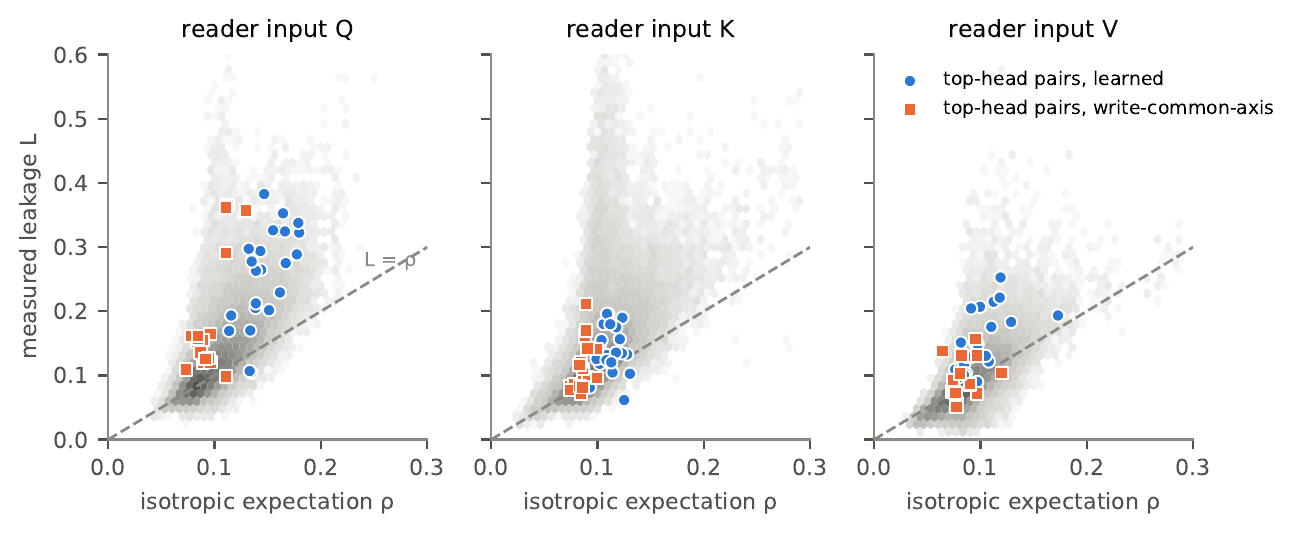
Figure 2. Measured leakage of the actual patching perturbation into the folded reading space, against its isotropic expectation , for every source-head later-reader pair (gray density; five models, three tasks) and for pairs among each task's top three heads (colored). Typical pairs leak about as much as their subspace geometry predicts. Pairs of task-relevant heads leak more, most strongly into the later head's query.
We measured the directional leakage of the actual patching perturbations, , into the folded Q, K and V reading spaces of every later head. We did this in five models (learned: two seeds on corpus R and one on S; write-common-axis: two seeds) on all three tasks, 240 examples each. The recomputed patching effects match the saved head-patching results to within . For each pair we also measured the actual response: the exact change in the reader's input caused by alone (the direct path) and by the full patched forward pass (total).
Every intervention projects onto the reading spaces of every later head. A typical source–reader pair receives 8–12% of the perturbation's energy, which is close to what the subspaces predict ( has median 1.09–1.13 for Q and K and 0.95–0.97 for V in learned models; 1.02–1.05 and 0.97 for write-common-axis). Across pairs, leakage tracks the isotropic expectation (Spearman 0.73–0.81 in learned models, 0.46–0.72 in write-common-axis). No head-level patch in these models is geometrically exclusive. Its perturbation is spread over the reading spaces of all later heads roughly as the geometry dictates.
Task-relevant heads leak into each other's queries more than geometry predicts (Figure 2). For the 40 ordered pairs among each task's top three heads, leakage into the later head's query has median percentile 97.6 among all later readers. 85% of these pairs lie above the 90th percentile, at a median of the isotropic expectation. The enrichment is weaker for V (, percentile 90) and K (, percentile 77). It is not an effect of layer position: compared only with pairs between the same two layers, query leakage between top heads still has median percentile 97, with 78% of pairs above the 90th percentile, in learned (97) and write-common-axis (96) models alike. For V the enrichment holds in learned models (percentile 95) but not in write-common-axis (63). For these pairs the direct change of the later head's input is closely aligned with its total change in both direction and size: the pooled cosine between and has median 0.86 for Q, 0.81 for K and 0.83 for V (0.50–0.53 for all pairs), and the norm ratio has median 0.98, 0.94 and 0.88 (0.72–0.80 for all pairs). The projection coefficient , the product of the two, has median 0.84, 0.81 and 0.70 (0.34–0.49 for all pairs); it depends on both angle and norms and is not bounded by one. The 40 pairs come from 15 model–task combinations and share heads, so they are not independent samples. Because these top heads were selected on the same evaluation split, we repeated the analysis with top heads selected on the discovery split (41 of 45 heads coincide). Within layer pairs, query leakage then has median percentile 97, with 78% of pairs above the 90th percentile, at the isotropic expectation.
Does this query leakage change where later heads attend? For every later head we measured the change of its attention distribution at the prediction position (total variation, TV) when only its query, only its keys, both (direct path) or the full forward pass carry the patch. For the 40 top-head pairs, perturbing only the later head's query changes its attention more than perturbing only its keys in 90% of pairs (median TV 0.029 vs. 0.014). That is about twice the median over all later heads (0.015), at median percentile 91. Across the later heads of each source, Q leakage predicts this query-only change (median Spearman 0.41 over 45 sources). In the full forward pass, the later top heads' attention still changes, slightly more than on the direct path (median TV 0.035 vs. 0.033). But the attention of all other later heads changes more as well (median 0.032 vs. 0.019 on the direct path), so the top pairs are no longer exceptional (percentile 66). What weakens in the full network response is the relative enrichment, not the change itself. These values measure how much attention mass moves, a few percent; on their own they do not bound the behavioral consequences.
Geometric reach is not the same as functional routing. Among the same-index pairs examined in Section 5.3, clamping the later important head changes the earlier head's output effect by % to 24%; across different-index pairs the change ranges from % to 56%. The relation between weight-space PK and the importance of individual head-to-head edges is reported in Appendix B.1.
5.2 Exclusive allocation of overlap did not consistently increase head-level concentration
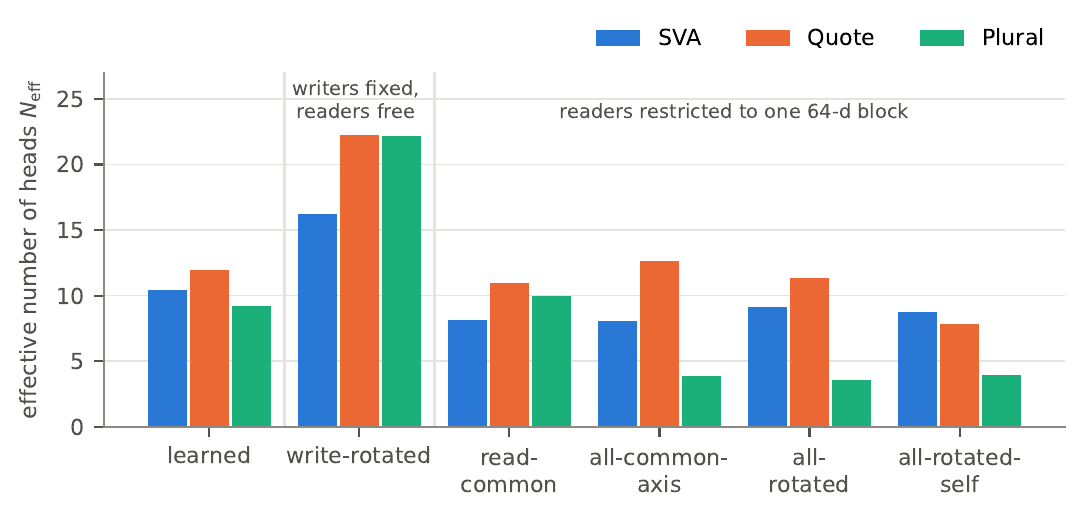
Figure 3. Effective number of heads (lower = more concentrated) on corpus S. The three models with fixed, block-restricted coupling (all-common-axis: cross-index exclusive; all-rotated and all-rotated-self: approximately uniform PK) have similar values on SVA and plural; on quote, all-rotated-self is more concentrated. Freezing writers with free readers spreads effects. One seed per model.
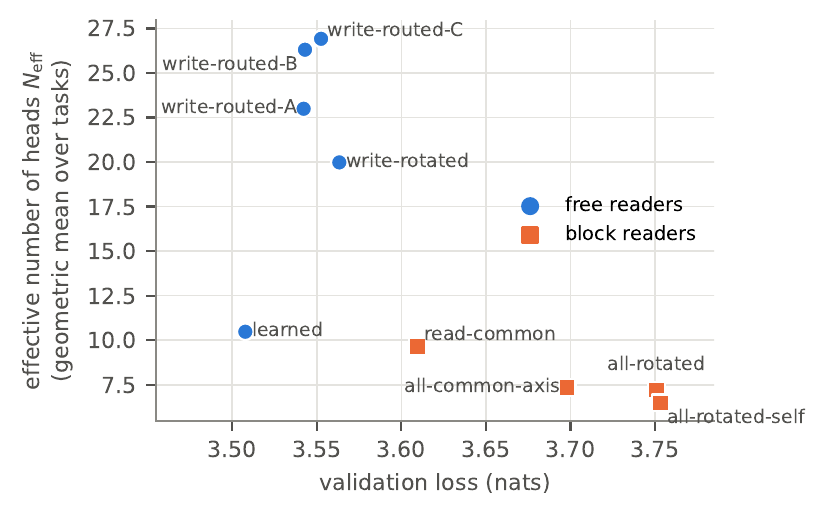
Figure 4. Validation loss against (geometric mean over tasks) for the nine corpus-S models, including the three 16-head write-routed models. The models separate into two clusters by reader type rather than following a gradient: among these corpus-S models, head-level concentration appears only where readers are restricted, and those models also have the fewest parameters and the worst loss.
all-common-axis and all-rotated differ in the variable the hypothesis names, but not only in it: all-common-axis also uses one basis in every layer and reads in its own write subspace, whereas all-rotated rotates the basis from layer to layer and reads another basis. The comparison is therefore between designs that change several geometric properties at once. In all-common-axis, a head's writes are orthogonal to every reader except same-index heads, so patching it can reach other indices only through MLPs. In all-rotated, every write overlaps every later reader by in weight space; here "uniform" refers to this approximately constant PK, not to identical principal angles. The hypothesis predicts that all-rotated is less concentrated, unless the other differences offset such an effect. Across the three tasks we did not observe a consistent difference in head-level concentration: is for all-common-axis and for all-rotated on SVA/quote/plural (Figure 3). all-rotated-self has approximately the same weight-space PK with every earlier writer as all-rotated, but each layer reads in its own write basis, and this also changes the principal-angle structure: some writers share three dimensions with readers of the next layer, whereas no writer of all-rotated shares a direction with a later reader (Appendix C). Its is , and its top head carries the largest share of of any model on SVA and quote (Section 5.3). Its quote value is lower than that of all-common-axis (7.9 vs. 12.7), the opposite of what exclusivity would predict. These values are close or point the wrong way, but they do not establish equivalence. Each model has one seed, so seed variation of these configurations is unknown; the seed pairs we have belong to other configurations and do not bound it.
Head-level and index-level concentration are different predictions. Cross-index exclusivity could concentrate effects on few head indices while spreading them over the layers of each index, leaving head-level unchanged. With and , the entropy splits exactly as , so with and , an exponentiated conditional entropy rather than an average number of layers (Table 3). On SVA and quote, all-common-axis concentrates on 2.0 and 3.8 indices, fewer than within-layer permutations of head indices give (null medians 5.0 and 5.6; , and 2.3 vs. 2.7 on plural), and spreads over 4.0 and 3.3 layers within an index, more than all-rotated, all-rotated-self and learned (1.7–2.1). Similar head-level values thus hide different structures. all-rotated and all-rotated-self are at chance at the index level (). The pattern is not specific to one design. mlp3456, a write-common-axis model on corpus S whose MLP is widened to the parameter count of learned, shows it on SVA and quote ( and ; index level ), but value384, which compensates capacity with a value adapter of width 384 instead, does not reach index-level significance on quote (). Models without a shared writer show parts of it: read-common, which shares a read block but learns its writers, concentrates on fewer indices on SVA (3.6, ), and write-rotated spreads over 2.6–3.3 layers per index and concentrates on fewer indices on quote (). These index-level tests are not corrected across models. In all-common-axis, cross-index exclusivity, a write subspace shared within an index and a read block shared within an index coincide by construction, so its index-level concentration cannot be attributed to any one of them.
| Model | SVA | Quote | Plural |
|---|---|---|---|
learned |
|||
write-rotated |
|||
read-common |
|||
all-common-axis |
|||
all-rotated |
|||
all-rotated-self |
|||
write-common-axis (mlp3456) |
|||
| from | |||
learned |
20.1 | 18.8 | 24.0 |
write-rotated |
25.3 | 34.8 | 40.1 |
read-common |
14.8 | 16.1 | 21.0 |
all-common-axis |
11.9 | 18.7 | 9.1 |
all-rotated |
13.8 | 17.4 | 8.3 |
all-rotated-self |
13.0 | 12.7 | 9.0 |
write-common-axis (mlp3456) |
19.0 | 34.4 | 28.7 |
Table 3. Decomposition of head-level into the number of effective head indices and the number of effective layers within an index, (corpus S, evaluation split). Last block: with absolute values taken per example, , instead of after averaging. Each value is rounded separately, so displayed factors need not multiply exactly.
Three checks concern how is estimated (Appendix C). First, because absolute values are taken after averaging over examples, a head that helps on some examples and hurts on others gets little weight. Taking absolute values per example first raises by a factor of 1.4–3.0 and largely preserves the relative ordering of models (Spearman 0.95 over all 57 model–task cases; 0.83–0.94 among the six corpus-S models of Figure 3), but some close comparisons reverse (learned vs. read-common on plural, learned vs. all-common-axis on quote); for the three models that freeze both writers and readers the pattern is unchanged (Table 3). Second, paired bootstrap intervals (95%) for the difference in , resampling the same evaluation examples for both models, show all-common-axis more concentrated than all-rotated and all-rotated-self on SVA ( [, ] and [, ]), less concentrated on quote ( [, ] and [, ]), and not resolved on plural ( [, ] and [, ]). Within the four balanced conditions of each task, all-common-axis is more concentrated than all-rotated in 3, 2 and 1 of the four conditions on SVA, quote and plural. Third, the evaluation examples come from few lexical groups (4 subject noun pairs for SVA, 8 variable names for quote, 24 nouns for plural). Leaving out any one group changes no model's by more than 9% and reverses none of these differences except the unresolved plural comparison with all-rotated-self. These checks condition on the evaluation vocabulary and templates: they do not address generalization to new vocabulary, nor seed variation.
Fixing the geometry also does not concentrate function in general. With the same 12 heads per layer as learned, write-rotated (frozen writers, free readers) has a larger on all three tasks ( vs. , factors 1.6, 1.9 and 2.4), with similar . Paired bootstrap intervals for the differences are [, ], [, ] and [, ], and no lexical group reverses them. The two models also differ in parameter count (116.97M vs. 124.05M) and validation loss ( nats), so the comparison is not of writer geometry alone. Each factor exceeds the ratio between the two seeds of learned on corpus R (1.3, 1.3 and 2.2), the only learned-writer seed pair, which indicates but does not bound seed variation in other configurations. The three write-routed models point the same way (factors 1.7–3.3 in all nine comparisons), but they have 16 heads per layer, so the number of candidate heads differs and raw comparisons are confounded; we treat them as supporting evidence. The direction also appears on corpus R for write-common-axis, where two seeds of each model allow a seed-level comparison. On quote, both of its seeds spread the effect over 1.6–2.1 times as many heads as both learned seeds ( and vs. and ). On SVA and plural the seeds overlap (, vs. , ; , vs. , ).
On corpus S, head-level fell below that of learned in 10 of the 12 reader-restricted model–task comparisons and in none of the three for write-rotated. This is not universal across corpora: on corpus R, write-common-axis with free readers is below learned in some single comparisons (plural, seed 42: 9.4 vs. 13.3; SVA, seed 43: 11.2 vs. 12.7), which we do not take as a stable effect. In the three 97.5M models that freeze both writers and readers, head-level concentration is strongest on plural, where one head carries 77–78% of the absolute effect; in read-common the top plural head carries 28%. Figure 4 shows why we do not attribute it to reader restriction as such. The concentrated models are also the ones with the fewest parameters, the highest loss and the smallest clean plural margins (logit difference 2.30–2.54, against 3.10 for learned and 3.14 for read-common). On plural, the reader-restricted model that keeps learned writers (read-common, 104.6M, nats) is not concentrated ( vs. 9.2 for learned), while the three 97.5M models ( to ) are. The rank correlation between loss and over the nine corpus-S models of Figure 4 (; over the six 12-head models) reflects the two clusters, not a graded relation. With the present models we cannot separate reader restriction from reduced capacity or weaker task performance.
Two related analyses are reported in Appendix B. Coordinate-level concentration depends strongly on the representation in which it is measured (Appendix B.2), and in the constrained models the direct path of top heads' effects is smaller (Appendix B.3).
5.3 Shared write subspaces align heads into lanes
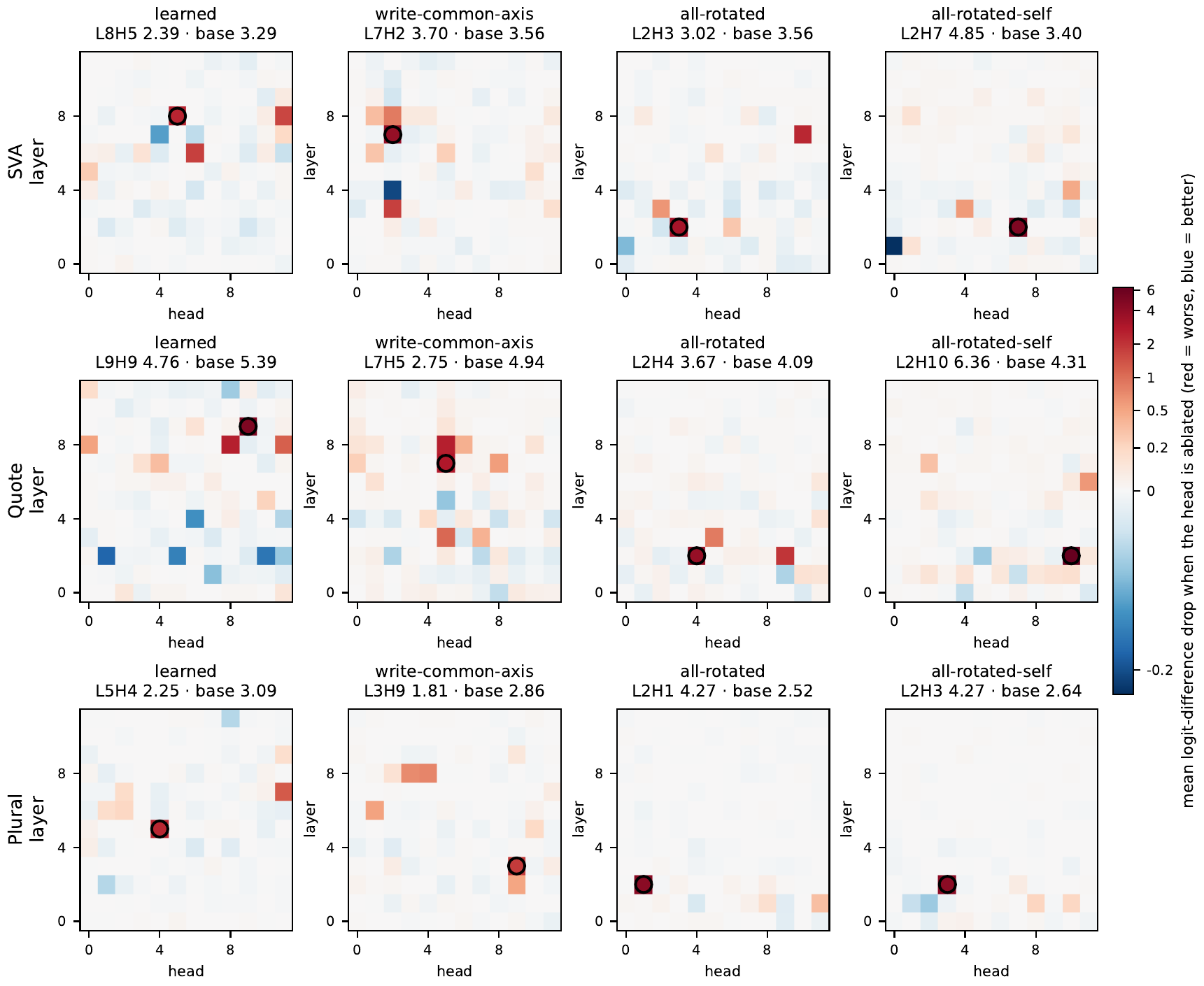
Figure 5. Mean drop in logit difference when one head is patched (discovery split; layer 0 at the bottom), for four models trained on corpus S. write-common-axis is the variant with an MLP widened to match the parameter count of learned (mlp3456); both have free readers. all-rotated and all-rotated-self freeze writers and readers in per-layer rotated bases and differ in which basis a layer reads, which also changes their principal-angle structure (Appendix C). Red: patching hurts; blue: it helps. Colors use on one scale for all panels; the circle and title give the head with the largest drop and the unpatched logit difference (base). With a shared write subspace, important heads stack in one column: the top three heads of write-common-axis all have index 2 on SVA and index 5 on quote (, ; , ; chance ), against for learned; plural shows no significant lane. The rotated models form no same-index lanes () but put the largest share of the effect on one head (39–78% and 61–77% of , against 34–45% for learned; Section 5.2). This concentration is not a same-index lane, and since it also appears in all-rotated, whose heads have approximately uniform PK with all heads of other layers, it does not come from cross-index exclusive coupling.
Geometry does change the organization of important heads. Figure 5 shows four models trained on corpus S: learned, a parameter-matched write-common-axis variant with a widened MLP, and the two models that freeze both writers and readers in bases rotated from layer to layer. When a head index keeps one write subspace in every layer, the heads that matter for a task stack on the same index. In the parameter-matched write-common-axis model of Figure 5, the top three heads all have index 2 on SVA and index 5 on quote ( and , and ), and the other capacity-compensated variant (value384) has a strong SVA lane (, ). all-common-axis, which shares both its write subspace and its read block across layers, has the strongest lanes we observed ( and on SVA and quote, and ; on plural), whereas read-common, which shares only the read block, has none (, ). The effect recurs on corpus R: on SVA/quote/plural for write-common () and for write-common-axis (). Models whose writers are learned or rotated from layer to layer show no same-index lanes: learned (, in all three learned models), write-rotated (–, ), all-rotated (–, ) and all-rotated-self (–, ). In these models a head index has no shared geometric meaning across layers, so this says only that effects do not concentrate along a given index; it does not exclude functional sequences that link different indices across layers. Testing for those would require estimating cross-layer correspondences on the discovery split and evaluating them on another split. Yet all-rotated-self concentrates its effect on a single head more than any other model. Its top head carries 61% and 64% of the summed absolute single-head effect on SVA and quote, the largest shares among the 19 configurations with head-evaluation data, against 27–37% in the three learned models; on plural it carries 77%, against 42–62%. The gap on SVA and quote is at least 24 percentage points; for reference, on SVA and quote, seeds of learned and write-common-axis differ by at most 9 points, which does not bound the seed variation of this configuration. Its shares also exceed those of all-rotated (42% and 39%), which has the same parameter count and validation loss (3.751 vs. 3.753); on plural the two rotated models concentrate equally (77% and 78%). The two models differ in which basis each layer reads, and with it in two geometric properties: each head of all-rotated-self reads its own write subspace, and some of its writers share three dimensions with readers of the next layer (Appendix C). The comparison does not separate these. Concentration on one head and alignment into lanes are thus separate properties: in the design with self-reading, we observed a larger top-head share on SVA and quote without a same-index lane. On SVA, a repeated index among the top three heads occurs in all 7 write-common-axis variants we trained (two seeds, a restricted-diagonal writer, two capacity-compensated models, an unscaled variant and a softmax-free architecture) and in none of 4 learned models. Alignment with coordinate axes is unnecessary, since the rotated shared writer (write-common) also forms lanes. Each test is a within-model permutation, corrected over the three tasks of that model; we did not correct across the models we examined, and the list below gives every shared-writer model for which we report a lane score. After this correction, the SVA lane remains significant in write-common (), in the parameter-matched write-common-axis (; quote ) and in value384 () and in all-common-axis (; quote ), but not in write-common-axis on corpus R (; quote ). These are observations across configurations, not replications across seeds. write-common-axis on corpus R has two seeds, and both repeat an index among their top three SVA heads, but we computed the lane score for seed 42 only; every other configuration has one seed. The lane is thus observed across several independently trained shared-writer configurations on both corpora, most clearly on SVA and more weakly on quote and plural, while its stability across seeds of one configuration has not been tested.
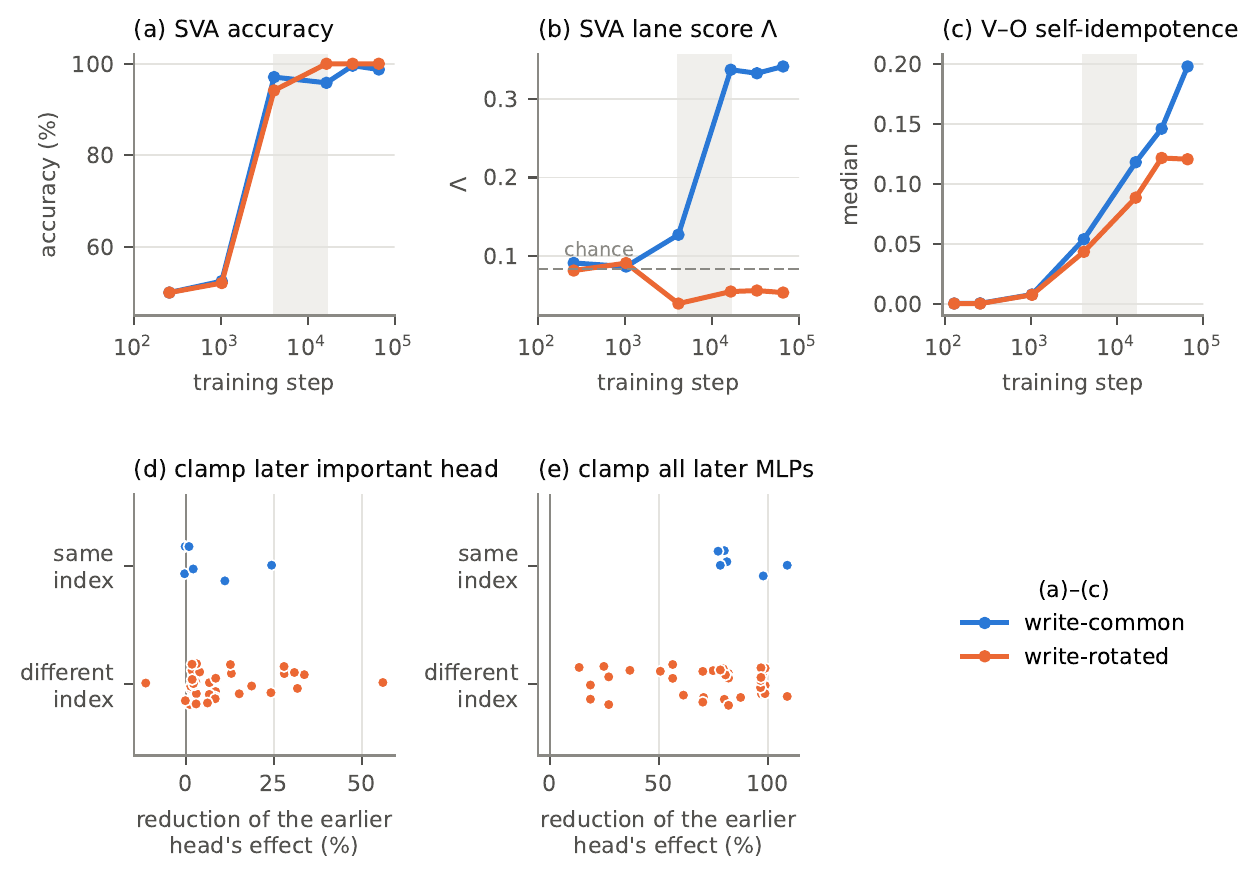
Figure 6. (a)–(c) SVA accuracy, lane score and V–O self-idempotence over training. Both models reach accuracy by step 4,096; the write-common lane forms only between steps 4,096 and 16,384 (shaded). (d)–(e) Drop in an earlier important head's effect when (d) a later important head or (e) all later MLPs are clamped to their clean values, as a fraction of the unclamped effect, for every ordered pair of top-three heads in five models and three tasks. Same-index pairs (blue) do not show larger drops than other pairs.
Three observations constrain what the lanes are (Figure 6). First, lanes are not needed for the task. write-common already solves SVA at 97% at step 4,096, when (). write-rotated reaches 100% without ever forming a lane.
Second, among the pairs we examined, same-index pairs are not preferred relays. Among the top-three pairs in the five-model analysis of Figure 6, same-index pairs occur only in write-common and write-common-axis. Clamping the later same-index important head to its clean value changes an earlier head's effect by % to 24% (for example, 0.9% for L5H4 L8H4 in write-common-axis); clamping a different-index important head changes it by % to 56%. Clamping all later MLPs reduces it by 70–109% in the three frozen-writer models and by 13–97% in learned. A reduction under clamping is not a flow through the clamped component: clamps interact with the rest of the network, and some reductions are negative (for example and for same-index pairs and for a different-index pair). Among the pairs we examined, same-index pairs were not generally preferred. Clamping one later head cannot rule out a relay spread redundantly over several heads; a joint clamp of a whole lane is the stronger test. In a separate analysis of all-common-axis, which clamps all later heads that share a source head's index at once (so paths through MLPs are included), the one exception is SVA: this clamp reduces the summed effect of the top five heads by 21% (0.6% for other indices); quote () and plural () show no such effect.
Third, lanes coincide with shared task sensitivities. We take , the gradient of the SVA logit difference on evaluation examples with respect to the attention output of layer . It measures how the task output responds to each layer's writes, not the language-modelling gradient that training follows. These task gradients are similar across layers (cosine 0.79–0.89 between adjacent layers). Projected onto the write subspaces of same-index heads, and have cosine 0.45–0.63 in write-common against 0.04–0.05 in write-rotated. This projected cosine also depends on the geometry itself: when the two write subspaces differ, it is small even for identical , so the contrast is not independent evidence of alignment produced by training. The task gradient also concentrates in the eventual lane before the heads align (procedure in Appendix C).
The measured facts are that lanes form after the task is solved, that among the pairs examined same-index heads are not preferred relays, and that same-index heads share projected task sensitivities. One account consistent with them is that a shared write subspace acts as a shared gradient address, so that same-index heads receive similar training signals and are trained toward similar roles. The facts do not establish the step from shared sensitivity to a shared training signal that forms the lane: we measured task sensitivities rather than the language-modelling gradient, the projected cosine is partly fixed by the geometry, and we did not show that same-lane heads write the same direction. An intervention that would identify the account is a model in which only half of the head indices share a writer across layers; the account predicts lanes on the shared indices only (Section 7).
5.4 Value read/write self-alignment arises in all evaluated free-reader models
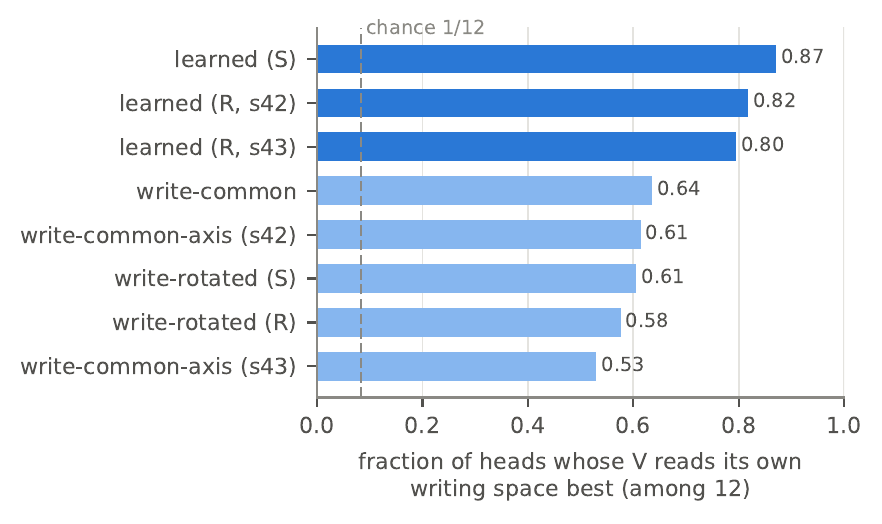
Figure 7. Fraction of heads in layers 1–11 (the layers that also have preceding-layer writers, the reader set of the original analysis; in layer 0, all 12 heads read their own writing space best in each of the six models checked) whose V reading space (weight space) overlaps most with the head's own writing space among the 12 heads of its layer, in the eight models with free readers.
In all eight free-reader models we evaluated (Figure 7), a head's weight-space V reading space is aligned with its own writing space: 53–87% of heads read their own writing space best, against a chance level of 8%. In all-common-axis and all-rotated-self the reading space coincides with the writing space by design, and in all-rotated their overlap is set to approximately the uniform value. read-common learns its writer, so its alignment is not fixed by design; it was not evaluated. We write for the normalized self-PK. The alignment is strongest with learned writers (normalized self-PK – vs. –) and above chance () but far from complete overlap everywhere. The scaled-idempotence statistic of Feng and Li (2026) is a different measurement: it concerns the orientation of the OV map within the subspaces rather than the overlap between them. Across models its trend matches that of the self-alignment in the five models where we computed it: its median is 0.49–0.52 for learned writers (learned on both corpora) and 0.12–0.22 for frozen ones (write-common, write-rotated and write-common-axis seed 42). In the frozen-writer models write-common and write-rotated, where the process can be traced, the alignment forms early in training. The fraction of heads that read their own writing space best is at chance at step 256 (0.09 and 0.08), 0.11 and 0.13 at step 1,024, and 0.56 and 0.54 at step 4,096, about 6% of training, against 0.64 and 0.58 at the end. The gradient favors the own block before that. At initialization the scalar (trace) component of the V gradient in a head's own block exceeds, in absolute value, that in each of the other eleven blocks in 6–7% of heads, which is chance (procedure in Appendix C). By step 256 it does so in 77–78%. This is the raw loss gradient, before AdamW, compared in absolute value: it shows an early preference of the gradient for the scalar direction of the own block, not the sign of the update or its size relative to the non-scalar part of the block. In the final weights the scalar part is negative in shallow layers and positive in deep ones, as for trained OV products in Trockman and Kolter (2023). Constraining geometry does not create this alignment.
6 Discussion
What read/write geometry controls, and what it does not. Our experiments show that geometric exclusivity, functional concentration, basis concentration and organizational alignment cannot be used interchangeably to interpret head-level effects. Geometry controls exclusivity at the attention level, which can be set exactly by design (in weight space). Coordinate-level concentration depends on the representation and intervention directions used to measure it; within one model, an orthogonal rotation inside each head changed it by only 1–8 points, so the large differences arise between representations and models. Geometry shapes organization, through which heads share write subspaces. In our comparisons, we could not separate any effect of geometry on head-level concentration of single-head patching effects from capacity; at the level of head indices, a parameter-matched shared-writer model also concentrated effects on SVA and quote. The hypothesis that removing non-orthogonal coupling would concentrate head-level effects predicts a relationship between geometric exclusivity and functional concentration that our comparisons do not consistently support. Whether geometry limits functional specificity when writers, normalization and capacity are matched remains untested. Whether geometry affects modularity in a stronger sense, such as separable sub-computations, is a question our measurements do not address.
What the conservation result explains, and what it does not. Proposition 1 describes the geometric quantity our designs manipulate. When writers decompose the residual stream orthogonally, the total overlap a reader receives from the writers of an earlier layer is fixed at . An exclusive design therefore does not remove overlap: it concentrates it on one partner, the same-index head, while a uniform design spreads the same total over all heads. Exclusivity changes with whom heads overlap, not how much. The proposition says nothing about how a change in allocation affects training or the concentration of effects; that relation is empirical. In our comparisons, the exclusive and uniform allocations with restricted readers gave head-level that differed little and in opposite directions across tasks (all-common-axis and all-rotated; Section 5.2). Separately, allocating writer-to-writer overlap to the same index by sharing write subspaces across layers aligned task-relevant heads into lanes (Section 5.3); these models have free readers, so this is an observation about shared writing, not a test of read/write exclusivity.
Head-level concentration instead follows a different variable. On corpus S, it appears where each head's reader is restricted to a fixed 64-dimensional subspace, and there it appears whether that subspace is exclusive (all-common-axis), overlaps every head of other layers uniformly (all-rotated) or coincides with the head's own write subspace (all-rotated-self, with the largest single-head shares). These models also have the fewest parameters (97.50M against 124.05M), the highest validation loss ( to nats) and smaller clean margins on quote and plural. Freezing only the writers costs little loss ( to nats) and spreads effects instead (Section 5.2). A consistent account is that restricting what each head can read limits how many heads can contribute independent parts of the computation, so the trained solution relies on fewer heads. On this account, capacity and the reader constraint, not the exclusivity of head-to-head channels, set the concentration of single-head effects. The account is a hypothesis: the reader constraint, parameter count and task margin vary together in our models, and a reader-restricted model with parameter-matched compensation would separate them (Section 7).
Two candidate organizing principles. Two hypotheses are consistent with much of the results; neither is established. The first is that MLPs act as the residual mixer. When head-to-head channels are constrained, the direct path shrinks, and in the attribution order we use more of the effect is assigned to MLPs, which no attention-level constraint reaches (under both orders only for write-common-axis; Appendix B.3). Because the reduction under clamping is not a flow and its attribution depends on order, this is an interpretation of the attribution, not a measured route. The second is that write subspaces act as gradient addresses: lanes coincide with which heads share task sensitivities rather than with which heads communicate, and the evidence is correlational (Section 5.3).
Implications for head-level intervention. For practice, we draw three consequences. First, head-level steering and patching results concern intervention sites. In the learned and write-common-axis models we measured, a head patch has a component in the folded reading space of every later head, largest in the queries of other task-relevant heads. Claims about head-exclusive channels therefore need leakage and path evidence. Second, concentration over residual coordinates should not be used as evidence of functional concentration unless it is compared with the same measurement before (Appendix B.2). Third, in models whose writers are shared across layers, the head index, not the (layer, head) pair, may be the more natural unit of analysis: in the two shared-writer models we decomposed, effects on SVA and quote concentrate on few indices while spreading over layers within an index (Section 5.2). Patching or ablating a whole lane is an obvious next experiment.
The value path in self-reading heads. Where holds by construction (all-common-axis, all-rotated-self), the value path factorizes exactly. With per-head normalization and value bias ,
so the OV map adapts content within without moving it out; in identity-writer models with free readers, removing only the scalar part of the own-block value map in shallow layers lowers the task logit difference more than an equal-norm random edit in 13 of 15 comparisons (Appendix C). A persistent information channel, an address fixed over depth, would additionally require the same in every layer, which holds only in all-common-axis; the only same-index relay we found was there, on SVA (Section 5.3), and we leave the hypothesis open.
7 Limitations
Seeds and scale. Most configurations have one seed, and models have parameters trained on tokens. Close values between single-seed models are not evidence of equivalence. The lane result recurs across several shared-writer models, but seeds of the same model would show how much it varies within a configuration. The single-head concentration of all-rotated-self also rests on one seed. The tasks are three binary next-token choices with templated prompts, and our robustness checks condition on their evaluation vocabulary; we have not tested larger pretrained models, the setting of most head-level steering work, or open-ended generation. The most direct follow-up is a comparison of read bases with writers, normalization and parameter count matched, with several seeds per configuration.
Confounds. Reader restriction is confounded with parameter count, per-head normalization, loss and clean task margins. A reader-restricted model with parameter-matched compensation, and separate restriction of Q, K and V, would separate these.
Mechanisms. The gradient-address account of the lanes is correlational. A model in which only half of the head indices share writes across layers would test it within one network.
Measurement. summarizes single-head patching on one task at a time and says nothing about joint effects or interactions. It also includes any downstream compensation, such as self-repair (McGrath et al., 2023), and treats each head as one unit, although a head can contain several functional substructures (Ahmad et al., 2025). The -values are within-model permutations, not seed-level tests. Path analyses cover top heads only. Sequential clamping assigns interactions by order; in the models we could re-run, the interaction was small in aggregate (median 5% of the effect) but exceeded 20% for 20 of 75 head–task cases. Top heads for the leakage, attention and path analyses were selected on the evaluation split used for measurement. For leakage, selection on the discovery split gives the same result; the attention and path analyses describe the evaluation-selected heads. Leakage uses the folded reading space, which omits the input-dependent rank-one LayerNorm term. Leakage was measured in learned and write-common-axis models. In the models that freeze both writers and readers (all-common-axis, all-rotated, all-rotated-self), design fixes the weight-space PK; in read-common, whose writers are learned, it does not. In all-common-axis, direct leakage into other-index readers is exactly zero, because a block reader sees only its own block. In the rotated models the weight-space PK is approximately uniform (). When a block's map and gains are non-degenerate, its folded reading space is the centered block (63 dimensions) and does not depend on the gains, so folded leakage differs from only through the centering and the direction of the actual perturbation; the gains enter the actual response instead. We did not measure it.
Additional seeds and the half-shared control are implemented and planned. Each could overturn a specific conclusion: the lane effect (seeds), the gradient-address account (half-shared), or the capacity explanation of concentration (parameter-matched readers).
8 Conclusion
We asked whether removing non-orthogonal read/write coupling between attention heads concentrates the effects of head-level interventions. Treating the geometry as an experimental variable separates properties that the question bundles together. Head interventions in the learned and write-common-axis models we measured are not geometrically exclusive: their perturbations project onto the folded reading spaces of every later head, most strongly onto the queries of other task-relevant heads. Exclusivity at the attention level can be imposed exactly. Yet in our single-seed comparisons we did not observe a consistent increase in concentration from coupling that is exclusive across head indices: a model whose heads can read only their own lane was not consistently more concentrated than models with approximately uniform cross-layer read/write PK across head pairs. Freezing where heads write, with readers free, spread effects on all three tasks in write-rotated on corpus S, which has the same number of heads as learned; the routed models, with more heads, point the same way, while on corpus R the comparison is resolved only on quote. The concentration that appears with restricted readers co-varies with lost capacity and weaker task margins. At the level of head indices, on SVA and quote, the exclusive design concentrates effects relative to within-layer permutations but spreads them over more layers within an index; parts of this pattern also appear in models without exclusive coupling.
What the geometry does shape is organization. When writers are shared across layers, task-relevant heads line up in lanes, an effect that recurs across shared-writer models on both corpora; single-head clamps did not show same-index heads as preferred relays, although the one joint lane clamp (all-common-axis, SVA) did, and the lanes coincide with shared task sensitivities. In the design where each layer reads its own rotated write basis, we observed a larger top-head share without a same-index lane; that design also changes the principal angles between layers, so the comparison does not isolate self-reading as the cause. Value read/write self-alignment arises in all eight free-reader models we evaluated and forms early in training. Head-specific interventions are therefore not head-exclusive, and in our tested configurations, making heads geometrically exclusive across indices did not consistently concentrate their effects. In the designs we examined, read/write geometry changed how heads are organized more clearly than how concentrated their effects are.
References
A. Ahmad, A. Joshi, A. Modi. Beyond components: singular vector-based interpretability of transformer circuits. NeurIPS, 2025. arXiv:2511.20273.
C. Christensen, L. Amdahl-Culleton, K. Ray, J. Tahir, P. Riechers, A. Shai. When is an attention head a computational unit? Shared circuits despite orthogonal representations. ICML, 2026.
K. Clark, U. Khandelwal, O. Levy, C. D. Manning. What does BERT look at? An analysis of BERT's attention. BlackboxNLP, 2019.
A. Conmy et al. Towards automated circuit discovery for mechanistic interpretability. NeurIPS, 2023.
N. Elhage et al. A mathematical framework for transformer circuits. Transformer Circuits Thread, 2021.
J. Feng, J. Li. Scaled idempotence in transformer attention: paired OV geometry and shared-value algebras. arXiv:2609.01129, 2026.
J. Ferrando, M. R. Costa-jussà. On the similarity of circuits across languages: a case study on the subject-verb agreement task. Findings of EMNLP, 2024.
D. Friedman, A. Wettig, D. Chen. Learning transformer programs. NeurIPS, 2023.
Q.-V. Lai-Dang, T. Kang, S. Son. Adaptive transformer programs: bridging the gap between performance and interpretability in transformers. ICLR, 2025.
J. Li et al. Multi-head attention with disagreement regularization. EMNLP, 2018.
K. Li, O. Patel, F. Viégas, H. Pfister, M. Wattenberg. Inference-time intervention: eliciting truthful answers from a language model. NeurIPS, 2023.
D. Lindner, J. Kramár, S. Farquhar, M. Rahtz, T. McGrath, V. Mikulik. Tracr: compiled transformers as a laboratory for interpretability. NeurIPS, 2023.
A. Makelov, G. Lange, A. Geiger, N. Nanda. Is this the subspace you are looking for? An interpretability illusion for subspace activation patching. ICLR, 2024.
T. McGrath et al. The Hydra effect: emergent self-repair in language model computations. 2023.
J. Merullo, C. Eickhoff, E. Pavlick. Talking heads: understanding inter-layer communication in transformer language models. NeurIPS, 2024.
P. Michel, O. Levy, G. Neubig. Are sixteen heads really better than one? NeurIPS, 2019.
J. Miller, B. Chughtai, W. Saunders. Transformer circuit faithfulness metrics are not robust. COLM, 2024.
T. Muşat. Mechanism and emergence of stacked attention heads in multi-layer transformers. ICLR, 2025.
A. J. Nam et al. Causal head gating: a framework for interpreting roles of attention heads in transformers. NeurIPS, 2025.
C. Olsson et al. In-context learning and induction heads. Transformer Circuits Thread, 2022.
E. Todd et al. Function vectors in large language models. ICLR, 2024.
A. Trockman, J. Z. Kolter. Mimetic initialization of self-attention layers. ICML, 2023.
F. Uehara, K. Santo. Reading and writing subspaces of attention heads are disjoint but overlap non-orthogonally. Manuscript, 2026.
S. Vaidyanathan, D. Arbour, A. Mueller, S. Niekum, D. Jensen. The curse of multiple mediators: hidden interaction effects in activation patching. arXiv:2606.27510, 2026.
E. Voita et al. Analyzing multi-head self-attention: specialized heads do the heavy lifting, the rest can be pruned. ACL, 2019.
K. Wang et al. Interpretability in the wild: a circuit for indirect object identification in GPT-2 small. ICLR, 2023.
H. Yamagiwa et al. Measuring affinity between attention-head weight subspaces via the projection kernel. arXiv:2601.10266, 2026.
H. Yun, T. Kang, K. Jung. Analyzing and controlling inter-head diversity in multi-head attention. Applied Sciences 11(4):1548, 2021.
Appendix A. All configurations
| Model (repository arm) | Writer / reader | Corpus | Params | Val. loss | Used in |
|---|---|---|---|---|---|
learned (plain-learned42) |
learned / free | R | 124.05M | 3.604 | 5.1, 5.2, 5.3, 5.4, B.1, B.2, B.3 |
learned (plain-learned43) |
learned / free | R | 124.05M | 3.595 | 5.1, 5.2, 5.3, 5.4, B.1, B.2, B.3 |
learned (dense) |
learned / free | S | 124.05M | 3.508 | 5.1, 5.2, 5.3, 5.4, B.1, B.2, B.3 |
write-common-axis (plain-identity42) |
/ free | R | 116.97M | 3.643 | 5.1, 5.2, 5.3, 5.4, B.1, B.2, B.3 |
write-common-axis (plain-identity43) |
/ free | R | 116.97M | 3.643 | 5.1, 5.2, 5.3, 5.4, B.1, B.2, B.3 |
write-common (common42) |
/ free | R | 116.97M | 3.648 | 5.3, 5.4 |
write-rotated (layered42) |
/ free | R | 116.97M | 3.654 | 5.3, 5.4 |
write-rotated (rotated-m1-42) |
/ free | S | 116.97M | 3.563 | 5.2, 5.3, 5.4, B.1, B.3 |
read-common (headblock-learned42) |
learned / block | S | 104.58M | 3.610 | 5.2, 5.3, B.1, B.2, B.3 |
all-common-axis (headblock-identity42) |
/ block | S | 97.50M | 3.698 | 5.2, 5.3, B.1, B.2, B.3 |
all-rotated (rotated-m2-42) |
/ other-basis block | S | 97.50M | 3.751 | 5.2, 5.3, B.1, B.3 |
all-rotated-self (rotated-m3-42) |
/ own-basis block | S | 97.50M | 3.753 | 5.2, 5.3, B.1, B.3 |
write-routed A (fixed-sum-hub42) |
routed 1612 / free | S | 124.05M | 3.542 | 5.2, B.1 |
write-routed B (fixed-split-cycle42) |
routed / free | S | 124.05M | 3.543 | 5.2 |
write-routed C (fixed-angle-split42) |
routed / free | S | 124.05M | 3.553 | 5.2 |
| fixeddiag42 | , 51 of 64 coords / free | R | 116.97M | --- | 5.3, B.1, B.2 |
| value384 | + value adapter / free | S | 124.05M | --- | 5.2, 5.3, B.1, B.2 |
| mlp3456 | , wider MLP / free | S | 124.05M | --- | 5.2, 5.3, B.1, B.2 |
| identity-original42 | (unscaled) / free | R | 116.97M | --- | 5.3, B.1, B.2 |
| multiscreen-identity42 | / free (softmax-free, 2116) | R | 106.51M | --- | 5.3, B.2 |
| multiscreen-learned42 | learned / free (softmax-free, 2116) | R | 128.53M | --- | 5.3, B.2 |
Table 4. All 21 trained configurations. Validation losses not recorded in the project documents are marked ---. "Used in" lists the sections and appendix subsections that analyze each model. Task performance is reported in Table 5.
Training data. Both corpora were tokenized with the GPT-2 tokenizer from HuggingFaceFW/fineweb-edu, configuration sample-10BT, revision 87f09149. Corpus R holds 200,000,000 training tokens (SHA-256 3c4fb6d0...), from which training samples with replacement; corpus S holds 1,073,741,825 tokens (SHA-256 e857368b...), consumed once over the training tokens. Both use data seed 1729 and the same 2M-token validation file (SHA-256 3dfd7b63...). The hashes are recorded in each checkpoint's manifest.
| Model (repository arm) | Corpus | SVA | Quote | Plural |
|---|---|---|---|---|
learned (plain-learned42) |
R | 99.2 / 4.32 | 97.5 / 4.75 | 94.2 / 3.04 |
learned (plain-learned43) |
R | 99.6 / 4.07 | 94.6 / 4.44 | 93.8 / 2.92 |
learned (dense) |
S | 99.6 / 3.49 | 100.0 / 5.50 | 97.1 / 3.10 |
write-common-axis (plain-identity42) |
R | 100.0 / 3.84 | 93.3 / 4.46 | 93.8 / 2.89 |
write-common-axis (plain-identity43) |
R | 100.0 / 3.93 | 90.4 / 4.76 | 90.0 / 2.87 |
write-common (common42) |
R | 98.8 / 4.00 | 92.1 / 5.03 | 92.9 / 2.96 |
write-rotated (layered42) |
R | 100.0 / 3.63 | 96.7 / 4.70 | 90.8 / 2.73 |
write-rotated (rotated-m1-42) |
S | 99.2 / 3.64 | 99.6 / 4.53 | 93.3 / 2.91 |
read-common (headblock-learned42) |
S | 98.3 / 3.62 | 99.6 / 5.49 | 94.6 / 3.14 |
all-common-axis (headblock-identity42) |
S | 100.0 / 3.81 | 99.2 / 4.99 | 92.1 / 2.30 |
all-rotated (rotated-m2-42) |
S | 100.0 / 3.88 | 91.3 / 3.92 | 95.4 / 2.44 |
all-rotated-self (rotated-m3-42) |
S | 98.8 / 3.66 | 93.7 / 4.22 | 93.7 / 2.54 |
write-routed A (fixed-sum-hub42) |
S | 99.6 / 3.45 | 97.1 / 4.20 | 95.4 / 3.06 |
write-routed B (fixed-split-cycle42) |
S | 100.0 / 3.63 | 99.2 / 4.93 | 94.2 / 3.04 |
write-routed C (fixed-angle-split42) |
S | 100.0 / 3.78 | 94.2 / 4.10 | 96.3 / 2.81 |
| fixeddiag42 | R | 99.6 / 3.90 | 90.8 / 4.83 | 92.5 / 3.13 |
| value384 | S | 99.2 / 3.81 | 95.0 / 3.96 | 94.6 / 2.99 |
| mlp3456 | S | 100.0 / 3.68 | 88.3 / 4.78 | 93.8 / 2.79 |
| identity-original42 | R | 99.2 / 3.08 | 97.9 / 4.38 | 92.5 / 2.96 |
| multiscreen-identity42 | R | 97.9 / 3.82 | 93.8 / 4.07 | 85.8 / 2.92 |
| multiscreen-learned42 | R | 95.8 / 3.47 | 87.5 / 4.22 | 92.5 / 3.54 |
Table 5. Clean task performance for all 21 configurations: accuracy (%) / logit margin (correct minus incorrect) on the evaluation split, 240 examples per task.
| Model | Corpus | SVA | Quote | Plural | SVA | Quote | Plural |
|---|---|---|---|---|---|---|---|
learned (s42) |
R | 10.0 | 12.8 | 13.3 | 12.7 | 11.4 | 5.1 |
learned (s43) |
R | 12.7 | 16.9 | 6.0 | 9.4 | 10.6 | 6.3 |
write-common-axis (s42) |
R | 17.7 | 27.0 | 9.4 | 9.0 | 10.5 | 6.2 |
write-common-axis (s43) |
R | 11.2 | 26.6 | 17.1 | 9.9 | 11.1 | 5.4 |
learned |
S | 10.4 | 12.0 | 9.2 | 7.9 | 12.5 | 4.9 |
write-rotated |
S | 16.2 | 22.2 | 22.2 | 9.2 | 10.6 | 6.0 |
write-routed A |
S | 18.9 | 31.6 | 20.3 | 8.7 | 10.2 | 5.7 |
write-routed B |
S | 29.1 | 29.0 | 21.6 | 8.8 | 11.3 | 4.8 |
write-routed C |
S | 31.1 | 39.7 | 15.8 | 8.8 | 8.9 | 5.1 |
read-common |
S | 8.1 | 11.0 | 10.0 | 9.3 | 12.4 | 6.2 |
all-common-axis |
S | 8.1 | 12.7 | 3.9 | 9.0 | 9.1 | 5.1 |
all-rotated |
S | 9.1 | 11.4 | 3.6 | 8.2 | 8.1 | 5.3 |
all-rotated-self |
S | 8.8 | 7.9 | 3.9 | 8.8 | 9.9 | 5.3 |
Table 6. Effective number of heads and summed absolute single-head effect (logit units) per task, evaluation split.
Appendix B. Supplementary results
B.1 PK and edge importance
We patched single head-to-head edges in 15 models and correlated each edge's weight-space PK with its KL effect on SVA (Table 7; procedure in Appendix C). Pooled over all edges, the Spearman correlation is clearly positive only in the three learned models (–). Within groups of edges that share a reader and an input, the correspondence is weaker elsewhere but not absent. In read-common, whose writers are learned and readers restricted, the pooled correlation is , but the within-reader medians are , and for Q, K and V; the V value lies within the learned range. In the frozen-writer models with free readers whose PK varies, the medians are small ( to ). In all-common-axis the correlation () is structural: every cross-index edge has by design and cannot carry a direct effect. We exclude all-rotated and all-rotated-self (PK 5.332–5.336 across edges) because their residual PK variation reflects deviations from the intended uniform design, rather than the overlap differences targeted by this analysis; their correlations are near zero. We did not test the within-reader medians for significance. Weight-space PK therefore predicts edge importance most clearly where writers and free readers are learned together.
| Models | Pooled | Q | K | V |
|---|---|---|---|---|
learned (3 models) |
0.30–0.32 | 0.46–0.47 | 0.36–0.40 | 0.12–0.25 |
read-common |
0.04 | 0.12 | 0.15 | 0.22 |
| Frozen writers, free readers (8 models) | –0.07 | 0.03–0.10 | 0.05–0.14 | –0.09 |
all-common-axis (structural) |
0.76 | 0.72 | 0.73 | 0.74 |
Table 7. Spearman correlation between an edge's weight-space PK and its KL effect: over all edges (pooled) and median within groups of edges that share a reader and an input. Ranges are over the models in each row.
B.2 Coordinate-level concentration depends on where it is measured
The observation that originally motivated this project concerns frozen coordinate writers, where task effects concentrate on few residual coordinates. On SVA, the top 10 coordinates of the best layer carry 45–83% of the positive effect in write-common-axis variants, against 10–13% in learned models, a 3.4–8.4-fold gap between the extreme pairs. Over all three tasks the figures are 32–83% and 10–21%. Within each task the two ranges do not overlap across the 11 models, and the selected coordinates beat magnitude-matched random sets in every comparison. Measured on SVA on the same number of directions inside the heads, before , the gap shrinks to 1.4-fold (52% vs. 36%, below), and to at most 1.7-fold after a random rotation within each head. The top 10 internal directions carry 52% in read-common (learned writer), 52% in all-common-axis and 36% in learned on corpus S. The large coordinate-level difference therefore depends strongly on the representation and directions in which effects are measured. We do not attribute the reduction to the basis alone: a learned is not orthogonal, so moving the measurement before also changes which directions are patched and their scale, and the models compared before and after are not the same set. The cleaner test of basis dependence holds the model, layer, examples and intervention site fixed and changes only an orthogonal rotation within each head; it moves the shares by 1–8 points (to 60%, 46% and 35%). A frozen writer guarantees that each internal component lands in a known coordinate, which makes writes traceable. The remaining gap before (52% vs. 36%) is a single comparison across different layers and models, and we do not interpret it.
B.3 Constraining heads shrinks the direct path of their effects
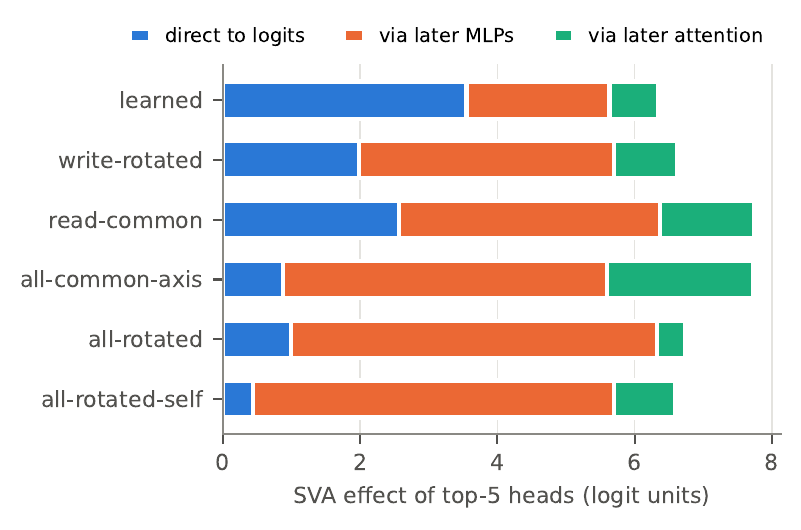
Figure 8. SVA effect of each model's top-5 heads, split by sequential clamping (corpus S): direct = drop with all later heads and all MLPs from the source layer on clamped to clean; via MLPs = (later heads clamped) direct; via later attention = total (later heads clamped). The split depends on the order in which clamps are released (see text).
To see by which paths the top heads' effects reach the output, we split each top head's SVA effect by sequential clamping (Figure 8). Let be the logit-difference drop when the head is patched and the named components are additionally held at their clean values. Then
Starting from the state with both clamps applied, this attribution releases the MLP clamp first and the head clamp second. Any interaction between attention and MLP paths is assigned by that order, so the two parts are not independent path contributions. Releasing the head clamp first instead gives
where is the interaction, the amount by which the two attributions differ.
Under the MLP-first release attribution shown in Figure 8, the direct path falls from 3.55 logit units in learned to 0.88 in all-common-axis and 0.44 in all-rotated-self, while the part attributed to later MLPs rises from 2.08 to 4.7–5.3. Totals are similar. The closest-matched pair is read-common (learned writer, 2.57 direct) and all-common-axis (frozen writer, 0.88 direct). Both restrict readers identically and have nearly equal totals (7.74 vs. 7.72). The shrinking of the direct path is order-independent, because it is measured with everything clamped. In the circuit found by ACDC for all-rotated (threshold 0.001), none of the 22 edges into attention comes from another head: 20 come from MLPs and 2 from the embeddings.
For the five models we could re-run (learned on corpora R and S, write-common-axis on R), we computed both attributions on all three tasks: top five heads, 75 head–task cases. The both-clamped condition reproduces the earlier direct values to four decimals. Shares below are the sum of a part over cases divided by the summed total effect. In aggregate the interaction is small: its median magnitude is 5% of a head's effect, and it amounts to 9% (signed) or 11% (absolute) of the summed effects. It is not small for every head: it exceeds 20% of the effect in 20 of 75 cases and 50% in 2, with a maximum of 90%. Within corpus R, the MLP share is 0.42 with the MLP clamp released first (as in Figure 8) and 0.49 with the head clamp released first for learned, against 0.69 and 0.81 for write-common-axis; the direct share is 0.48 against 0.17. learned on corpus S gives 0.36 and 0.41 with direct share 0.57. The difference between the groups thus holds under both attributions, although individual heads can depend strongly on the order. The constrained models of Figure 8 were not available for re-running, so their split is available in one order only. For them, the order-independent finding is that the direct effect, measured with everything clamped, is smaller.
Appendix C. Measurement protocols
Splits. Each task has disjoint discovery (300), validation (240), evaluation (240) and holdout (32) splits. , , leakage, path decomposition and pathway clamping use the evaluation split; their top heads are ranked by evaluation-split patching effects. The lane heatmaps and (Figure 5) use discovery-split effects, with top-three heads chosen on discovery and checked to have positive evaluation effects (all 15 do). Coordinates for coordinate-level concentration are selected on validation.
Coordinate-level concentration. In the layer of the task's best head, we intervene on one residual coordinate (after , before the residual addition) or one internal head direction (before ) at a time, at the final input position. The effect is the logit-difference drop. We report the sum of the ten largest drops divided by the sum of all positive drops. This is a share of single-direction effects, not the effect of intervening on ten directions jointly. For the rotated control, each head's internal basis is rotated by one random orthogonal matrix.
Clamping. "Clamping" a component holds its output at the value from the clean run while the source head is patched. The path decomposition of Figure 8 clamps all heads in later layers and/or all MLPs from the source layer on. The pathway test of Figure 6 clamps one later important head, all later heads with the same index, or all later MLPs. It reports . This is a reduction under intervention, not a flow, and it can be negative.
PK and edge importance. For each of 15 models (learned on both corpora, read-common, all-common-axis, all-rotated, all-rotated-self, write-rotated on corpus S, write-routed A, and the identity-writer models plain-identity42 and 43, fixeddiag42, value384, mlp3456 and identity-original42), we replaced every head-to-head edge, from a writer head in layer to the Q, K or V input of a reader head in a later layer, one at a time by its value on the reference prompt, and measured the full-vocabulary KL divergence of the output from the clean model on 16 SVA validation examples (28,512 edges per 12-head model). PK is computed in weight space between the writer's columns and the reader's input rows. We report the Spearman correlation over all edges (pooled) and its median within groups of edges that share a reader and an input (Q, K or V). Script: research/pk_edge_summary_2026_09_25.py.
Task-gradient alignment. For write-common and write-rotated on corpus R, at training steps 1,024 to 65,536, we took the gradient of the SVA logit difference (240 evaluation examples) with respect to the attention output of each layer, flattened over examples and positions, and report the cosine between layers. This is a task sensitivity, not the training gradient. Same-index alignment is the cosine between the residual-space projections and onto the two heads' write subspaces, averaged over layer pairs and heads; the text reports its range over the four training steps, as for the adjacent-layer cosine. For a write subspace shared across layers this equals the cosine of the internal coordinates ; for subspaces that differ by layer it is also reduced by their angle. The lane share of the gradient is (uniform ). Script: research/lane_shared_gradient_2026_09_28.py.
Robustness of . From the per-example results of the evaluation split (240 examples, 60 per condition), with the drop for example , we computed (i) from instead of ; (ii) 95% percentile intervals over 2,000 bootstrap resamples of examples; (iii) within each of the four conditions; and (iv) for the 12-head models, over head indices from , with a null distribution from 5,000 independent permutations of head indices within each layer and a lower-tail . The per-head means reproduce the summaries used for (maximum difference below ). Code and output: research/neff_robustness_2026_10_09.py and .json. The index/layer decomposition, the paired bootstrap of differences (2,000 resamples of the 240 examples shared by all models) and the lexical leave-one-group-out analysis are in research/neff_paired_lexical_2026_10_09.py; lexical groups are the subject noun pair (SVA), the first variable name (quote) and the noun (plural).
Self-alignment statistics. The scaled-idempotence statistic follows Feng and Li (2026): for each head, , with the head's writer block (without the gain ) and the transpose of its block of , and . is scale-invariant, and LayerNorm is ignored. We report the median over all 144 heads of the final checkpoint, in five models: learned on both corpora, write-common, write-rotated and write-common-axis seed 42. For the gradient comparison, denotes the writer block of head in the same layer. We computed the language-modeling loss gradient with respect to the head's block of on 32 sequences of 512 tokens from the language-modeling validation set, and for each head compared with for the eleven . We report the fraction of heads whose own term is the largest (chance ). The checkpoints are step 0 (the training initialization, regenerated from its seed) and step 256 of write-common and write-rotated (seed 42). Code: research/scaled_idempotence_2026_09_28.py and research/lane_formation_timeline_2026_09_28.py.
Scalar part of the own-block value map. In five models with identity-type writers and free readers (write-common-axis seeds 42 and 43, its restricted-diagonal variant fixeddiag42 and the capacity-compensated value384 and mlp3456), we edited in layers 1–4 so that each head's own-lane map , the block of on the coordinates its lane actually uses, loses its scalar part with . Here , except for fixeddiag42. The control instead removes an equal-norm , with a random orthogonal matrix. We report the drop in logit difference on each task's evaluation split relative to the unedited model, for 5 models 3 tasks comparisons. The control dropped more in two of them (write-common-axis seed 43 and fixeddiag42, both on plural). Data: experiments/pk/results/lane-ablate-01.json.
Frozen bases and output scale. The rotated bases come from one family of orthogonal matrices. With , and , member is , where is the Sylvester Hadamard matrix, the -th quadratic form of a Kerdock set over and a Haar-random orthogonal matrix from a fixed named stream. Because every pairwise sum of Kerdock forms is bent, head blocks of different members have within of (5.332–5.336 measured), and head blocks of one member are orthogonal. Construction rejects any member set whose PK deviates from by more than 1%. Layer writes in member (); write-common uses member 0 in every layer; all-rotated reads in members 12–23 (layer reads member ); all-rotated-self reads in its own write member. The members were taken in index order. We measured the principal angles between all head blocks of the 24 members, regenerated with the training source (its hash matches the training record). PK lies in 5.3320–5.3359. In each member pair , 64 of the 144 head pairs share exactly three dimensions (principal angle zero), with remaining cosines at most 0.83; 16 head pairs also share three dimensions in and . No other member pair shares a direction. Thus in write-rotated and all-rotated-self, write blocks of layers and share these dimensions, and in all-rotated-self, whose readers use their own layer's write member, some writers of layer share three dimensions with readers of layer . In all-rotated, shared directions occur between writers, between readers, or between a writer and a reader of the same layer, which reads before that layer writes; none occurs between a writer and a later reader. Code: research/rotated_principal_angles_2026_10_09.py. All frozen writers (axis and rotated) are multiplied by , the initial output scale of the learned map; fixeddiag42 uses and identity-original42 uses 1.
Leakage. For each source head we compute from the clean and reference pre- outputs at all positions, verify that the patched attention output differs from the clean one by exactly (maximum error on the full runs), and project it onto the folded reading spaces of all later heads. The discovery-split selection check and the cosine and norm ratios of Section 5.1 are recomputed from the saved arrays by research/leakage_checks_2026_10_07.py, which also lists the selected heads. The direct response re-evaluates the reader's LayerNorm and input projection on ; the total response uses the residual of the patched forward pass.
Attention change. For each task's top three heads and every later head , we compute 's attention distribution at the final position from its query and keys and report the total variation from the clean distribution, averaged over examples. "Query only" recomputes the query on with clean keys; "keys only" does the reverse; "direct" uses for both; "total" uses the residual of the patched forward pass. Top heads are ranked by evaluation-split effects.
Two-order path decomposition. For each task's top five heads we measure , , and , where MLPs are clamped from the source layer on. Releasing the MLP clamp first from the both-clamped state (the attribution of Figure 8) attributes to MLPs and to attention. Releasing the head clamp first attributes to attention and to MLPs. The interaction is the difference between the two attention attributions. Shares are sums over head–task cases divided by the summed . The analysis code names these orders by which clamp is applied first, the reverse of the release order used here. A check run with every component clamped and nothing patched reproduces the clean output exactly.
Circuit size. ACDC (Conmy et al., 2023) circuit sizes depend on the threshold, as do faithfulness-based circuit comparisons generally (Miller et al., 2024). At 0.001, all-rotated needs 138 edges against 179 for learned. At 0.003 the order reverses. We make no circuit-size claim.