Abstract
Attention heads are often said to read from and write to subspaces of the residual stream, and to interact when these subspaces overlap. But the subspaces are defined in several ways, and what overlap means is unclear. We define a head's reading and writing subspaces as the orthogonal complement of the kernel and the image of its weight maps. This definition is intrinsic and shows why these are the subspaces a head reads from and writes to. We then show that, for almost all weights, the writing subspaces of a layer form a direct sum of the residual stream when the head widths add up to its dimension, and that any two head subspaces, within or across layers, are disjoint. Yet some pairs must be non-orthogonal, so disjoint subspaces still interact through projection. We measure this non-orthogonality with the projection kernel, which is shown to be a natural measure of information transmission. In trained models, a few head pairs are strongly non-orthogonal and most are nearly orthogonal. This spread is much larger than when the same weights are randomly assigned to heads, which suggests that training selects which subspaces interact and how strongly.
Introduction
A decoder-only Transformer (Vaswani et al., 2017) keeps one vector per token, the residual stream, and every attention head and every MLP reads from it and adds to it. We write vectors as columns. In layer with heads, head reads through query, key and value projections of size and writes through an output projection of size . With head outputs , the attention output of the layer is
Heads are widely described as reading from and writing to subspaces of the residual stream. The residual stream has been described as a communication channel in which layers interact by writing to and reading from the same or overlapping subspaces and do not interact if the subspaces are disjoint, with the subspaces of a head identified from the right and left singular vectors of (Elhage et al., 2021). Singular value decompositions of the composed query-key and output-value maps of pairs of heads reveal low-rank communication channels between them (Merullo et al., 2024). The subspaces of a head have also been defined as the spans of the columns of its weight matrices, with the projection kernel (PK) between them interpreted as the overlap of the subspaces, that is, as the amount of information the heads can share (Yamagiwa et al., 2026). Reading and writing spaces are referred to in other work as well (Wang et al., 2023; Feng and Li, 2026).
These descriptions can be made more precise on two points. The first is the characterization of the subspaces. The right and left singular subspaces of are algebraically equivalent, under conditions, to the column spaces (Yamagiwa et al., 2026), but they characterize the input and output directions to which a composed operator is sensitive, are given for values and outputs only, and depend on the spectrum of the product when only leading singular vectors are kept. The spans of columns give the same subspaces in the coordinates of a matrix. In both, the subspace that is read is named, but that the read depends on the residual stream only through it is left implicit. The second is the meaning of overlap. Treating dimensions as bandwidth and stating that heads writing to disjoint subspaces do not interact reads overlap as sharing a subspace (Elhage et al., 2021). Overlap has also been described as a large PK, that is, as the subspaces sharing more directions with small principal angles (Yamagiwa et al., 2026), but PK is a sum of squared cosines of principal angles and is nonzero whenever two subspaces are not orthogonal, whether or not they share a subspace. How disjointness, orthogonality and interaction relate is not made explicit.
We therefore redefine the subspaces from the linear maps themselves. A linear map discards exactly its kernel, so every read factors as an orthogonal projection onto the orthogonal complement of the kernel followed by an invertible map. We define the reading space of head of layer for queries as
and in the same way and ; the writing space is . Kernel and image are properties of the map, not of its matrix in particular bases, and the factorization shows that components orthogonal to do not affect the read. For full-rank heads and before normalization is folded in, these are the same subspaces as in earlier work; the redefinition changes how they are characterized, gives reading spaces for queries and keys, and lets the pre-attention normalization be folded in.
Under this definition we show, in theory and in trained models, how the spaces are arranged. Within a layer, for almost all weights the writing spaces decompose the residual stream as a direct sum when the head widths add up to , so they are disjoint; moreover, for generic weights any two head subspaces, within or across layers, are disjoint whenever their dimensions add up to at most that of the space they lie in. In the comparisons we checked in a 124M model and Qwen2.5-7B, no pair shares a direction, up to one borderline pair. Yet some pairs must be non-orthogonal: because the writing spaces of a layer span the residual stream, every reading space is non-orthogonal to at least one of them, and conversely every writing space is non-orthogonal to at least one reading space of each kind of any later layer whose reading spaces span the residual stream. On the linear path a write reaches a reader only through its projection onto the reading space, which is nonzero for some write exactly when the two spaces are not orthogonal. Disjoint subspaces therefore interact via projection, which is a counterexample to the statement that reading and writing spaces that are disjoint cannot interact (Elhage et al., 2021). We use overlap only in this sense, as non-orthogonality, and measure its degree with PK, which on the linear path gives the transmitted fraction of a write exactly on average and bounds it sharply for a single write.
We then measure the degree of overlap for all pairs of writing spaces within each layer of the 124M model, Qwen2.5-7B, all 94 layers of Qwen3-235B-A22B and Pythia-70m, and, in the 124M model and Qwen2.5-7B, for all pairs of reading spaces of one kind and all pairs from a writing space to a reading space of a later layer. In every model we find a right tail of strongly overlapping pairs, some with minimum principal angles below 3 degrees, while most pairs overlap about as weakly as random subspaces. We compare the dispersion across pairs with two null models that preserve the learned spectrum or the learned columns and randomize only which directions belong to which head. Between the writing spaces of one layer and the reading spaces of a later layer, the dispersion exceeds every null sample in 197 of 198 layer-pair and read-kind conditions of the 124M model and in all 1,134 of Qwen2.5-7B; it does so in every layer for the writing spaces of the 124M model and for the Q and K reading spaces of both models. On real activations of the 124M model, the fraction of a write that projects onto a reading space correlates with the degree of overlap (Spearman 0.72 - 0.77).
Our contributions are the following.
-
We characterize the reading and writing spaces of a head through the kernel and the image of its linear maps, so that the definition is intrinsic and makes clear why these are the subspaces read from and written to.
-
We show, in theory and in two trained models, that for almost all weights the writing spaces of a layer decompose the residual stream as a direct sum when the head widths add up to its dimension, and that any two head subspaces, within or across layers, are disjoint.
-
We show that disjoint spaces can nevertheless interact because some pairs must be non-orthogonal: on the linear path a write reaches a reader through its projection onto the reading space, whose size PK gives on average and bounds sharply for a single write.
-
Using PK as the degree of non-orthogonality, we find a statistical bias in its distribution over pairs of heads: the dispersion across pairs exceeds that of null models that keep the learned weights and randomize only their assignment to heads.
Section 2 reviews further related work. Section 3 defines reading and writing spaces. Section 4 shows the direct-sum decomposition, the interaction via projection and the necessary non-orthogonality. Section 5 measures the distribution of overlap in trained models. Section 6 discusses the results, and Section 7 concludes. Proofs are in Appendices A - D and supplementary measurements in Appendices E - H.
Related work
Communication between heads
Composition scores quantify how strongly an earlier head feeds a later one (Elhage et al., 2021), and composition underlies mechanisms such as induction heads (Olsson et al., 2022). The spectral components of composed maps have been analyzed to find communication channels (Merullo et al., 2024); we instead define the full space of each individual read map and compare the non-orthogonality of these spaces with PK and with null models. PK between head subspaces recovers the head-to-head interactions of the indirect-object-identification circuit (Wang et al., 2023) more clearly than composition scores, and its distribution has been compared with that of random subspaces (Yamagiwa et al., 2026); we compare it also with null models that keep the learned weights, and extend it to models up to 235B parameters.
Diversity, orthogonality and redundancy of heads
Regularizers push heads toward more diverse or mutually orthogonal subspaces (Li et al., 2018; Lee et al., 2019), orthogonality between heads has been reported to decrease during training (Li et al., 2021), many heads can be pruned with little loss (Michel et al., 2019; Voita et al., 2019), and a statistical theory holds orthogonal head subspaces to be optimal for variance reduction (Fokoué, 2026). In high dimension many directions can be nearly orthogonal at once, which superposition exploits (Elhage et al., 2022).
Own-head geometry and normalization
For a few percent of heads the effective OV operator is nearly a scaled projection (Feng and Li, 2026); our own-head measurement (Section 5.5) is a subspace-level statistic that ignores sign and singular values. With pre-normalization (Xiong et al., 2020), LayerNorm (Ba et al., 2016) or RMSNorm (Zhang and Sennrich, 2019) passes only the direction of the residual vector to the next block (Riechers, 2024); Section 4.2 separates the resulting normalization path from the linear path.
Reading spaces and writing spaces
We keep the column convention of Section 1: for and , with and . The superscript names head of layer ; is the number of heads of a layer, and is the output matrix of layer .
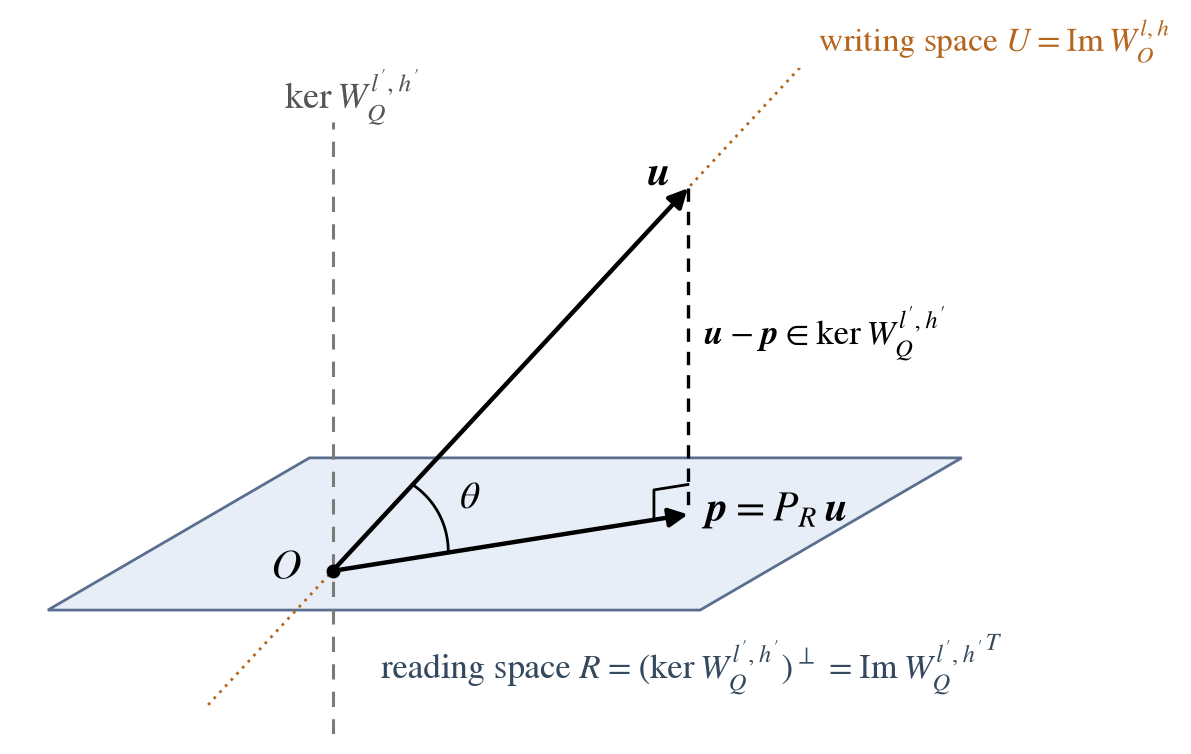
Figure 1. A writing space and a reading space are disjoint but overlap non-orthogonally, so they communicate through projection. The figure concerns the linear map of the reader, shown for the query map of head in a later layer . That head depends on the residual only through the orthogonal projection onto its reading space (the shaded plane through the origin ). A write in the writing space of head in layer reaches it as ; the component lies in and is invisible to the reader. and share no direction, yet is nonzero because is not orthogonal to ; here . In a model both spaces have dimension ; here is drawn two-dimensional and one-dimensional so that, in three dimensions, they can be shown disjoint yet not orthogonal.
Every read of a head is a linear map of the residual vector, and every write is the image of a linear map. We define the subspaces through the kernel and the image of these maps.
Definition (reading space and writing space) For head of layer and , the reading space for and the writing space are
Proposition (reads factor through the reading space) For every residual vector , , where is the orthogonal projector onto and the restriction is injective. Every write of the head lies in , and every vector of is the write of some head output.
The components of orthogonal to therefore do not affect the read, and the projection loses nothing the head uses (proof in Appendix A). The two expressions for agree by the identity (Strang, 1993).
An intrinsic characterization
Kernel and image are properties of a linear map, not of the matrix that represents it in particular bases. A span of the columns of a weight matrix is the same subspace, written in coordinates. Written as and , the spaces are defined without reference to any basis, given the inner product of the residual stream, which is also the one used by the normalization and by PK, and they are unchanged by any change of the head's internal coordinates. For full-rank heads they coincide with the column spaces of the weight matrices (Yamagiwa et al., 2026) and with the singular subspaces of and (Elhage et al., 2021) (Appendix A). The redefinition changes the characterization, not the subspaces that earlier work measured; its use in this paper is that the projection onto the reading space is the path by which a write reaches a reader (Section 4.2).
Normalization
With pre-attention normalization the head reads , where removes the mean ( for RMSNorm). The numerator is linear in , so the definition applies to the composed map , whose reading space we use throughout. The scalar is treated in Section 4.2.
Direct sum, interaction via projection and necessary non-orthogonality
Conditions for a direct sum, and disjointness of generic pairs
Proposition (direct-sum decomposition is generic) (a) Let . For every outside a set of Lebesgue measure zero, is a direct sum of subspaces of dimension , which equals when ; the same holds for the reading spaces of each kind defined by the maps . (b) Two subspaces of of dimensions and with , drawn independently from distributions with densities, intersect only in with probability one.
The reason is simple. The sum fails to be direct only if the columns of are linearly dependent; when this means . Such weights lie on a surface in the space of all weights, a set of volume zero, so weights drawn from any continuous distribution avoid it with probability one, and any exceptional weight leaves it under an arbitrarily small perturbation. In the same way two subspaces whose dimensions add up to at most share a direction only on a set of volume zero, much as two random lines in space do not meet. Within a layer the writing spaces are therefore disjoint, and generic subspaces of different layers are disjoint as well, provided their dimensions add up to at most that of the space they lie in. The detailed proof is in Appendix B.
Three cases need care. Folding an RMSNorm gain keeps the decomposition of the reading spaces, since the gain is invertible, but LayerNorm's mean removal maps every reading space into the -dimensional subspace of mean-zero vectors, so there the folded reading spaces of a layer cannot form a direct sum when ; they remain pairwise disjoint for generic weights, with dimension conditions taken in that subspace. Under grouped-query attention several query heads share one key and one value reading space, which we count once; these spaces are fewer than , so their direct sum is a proper subspace. When , as for the writing spaces of Qwen3-235B, no direct sum of -dimensional blocks exists.
Training could in principle reach exceptional weights, so we check the trained models (Section 5.1). For every pair of head subspaces we computed the smallest principal angle, within layers (writing spaces, and Q, K, V reading spaces against their own kind) and from every writing space of layer to every reading space of every layer .
| Model | comparison | pairs | smallest angle (degrees) | median smallest angle (degrees) |
|---|---|---|---|---|
| 124M | within layer: O / Q / K / V | 792 each | 8.8 / 6.1 / 3.9 / 21.3 | - |
| 124M | across layers: O against Q / K / V | 9,504 each | 13.1 / 13.0 / 21.7 | 51 - 56 |
| Qwen2.5-7B | within layer: O / Q / K / V | 10,584 / 10,584 / 168 / 168 | 0.39 / 1.4 / 6.1 / 7.4 | - |
| Qwen2.5-7B | across layers: O against Q / K / V | 296,352 / 42,336 / 42,336 | 14.8 / 13.3 / 17.0 | 67 - 69 |
Table 1. Smallest principal angle over pairs of head subspaces within and across layers.
No pair has a smallest angle below 0.1 degrees, and only one has a smallest angle below 1 degree: two writing spaces of Qwen2.5-7B layer 27, at 0.39 degrees (sine 0.007), within a few times the perturbation that BF16 rounding (relative precision about 0.4%) could introduce. Even the closest cross-layer pairs, about 13 degrees apart, are far from orthogonal (cos 13 degrees = 0.97). We did not compare writing spaces of different layers with each other, and for Qwen3-235B, of which only was fetched, we compared only writing spaces within a layer (Section 5.2).
Disjoint subspaces interact via projection
Let a writer in layer have writing space , and let a reader in a later layer have normalization-folded read map with reading space . With the normalization without its gain and its Jacobian, a small write added to the residual changes the reader's input by to first order. For LayerNorm, with ,
and the same holds for RMSNorm with .
The linear path passes only through projection
Since and is injective on , the linear term vanishes if and only if . Disjointness does not make the projection vanish: the linear term vanishes for every only if and are orthogonal. In the plane, and are disjoint for every , yet a unit write along projects onto with norm , nearly all of it at . Disjoint subspaces thus interact via projection, contrary to the explanation that disjoint subspaces do not interact (Elhage et al., 2021).
Overlap means non-orthogonality
We therefore use "overlap" in one sense only. and are disjoint when , and they overlap when , i.e. when they are not orthogonal. With orthonormal basis matrices and principal angles (Björck and Golub, 1973), , the degree of overlap is measured by the projection kernel (Hamm and Lee, 2008) and its normalized value
We also call the degree of non-orthogonality. For a unit write drawn isotropically from with , the expected squared norm of its projection onto is exactly (Appendix D), and PK also bounds the transmission of every single write.
Proposition (PK bounds transmission) For every unit write , . The bound is tight: for ,
Thus, the squared norm of the component of a write that reaches the reading space directly along the linear path is bounded above by , the bound is tight, and nothing is transmitted when PK is zero. If information transmission is evaluated by the norm of the projected vector, PK is in this sense a natural measure of the overlap between the reading and writing spaces of heads (proof in Appendix D). PK can therefore be used as a measure of information transmission between heads.
Two subspaces overlap strongly, or make small angles, when is large, and weakly, or make large angles, when is small. The minimum principal angle is a separate indicator: in 64 dimensions a single small angle with all others near 90 degrees gives of only about 1/64.
The normalization path
The second term is not determined by : it lies along and scales with the component of along , so it can act even between orthogonal spaces. To first order it vanishes when has no component along , and also when . In the first case a finite write can still act through a second-order change of the norm if ; if and , the read stays zero for any finite write. Section 5.4 measures its size.
Some pairs must be non-orthogonal
Orthogonality of a given pair is a measure-zero condition, but it can hold for single pairs. It cannot hold for all pairs at once.
Proposition (lower bound on the largest overlap) Let be subspaces that span , let , and let be any subspace of dimension . Then
where is the smallest eigenvalue of .
By this proposition, when the writing spaces of layer span , every reading space of any later layer is non-orthogonal to for some . Conversely, for any and any later layer whose query reading spaces span , there exists such that is non-orthogonal to ; the same holds for K and V. By the previous proposition the spanning condition holds for almost all weights when and the reading spaces are those of the maps . It fails for the key and value reading spaces under grouped-query attention, and after folding LayerNorm the reading spaces span only the mean-zero subspace; a writing space of dimension is then still non-orthogonal to some reading space, but the quantitative bound vanishes. In the orthogonal layout and the bound equals the isotropic value of Section 5.1; in general it is weaker by the factor (proof in Appendix C).
In both trained models the bound for fixed reading spaces holds but is numerically weak.
| Model | over layers | pairs of layers | min over reading spaces of , Q / K / V | pairs of layers where it is below the isotropic value, Q / K / V |
|---|---|---|---|---|
| 124M | - | 66 | 0.084 / 0.084 / 0.048 | - |
| Qwen2.5-7B | - | 378 | 0.024 / 0.033 / 0.012 | 23 / 6 / 112 |
Table 2. Lower bound on the largest overlap and its observed value for fixed reading spaces.
In the 124M model every Q and K reading space overlaps some writing space of every earlier layer at about the isotropic value 0.083 or more; in Qwen2.5-7B some reading spaces, most often V, overlap every writing space of some earlier layer more weakly than random subspaces would (isotropic value 0.036).
Overlap in trained models
Setup
Models
(a) A 124M decoder with the shape of GPT-2 small (Radford et al., 2019), trained in-house (internal run name "capacity-three baseline": 12 layers, 12 heads, , , pre-LayerNorm, 65,536 steps of one-epoch training; 66 head pairs per layer). (b) Qwen2.5-7B (Qwen Team, 2024), base and instruct (28 layers, 28 query heads and 4 key-value heads, , ; 378 pairs of writing spaces per layer). (c) Qwen3-235B-A22B (Qwen Team, 2025), all 94 layers (64 heads, , ; 2016 pairs per layer). (d) Pythia-70m (Biderman et al., 2023) (6 layers, 8 heads, , ). For (b) and (c) only the needed tensors were fetched (BF16, analyzed in FP64). Rank was 128 for every head at relative tolerance 1e-6, and the direct-sum defect never exceeded the part forced by dimension, : in (a) and (b) every is numerically invertible, and in (c), where the head widths add up to (), the defect of 4096 is forced by dimension. Reading spaces fold the pre-attention gain and, for the LayerNorm of (a), the mean removal. Qwen2.5-7B uses grouped-query attention (GQA; Ainslie et al., 2023), so each layer has 28 Q reading spaces (378 pairs) but only 4 K and 4 V reading spaces (6 pairs each).
| Model | heads (query / key-value) | layers | pairs of writing spaces per layer | isotropic value | ||
|---|---|---|---|---|---|---|
| 124M baseline | 768 | 64 | 12 / 12 | 12 | 66 | 0.0833 |
| Qwen2.5-7B base | 3584 | 128 | 28 / 4 | 28 | 378 | 0.0357 |
| Qwen3-235B-A22B | 4096 | 128 | 64 / 4 | 94 | 2016 | 0.0313 |
| Pythia-70m | 512 | 64 | 8 / 8 | 6 | 28 | 0.125 |
Table 3. Models and the isotropic value.
Statistics and baseline
For each layer and each unordered pair of spaces of one kind we compute and the smallest principal angle; per layer we report the mean of , its standard deviation over pairs, which we call the dispersion, and the smallest angles. For writer/reader pairs across layers the same statistics are taken over all pairs of a writing space of layer and a reading space of a later layer . For two independent uniformly random subspaces of dimension , (1/12 for the 124M model, 128/3584 = 0.0357 for Qwen2.5-7B, 128/4096 = 0.0313 for Qwen3-235B), which we call the isotropic value; the standard deviation of is (Yamagiwa et al., 2026), about 0.0017 for , 0.0024 for , and 0.0003 for . This random-subspace baseline is an expectation, not a lower bound.
Null models
A learned writes much more strongly along a few directions, which can also affect the angles between head subspaces. To separate this from the assignment of directions to heads, we use two null models: a spectrum-preserving rotation, which replaces by with a uniformly random orthogonal matrix and so preserves , hence all singular values, but changes the columns; and a column re-assignment, which keeps the set of learned columns and permutes them before splitting into heads. For reading spaces they are applied to the stacked read matrix, and for writer/reader pairs independently to writer and reader. We drew 30 samples of each for the writing spaces of the 124M model, the Q and K reading spaces of the 124M model and Qwen2.5-7B, and the writer/reader pairs of both models (FP64, except FP32 for the cross-layer comparison of Qwen2.5-7B); layer 46 of Qwen3-235B has 3 samples of each. Other comparisons use the random-subspace baseline only.
Statistical bias
Empirical one-sided p-values are for of samples at least as extreme (Phipson and Smyth, 2010), at least 1/31 = 0.032 against 30 samples. We say that the overlap of pairs of heads is statistically biased in a layer, or for a pair of layers, when the dispersion of exceeds every sample of both null models. The test statistic is the standard deviation; the shape of the distribution is described separately by quantiles, and with 30 samples the smallest reportable p-value is 1/31, which does not exclude that some assignment reproduces the observation.
Shape: a few strong pairs, most weak
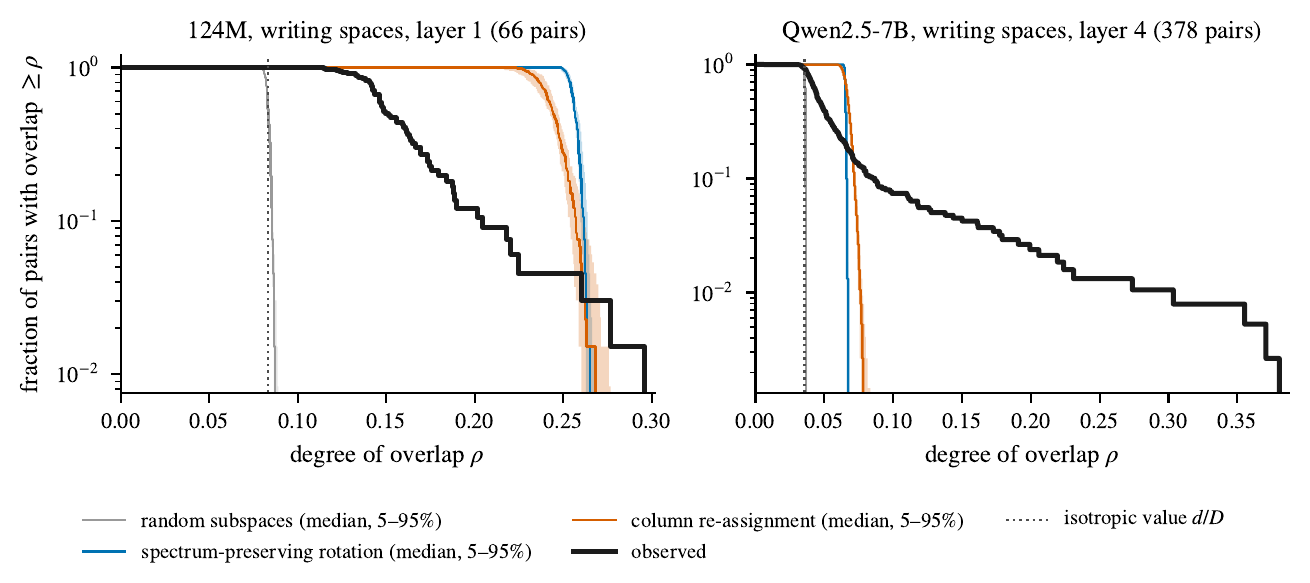
Figure 2. Fraction of pairs of writing spaces whose degree of overlap is at least , for one layer of each model (log scale). The layer is fixed in advance as the one at the upper median of the per-layer dispersion. Black: observed. Colored: for each null model and for random subspaces, a curve is computed for each of the 30 samples; the line is their median and the band their 5th - 95th percentile, i.e. the variation between null samples, not a confidence interval of the observation. Dotted: the isotropic value . Data: reports/pair-distributions/capacity-three-baseline-writing.json, reports/pair-distributions/qwen25-7b-writing-layer4.json.
Figure 2 shows the whole distribution for one layer of each model, the 124M model and Qwen2.5-7B. Against random subspaces, the observed pairs spread from about the isotropic value to several times it (124M layer 1: median 0.150, 95th percentile 0.248, maximum 0.296; Qwen2.5-7B layer 4: 0.045, 0.137, 0.380). Against the null models the picture has two parts. Most observed pairs overlap less than any pair that either null model produced (60 of 66 in the 124M layer and 270 of 378 in the Qwen2.5-7B layer lie below every re-assignment value), because the null models spread the strong directions of over all heads. A right tail beyond every null value is clear in Qwen2.5-7B (39 of 378 pairs above every re-assignment value) but consists of one pair in the 124M layer. The larger dispersion of Section 5.3 therefore comes from a wider spread, not necessarily from a longer right tail. Over all 12 layers of the 124M model the observed median is below the median of every null sample in 11 layers, and the 95th percentile exceeds the 95th percentile of every null sample in 8 (Figure 7 in Appendix E). The statistics per model are in Table 5 (Appendix E).
In every layer of all four models the mean over pairs of writing spaces exceeds the isotropic value only by a factor 1.1 - 2.4 (1.4 - 2.1 for 124M, 1.1 - 2.1 for Qwen2.5-7B, 1.1 - 2.4 for Qwen3-235B, 1.1 - 1.9 for Pythia-70m), while the dispersion is 11 - 31 (124M), 16 - 41 (Pythia-70m) and roughly 30 - 300 (Qwen models) times the standard deviation of the random-subspace baseline. A typical pair has close to the isotropic value, 0.03 - 0.06 in the Qwen models and 0.08 - 0.14 in the 124M model; its smallest principal angle is still 25 - 66 degrees, so weak overlap means a small , not that every angle is near 90 degrees.
The distribution has a right tail of strong pairs. In Qwen2.5-7B layer 14 the median over 378 pairs is 0.045, the 95th percentile 0.271 and the maximum 0.537; 31% of pairs exceed twice the isotropic value and 0.3% fall below half of it. In Qwen3-235B layer 46 (2016 pairs) the median is 0.039, the 95th percentile 0.067 and the maximum 0.392; 6.5% exceed twice the isotropic value and none fall below half. We report right tails as examples in each model, not as a property of every layer: the standardized third moment of layer 3 of Pythia-70m is slightly negative. Some pairs make almost zero angles (0.39 degrees in Qwen2.5-7B layer 27, 2.2 and 2.7 degrees in Qwen3-235B layers 0 and 92). Across layers, the largest writer/reader pairs are a layer-5 writing space against a layer-6 K reading space of the 124M model (, then 0.454 for 5 7 and 0.31 for 3 7, K) and writing spaces of Qwen2.5-7B layer 23 against V reading spaces of layers 27, 26 and 25 ( 0.685, 0.674, 0.621), while the mean over pairs stays near the isotropic value. Further examples are in Appendix F and a comparison with a spectrum-weighted measure in Appendix G.
Dispersion against the null models
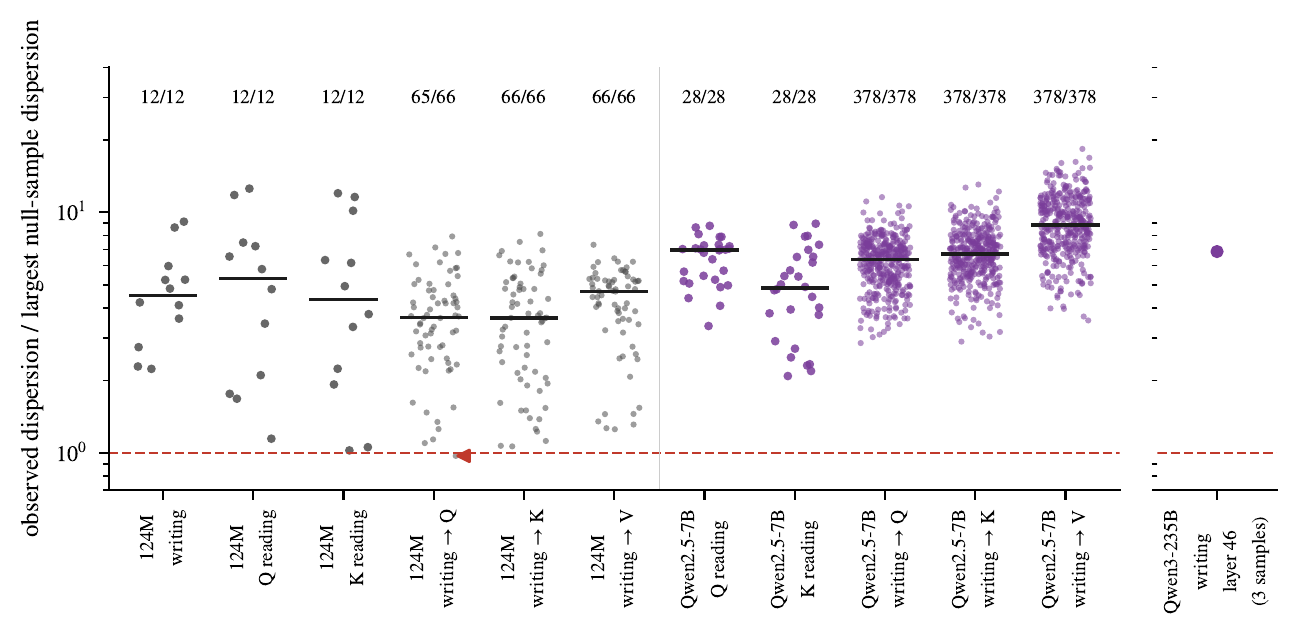
Figure 3. For every comparison with the null models, the ratio of the observed dispersion of to the largest dispersion among all samples of both null models (log scale); each point is a layer (within layer) or a pair of layers (across layers), horizontal bars are medians and the numbers at the top count . The dashed line is ; the one point below it (triangle) is 124M, layer 0 against the Q reading spaces of layer 3, . Qwen3-235B layer 46 has 3 null samples and is shown separately. Data: see Table 4.
| model | comparison | conditions | null samples each | above every sample of both | median | median ratio to the mean of the rotation samples | median ratio to the mean of the re-assignment samples |
|---|---|---|---|---|---|---|---|
| 124M | writing spaces, within layer | 12 | 30 | 12 | 4.5 | 11.8 | 5.7 |
| 124M | Q reading spaces, within layer | 12 | 30 | 12 | 5.3 | 11.3 | 6.7 |
| 124M | K reading spaces, within layer | 12 | 30 | 12 | 4.4 | 11.5 | 5.9 |
| 124M | writing Q, across layers | 66 | 30 | 65 | 3.7 | 7.6 | 4.7 |
| 124M | writing K, across layers | 66 | 30 | 66 | 3.6 | 6.8 | 4.4 |
| 124M | writing V, across layers | 66 | 30 | 66 | 4.7 | 8.5 | 5.7 |
| Qwen2.5-7B | Q reading spaces, within layer | 28 | 30 | 28 | 7.0 | 31.5 | 8.1 |
| Qwen2.5-7B | K reading spaces, within layer | 28 | 30 | 28 | 4.8 | 20.9 | 8.2 |
| Qwen2.5-7B | writing Q, across layers | 378 | 30 | 378 | 6.4 | 18.5 | 7.5 |
| Qwen2.5-7B | writing K, across layers | 378 | 30 | 378 | 6.7 | 19.5 | 8.5 |
| Qwen2.5-7B | writing V, across layers | 378 | 30 | 378 | 8.8 | 36.4 | 12.9 |
| Qwen3-235B-A22B | writing spaces, layer 46 | 1 | 3 | 1 | 6.9 | 27.3 | 7.1 |
Table 4. Summary of the comparisons of the dispersion with the null models.
Figure 3 and Table 4 collect every comparison: the dispersion exceeds every sample of both null models in 233 of 234 conditions of the 124M model, in all 1,190 of Qwen2.5-7B and in the one layer of Qwen3-235B, with median ratios of 3.6 - 8.8 to the largest null sample. The conditions share weights and layers, so they are not independent replications, and the comparisons across layers make up 1,332 of them. The ratio to the largest sample depends on the number of samples, which is why Qwen3-235B is shown apart. The direction of the mean, a separate property, is shown per pair of layers in Figure 9 (Appendix F). The writing spaces of Qwen2.5-7B have no null samples yet.
Writing spaces
In the 124M model the observed dispersion is 0.019 - 0.053 per layer, against 0.0024 - 0.0037 under the spectrum-preserving rotation (largest of 30 samples 0.0048) and 0.0036 - 0.0101 under column re-assignment (largest sample 0.0155): it exceeds every null sample in all 12 layers (24 of 24 comparisons), by a factor 5 - 20 over the rotation. In Qwen3-235B layer 46 it is 0.0171 against 0.0006 and 0.0024. The mean moves the other way: in 11 of 12 layers of the 124M model it lies below all 30 samples of both null models (means 0.126 - 0.306 and 0.123 - 0.268; layer 7 is the exception at 0.134 vs 0.128 / 0.133). The learned writes strongly along a few directions (leading singular values 2.7 and 1.9 against a bulk of 0.3 - 0.6), which raises the mean overlap of a random assignment; the trained assignment overlaps less. Qwen3-235B layer 46 points the same way (0.043 vs 0.058 and 0.055, ). The smallest angle over pairs is below every rotation sample in all 12 layers (8.8 - 38.3 degrees vs 14.7 - 49.7 degrees) but not below every column re-assignment sample in six layers (Appendix E): re-assigning learned columns can itself put two nearly parallel columns into different heads, so a single strong pair is not specific to the trained assignment; the dispersion is.
Reading spaces
The Q and K reading spaces show the same statistical bias. The random-subspace baseline is for , (100 samples) and for Qwen2.5-7B.
The dispersion exceeds every sample of both null models in all 12 layers of the 124M model for Q and K (48 of 48 comparisons) and in all 28 layers of Qwen2.5-7B (112 of 112). Null samples never exceed 0.0051 (rotation) and 0.0175 (re-assignment) for the 124M model, and 0.0023 / 0.0036 (rotation, Q / K) and 0.0132 / 0.0248 (re-assignment) for Qwen2.5-7B. The K statistics of Qwen2.5-7B rest on 6 pairs per layer. Per-layer values are in Table 7 and further details in Appendix F.
Writer/reader pairs across layers
This comparison concerns the pairs through which heads of different layers communicate: for each pair of layers and each read kind we compared the dispersion of over the writer/reader head pairs, 144 in the 124M model and 784 (Q) or 112 (K, V) in Qwen2.5-7B, with the null samples.
The dispersion exceeds every sample of both null models in 197 of 198 conditions of the 124M model and in all 1,134 of Qwen2.5-7B. The one exception, layer 0 against the Q reading spaces of layer 3 in the 124M model, has a dispersion of 0.00189 against 0.00194 for the largest re-assignment sample (). Values per read kind are in Table 8 (Appendix F). In Qwen2.5-7B the dispersion is 0.0015 - 0.035 (Q), 0.0016 - 0.037 (K) and 0.0018 - 0.124 (V), against at most 0.0009 for any rotation sample and 0.0049, 0.0050 and 0.0114 for any re-assignment sample; its ratio to the mean of the rotation samples is 4 - 57, 4 - 84 and 5 - 227. The mean depends on read kind and distance: Q and K reading spaces mostly overlap earlier writing spaces less than random assignments would, V more often more.
Projection on real activations
We measured the two paths of Section 4.2 in the 124M model on 2,048 tokens (8 windows of 256) from the FineWeb-Edu validation split (Penedo et al., 2024). For every head of every layer and every head of every later layer we took the actual write of head and the residual entering layer , computed the linear term, the normalization term and their sum for the Q, K and V read maps of head , and averaged their squared norms over tokens (9,504 pairs for each read kind). This is the first-order response along the direct residual path, not the total effect of head on head .
For the typical pair the linear term and the full response have similar energy: the median over pairs of the ratio of the mean squared norm of the linear term to that of the full response is 1.016 (Q), 1.011 (K) and 1.004 (V) (5th - 95th percentile 0.99 - 1.09, 0.90 - 1.21, 0.97 - 1.04), with a median relative RMS error of 10.2%, 14.6% and 9.5% for the normalization term and the full term. The normalization term has 5.6 - 6.8% of the energy of the linear term (6.8% Q, 5.6% K, 6.0% V summed over pairs; 1.0%, 2.0%, 0.9% for the median pair). Summed over pairs, the full term has 12% (Q) and 33% (K) less energy than the linear term and 1% more for V; the cross term is negative in this sample although positive for 441 (Q), 510 (K) and 395 (V) of the 9,504 pairs, and no sign follows in general.
With the second moment of the writes, the fraction of their energy that projects onto the reading space is
which equals when is isotropic on ; for other writes it lies between and (Section 4.2). It correlates with at Spearman 0.77 (Q), 0.75 (K) and 0.72 (V) (Pearson 0.67, 0.51, 0.66; median ratio to 1.18, 1.17, 0.96). The size of the reader's response depends further on its read map and on the writes: the squared norm of the linear term correlates with at 0.74 (Q) and 0.65 (K) but not for V (0.03). Within one pair of layers, the correlation over its 144 head pairs has median 0.82 (Q), 0.69 (K) and 0.67 (V) over the 66 pairs of layers and is slightly negative for one pair of layers for K and one for V (Figure 5, Appendix D). The ratio of the measured fraction to has 5th - 95th percentile 0.90 - 2.21 (Q), 0.89 - 2.84 (K) and 0.50 - 1.55 (V): ranks pairs, but it does not predict the fraction of an individual pair closely (Figure 4). Composition scores (Elhage et al., 2021) correlate with at Spearman 0.67 (Q), 0.63 (K) and 0.79 (V) (Pearson 0.47, 0.24, 0.66); they also reflect singular values and the alignment of internal directions, and are computed from unfolded weights. Data: reports/read-paths/capacity-three-baseline-read-paths-v2.json (lm/wo_read_paths.py).
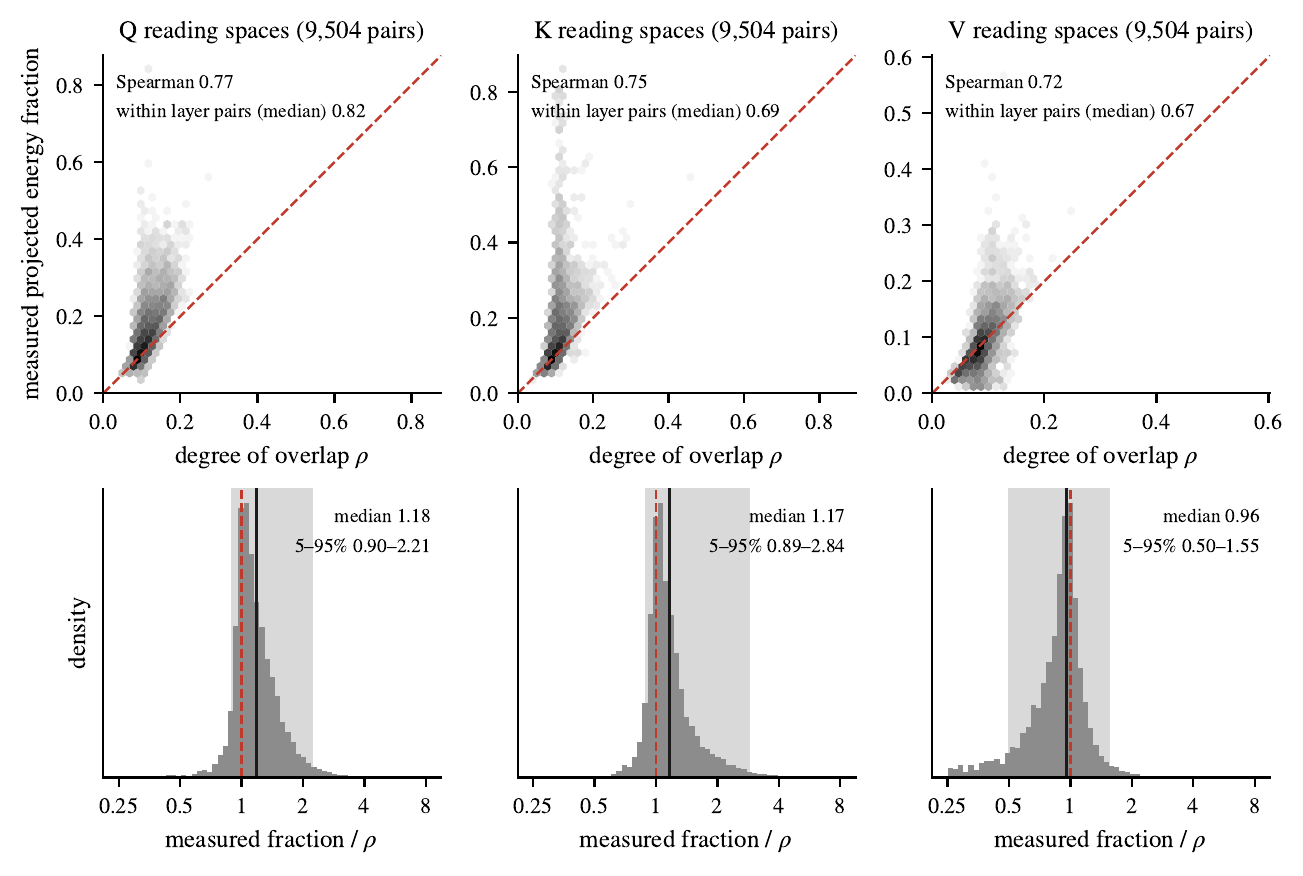
Figure 4. Top: measured projected energy fraction of the actual writes against for all 9,504 writer/reader head pairs of the 124M model per read kind (hexagonal bins, log count); the dashed diagonal is the value for isotropic writes. Bottom: distribution of the ratio of the measured fraction to (log scale), with its median (solid), the 5th - 95th percentile (shaded) and ratio 1 (dashed). The measured fraction is not the size of the reader's response (Figure 5).
V reading spaces, own-head overlap and instruction tuning
V reading spaces (Qwen2.5-7B)
Six layers (0, 7, 9, 18, 19, 21) have mean 0.015 - 0.030 among their V reading spaces, i.e. 0.4 - 0.8 of the isotropic value and 20 - 60 baseline standard deviations below it (against the random-subspace baseline); the last two layers are the opposite (0.404 and 0.717).
Own-head overlap (124M)
Averaged over the heads of a layer, a head's V reading space overlaps its own writing space more strongly than the writing spaces of other heads (0.099 - 0.373 vs 0.070 - 0.108, permutation-test in every layer); this is a subspace-level statistic and does not by itself show copying (Appendix H).
Instruction tuning (Qwen2.5-7B)
The degree of overlap between the writing spaces of the base and instruct models agrees pair by pair (largest absolute difference , largest relative difference 0.53% over 10,584 pairs), although the o_proj tensors differ; since is unchanged by a common rotation, this does not show that each space stayed in place.
Discussion
Within a layer the writing spaces almost always decompose the residual stream as a direct sum when the head widths add up to its dimension, and head subspaces are generically disjoint, so on the linear path heads communicate only through non-orthogonal overlap. On real activations the projected fraction of a write correlates in rank with the degree of overlap, which thus indicates roughly how much of a write enters each reading space along the direct path.
Evidence that the arrangement is learned selectively
The null models preserve either the singular values and of each learned matrix or its set of columns, and change only which directions belong to which head. The observed dispersion of overlap exceeds all 30 samples of each null model in every layer tested, for the writing spaces of the 124M model and the Q and K reading spaces of the 124M model and Qwen2.5-7B (one-sided per layer), and in 197 of 198 cross-layer conditions of the 124M model and all 1,134 of Qwen2.5-7B. The dispersion result is common to almost every comparison; the direction of the mean is not (exceptions in layer 7 of the 124M writing spaces and its middle layers for Q and K; across layers the mean for V is more often above the nulls). Which pairs overlap strongly, and how strongly, is thus far from what random assignments drawn from the null models produce, although this does not identify what the arrangement is for.
A hypothesis
With over the writing spaces of a layer, , so the overlap of writing spaces measures how unevenly the heads cover the directions of the residual stream ( exactly when they are orthogonal). Since every reader sees the residual stream through a normalization, we conjecture that, under a bound on head-output norms, a few strongly overlapping pairs among many weakly overlapping ones let several heads add efficiently to jointly covered directions at a small cost in separability. Testing it requires such a bound, the activations heads produce, and the sign information PK discards.
Limitations and future work
PK is a property of the weights; it ignores sign, rotations within subspaces, singular values and usage, and own-head overlap or strong pairs do not by themselves show copying or reinforcement. The activation analysis is first order, local and limited to the 124M model. Null samples for writing spaces exist only for the 124M model and one Qwen3-235B layer, and the reading-space analysis covers two models. MLPs, which read and write the whole residual stream, are not analyzed. Next steps are to test the hypothesis on activations, to weight directions by usage, to complete the null comparisons for the Qwen writing spaces, and to report separately architectures that fix to the identity or to an orthogonal basis, which we have trained at 124M and 405M parameters.
Conclusion
The reading and writing spaces of attention heads can be defined intrinsically as the orthogonal complement of the kernel and the image of their weight maps, which makes explicit that every read passes through a projection onto the reading space. For almost all weights the writing spaces of a layer decompose the residual stream as a direct sum when the head widths add up to its dimension, and any two head subspaces are disjoint, so disjointness does not separate heads. Orthogonality would, but it cannot hold for all pairs: some pairs must be non-orthogonal, and disjoint subspaces interact through projection, whose size PK bounds tightly and gives exactly on average. Measured with PK, trained models concentrate strong non-orthogonality in a few head pairs, far beyond what random assignments of the same weights produce, which suggests that training selects which subspaces communicate and how strongly. What this arrangement is for, and how it relates to normalization, remains to be tested.
Appendix
Appendix A: Reading and writing spaces
Proof of the proposition in Section 3. Decompose with and . Then , and a vector of mapped to zero lies in the kernel as well, hence is zero, so the restriction is injective. The statement about writes is the definition of the image. The restriction is an invertible linear map onto the image (onto for a full-rank head). The spaces are invariant under , and , for any invertible .
In the matrix convention used here and by Yamagiwa et al. (2026), the column spaces of , , and , which are , , and . The left singular vectors of with nonzero singular values span when has full row rank, and the right ones span when has full column rank; for they give when has full row rank and when has full row rank. The constructions differ only for rank-deficient heads or when only leading singular vectors are kept.
Appendix B: Direct-sum decomposition and disjointness
Proof of the proposition in Section 4.1. (a) The sum is a direct sum of -dimensional subspaces if and only if . This fails exactly on the zero set of the sum of squared maximal minors of ( when ), a nonzero polynomial in the entries, whose zero set has Lebesgue measure zero; the same argument applies to the stacked read matrix . For matrices with discrete entries the question is subtler (Tao and Vu, 2007). (b) When , the set of pairs of subspaces with a common nonzero direction has positive codimension in the product of Grassmannians (transversality), hence measure zero. Orthogonality is not generic either: when the writing spaces are mutually orthogonal if and only if is block-diagonal with blocks, a system of polynomial equations. Setting to the identity gives the orthogonal layout
but a later reader whose reading space is non-orthogonal to several blocks still receives all of them; absence of communication on the linear path is the condition on a writer and a reader, not on writing spaces alone.
Appendix C: Lower bound on the largest overlap
Proof of the proposition in Section 4.3. , so . The largest of the terms is at least their mean, and . With the stacked orthonormal bases, , so is the squared smallest singular value of , positive because the span . If the span only a subspace , then is still non-orthogonal to some whenever , since otherwise . If is an orthogonal decomposition, , so in the orthogonal layout and the bound is when .
Appendix D: Linear and normalization paths
The formula of Section 4.2 is the Jacobian of applied to and composed with . In two dimensions, with RMSNorm (gain 1, ) and a reader , adding , which is orthogonal to the reading space, to changes the reader's value from 1 to although . When , a unit write in projects onto with norm between and , the singular values of , and .
Proof of the proposition in Section 4.2 (PK bounds transmission). The largest singular value of is , so for every unit ; moreover and . Hence the supremum is at most . It is attained by choosing the principal angles, which is possible for any values in when : for take and all other angles equal to 90 degrees; for take and distribute over the remaining squared cosines, where . For the average, a unit vector drawn isotropically from has , so when ; since is at least the mean of the squared cosines, .
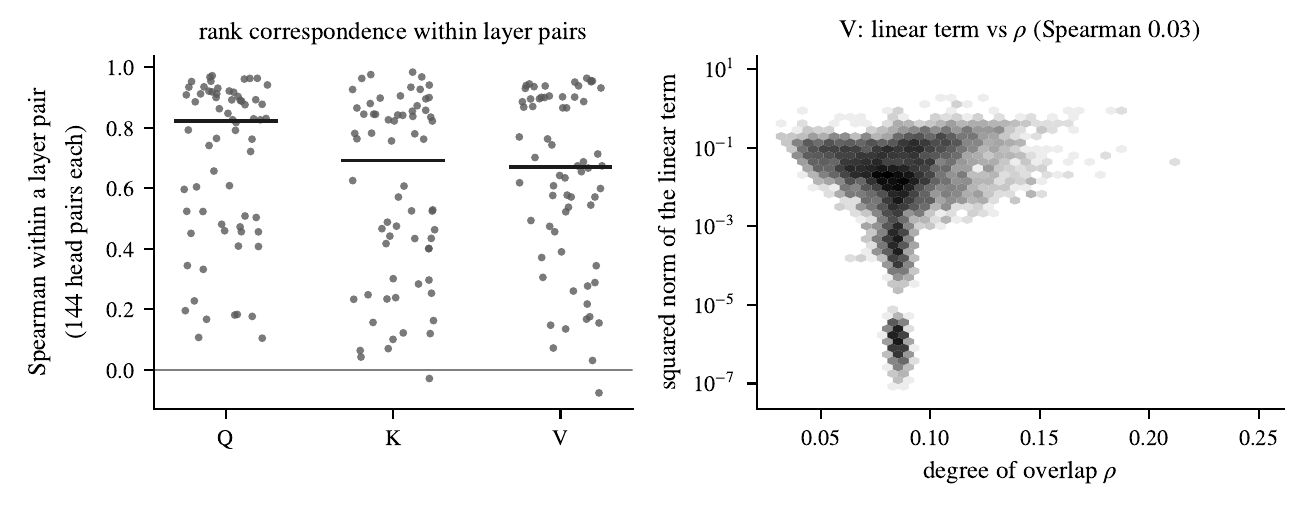
Figure 5. Left: Spearman correlation between and the measured projected energy fraction over the 144 head pairs of each pair of layers of the 124M model (66 pairs of layers per read kind; bars are medians). Right: mean squared norm of the linear term of the V read map against (Spearman 0.03); the projected fraction and the size of the response after reading differ.
Appendix E: Writing spaces
The statistics of the writing spaces of all four models are summarized in Table 5.
| Model | heads | layers | isotropic | mean over pairs of writing spaces (median over layers, range) | dispersion (median, range) | SD under the random-subspace baseline | layers with a pair below 10 degrees | ||
|---|---|---|---|---|---|---|---|---|---|
| 124M baseline | 768 | 64 | 12 | 12 | 0.0833 | 0.135 (0.114 - 0.176) | 0.033 (0.019 - 0.053) | 0.0017 | 2 |
| Qwen2.5-7B base | 3584 | 128 | 28 | 28 | 0.0357 | 0.059 (0.038 - 0.077) | 0.043 (0.021 - 0.106) | 0.0004 | 7 |
| Qwen3-235B-A22B | 4096 | 128 | 64 | 94 | 0.0313 | 0.054 (0.036 - 0.074) | 0.033 (0.010 - 0.083) | 0.0003 | 9 |
| Pythia-70m | 512 | 64 | 8 | 6 | 0.125 | 0.195 (0.141 - 0.235) | 0.071 (0.039 - 0.098) | 0.0024 | 4 |
Table 5. Mean and dispersion of the degree of overlap between the writing spaces of a layer.
Layers where the observed smallest angle is not below every column re-assignment sample:
| Layer | observed smallest angle (degrees) | smallest angle among column re-assignment samples (degrees) |
|---|---|---|
| 1 | 9.745 | 6.130 |
| 2 | 25.196 | 18.909 |
| 3 | 14.293 | 8.188 |
| 4 | 38.343 | 28.530 |
| 5 | 34.361 | 33.655 |
| 11 | 20.281 | 13.218 |
Table 6. Layers of the 124M model where the observed smallest angle between writing spaces is not below every column re-assignment sample.
In Qwen3-235B the mean stays near 0.05 while the dispersion roughly doubles in the last third (layers 60 - 93: 0.04 - 0.08 vs 0.02 - 0.03 in layers 20 - 50), and small minimum angles concentrate in the first three and last three layers; Qwen2.5-7B shows the same late-layer rise (layers 18 - 27 include the five most dispersed layers). Base and instruct agree per layer to three or four decimal places (layer 14: mean 0.0767 / 0.0767, dispersion 0.0821 / 0.0821, smallest angle 21.91 / 21.91 degrees; median absolute difference ).
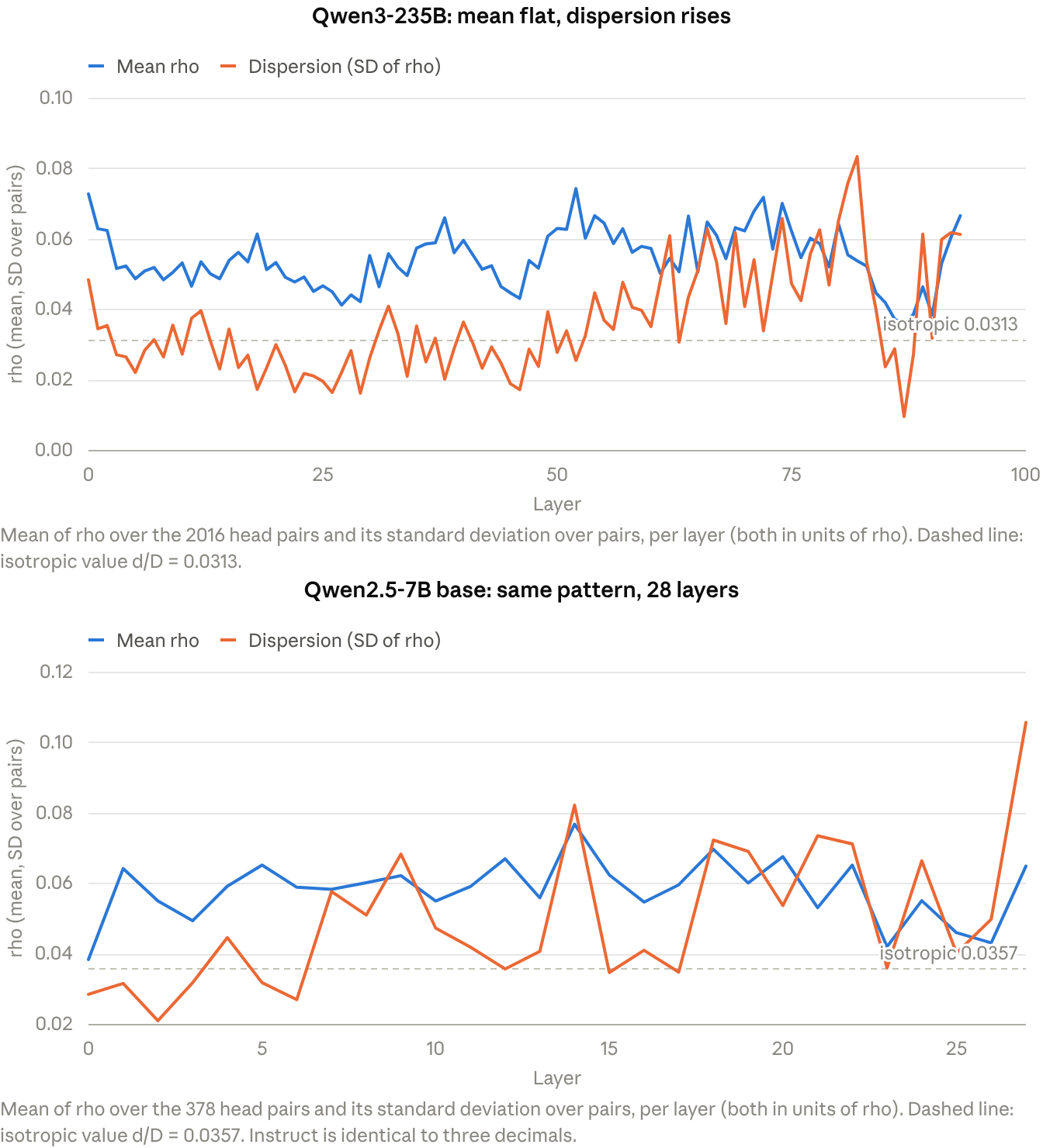
Figure 6. Depth profile of the mean and the dispersion of the degree of overlap across writing-space pairs (top: Qwen3-235B-A22B, 94 layers; bottom: Qwen2.5-7B base, 28 layers; observed only). In both models the mean stays within a factor 2.4 of the isotropic value while the dispersion is 30 - 300x the standard deviation of the random-subspace baseline and grows toward the last layers. Data: reports/wo-spark-all94-02XVEgdF, reports/qwen25-7b-pair-6wgSVtY8.
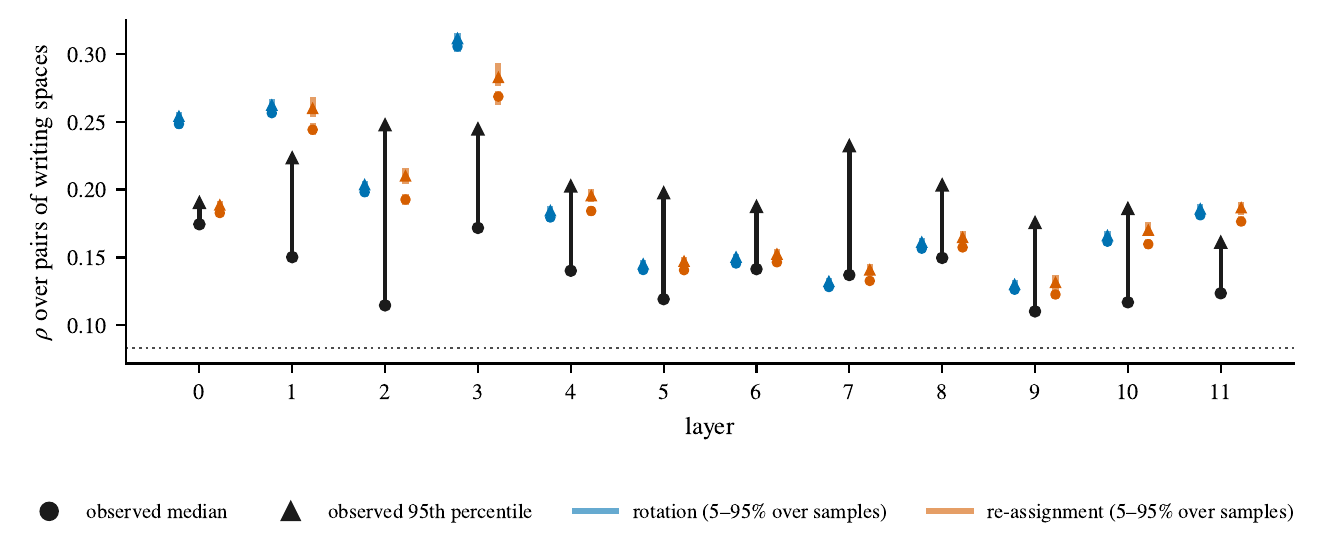
Figure 7. Per-layer median (circle) and 95th percentile (triangle) of over the 66 pairs of writing spaces of the 124M model (black), and for each null model the 5th - 95th percentile over its 30 samples of the same quantiles (colored bars). The dotted line is the isotropic value. The same summary for the other comparisons will be added when the per-pair null samples have been recomputed. Data: reports/pair-distributions/capacity-three-baseline-writing.json.
Appendix F: Reading spaces and writer/reader pairs
In the 124M model the mean overlap of Q and K reading spaces is below both null models in most layers (means under the rotation null model 0.20 - 0.38 for Q, 0.19 - 0.42 for K), but a contiguous block of middle layers overlaps more strongly; V reading spaces overlap most evenly, and the mean smallest angle over pairs is 21.9 - 39.3 degrees for Q, 14.2 - 40.5 for K, 41.4 - 50.8 for V and 24.3 - 48.7 for the writing spaces. In Qwen2.5-7B the Q dispersion is 60 - 270 times the baseline standard deviation, the mean Q and K overlap is 1.8 - 7.6 and 1.5 - 9.2 times the isotropic value (rotation means 0.089 - 0.347 for Q), the minimum Q angle is below every rotation sample in all 28 layers, and for K it is below every rotation sample in 17 layers and above every sample in 8. Reading spaces overlap more strongly than writing spaces (median layer 3.0x the isotropic value for Q against 1.65x for O); layer 1 is extreme (mean 0.271, mean minimum angle 9.4 degrees, minimum 1.4 degrees), and the Q reading spaces of the last two layers have mean 0.169 and 0.209. In the 124M model two K reading spaces make 3.9 degrees in layer 4 and 6.7 degrees in layer 2. Six V layers of Qwen2.5-7B have mean smallest angles of 50 - 72 degrees, and layer 27 has 9.8 degrees.
| Model | reading space | pairs per layer | mean (range over layers) | layers with mean below every sample of both null models | dispersion (range) | layers with dispersion above every sample of both null models | smallest angle over pairs (degrees) |
|---|---|---|---|---|---|---|---|
| 124M | Q | 66 | 0.145 - 0.221 | 8 of 12 (layers 6 - 9 above) | 0.012 - 0.082 | 12 of 12 | 6.1 |
| 124M | K | 66 | 0.136 - 0.211 | 10 of 12 (layers 7, 9 above) | 0.013 - 0.087 | 12 of 12 | 3.9 |
| 124M | V | 66 | 0.114 - 0.180 | - | 0.016 - 0.048 | - | 21.3 |
| Qwen2.5-7B | Q | 378 | 0.066 - 0.271 | 28 of 28 | 0.021 - 0.093 | 28 of 28 | 1.4 |
| Qwen2.5-7B | K | 6 | 0.054 - 0.329 | 28 of 28 | 0.016 - 0.118 | 28 of 28 | 6.1 |
| Qwen2.5-7B | V | 6 | 0.015 - 0.717 | - | 0.003 - 0.395 | - | 7.4 |
Table 7. Degree of overlap between reading spaces of one kind within a layer, against the null models.
| Model | read kind | pairs of layers | dispersion above every sample of both null models | median ratio of dispersion to the rotation null model | mean below every sample of both | mean above every sample of both |
|---|---|---|---|---|---|---|
| 124M | Q | 66 | 65 | 7.6 | 40 | 15 |
| 124M | K | 66 | 66 | 6.8 | 36 | 19 |
| 124M | V | 66 | 66 | 8.5 | 10 | 39 |
| Qwen2.5-7B | Q | 378 | 378 | 18.5 | 242 | 36 |
| Qwen2.5-7B | K | 378 | 378 | 19.5 | 153 | 72 |
| Qwen2.5-7B | V | 378 | 378 | 36.4 | 81 | 148 |
Table 8. Dispersion of the degree of overlap between the writing spaces of one layer and the reading spaces of a later layer, against the null models.
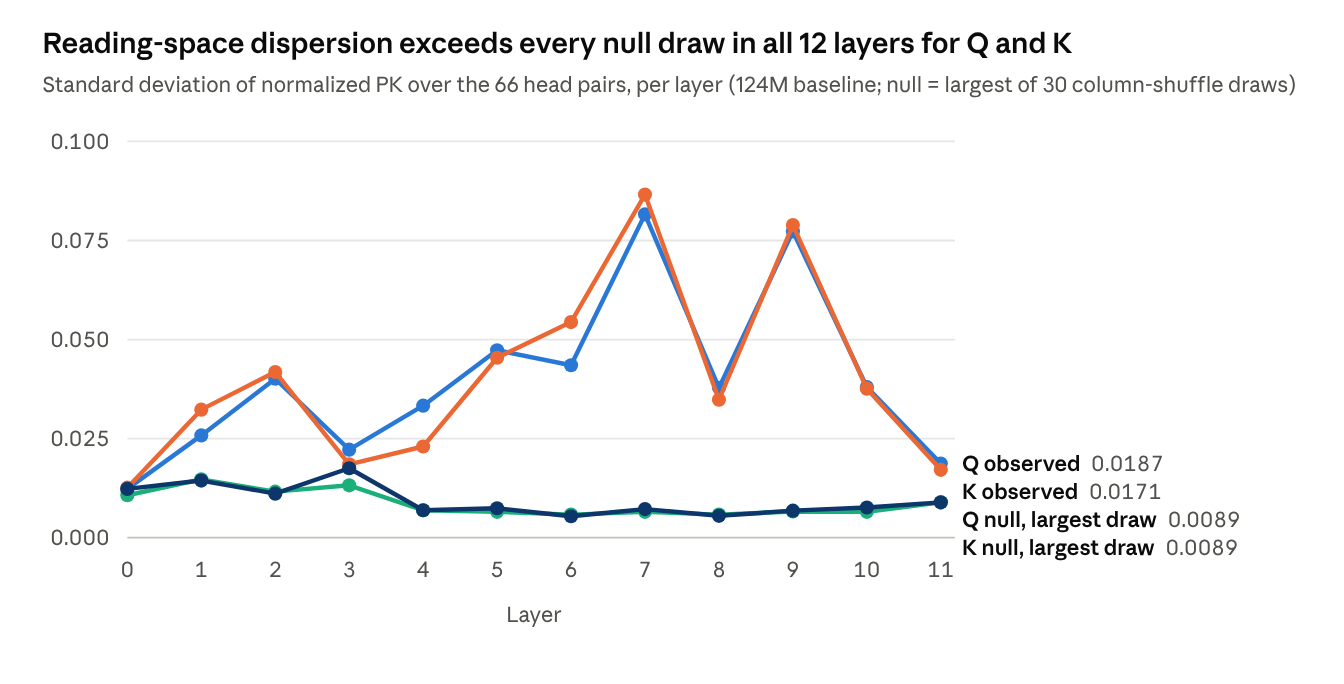
Figure 8. Dispersion of the degree of overlap across pairs for the Q and K reading spaces per layer of the 124M baseline, against the largest of the 30 column re-assignment samples. The rotation samples never exceed 0.0051. Data: reports/read-geometry/capacity-three-baseline.json.
In the 124M model the mean over writer/reader pairs decays with the gap : at gap 1 it is 0.115 (Q), 0.104 (K) and 0.091 (V), and by gap 9 or more all three are within 0.01 of 0.083. In Qwen2.5-7B the mean at gap 1 is 0.047 - 0.048 (1.3x the isotropic value) and decays to the isotropic value by a gap of about 10 for Q and K; for V it goes below the isotropic value at gaps 7 - 18 (0.029 - 0.035). The mean for Q is below every null sample in 63 of the 78 pairs of layers at gap 3 or less and in 66 of the 153 at gap above 10; for V it is above every null sample in 77 of the 153 pairs at gap above 10 and below in only 20. Over the V reading spaces of layers 24 - 27 the writing spaces of layer 23 reach 0.55 - 0.69, and those of layer 3 reach 0.51 - 0.56 against layers 25 - 27 (0.563 against layer 27); the largest Q pair is 0.386 (23 27) and the largest K pair 0.297 (21 22).
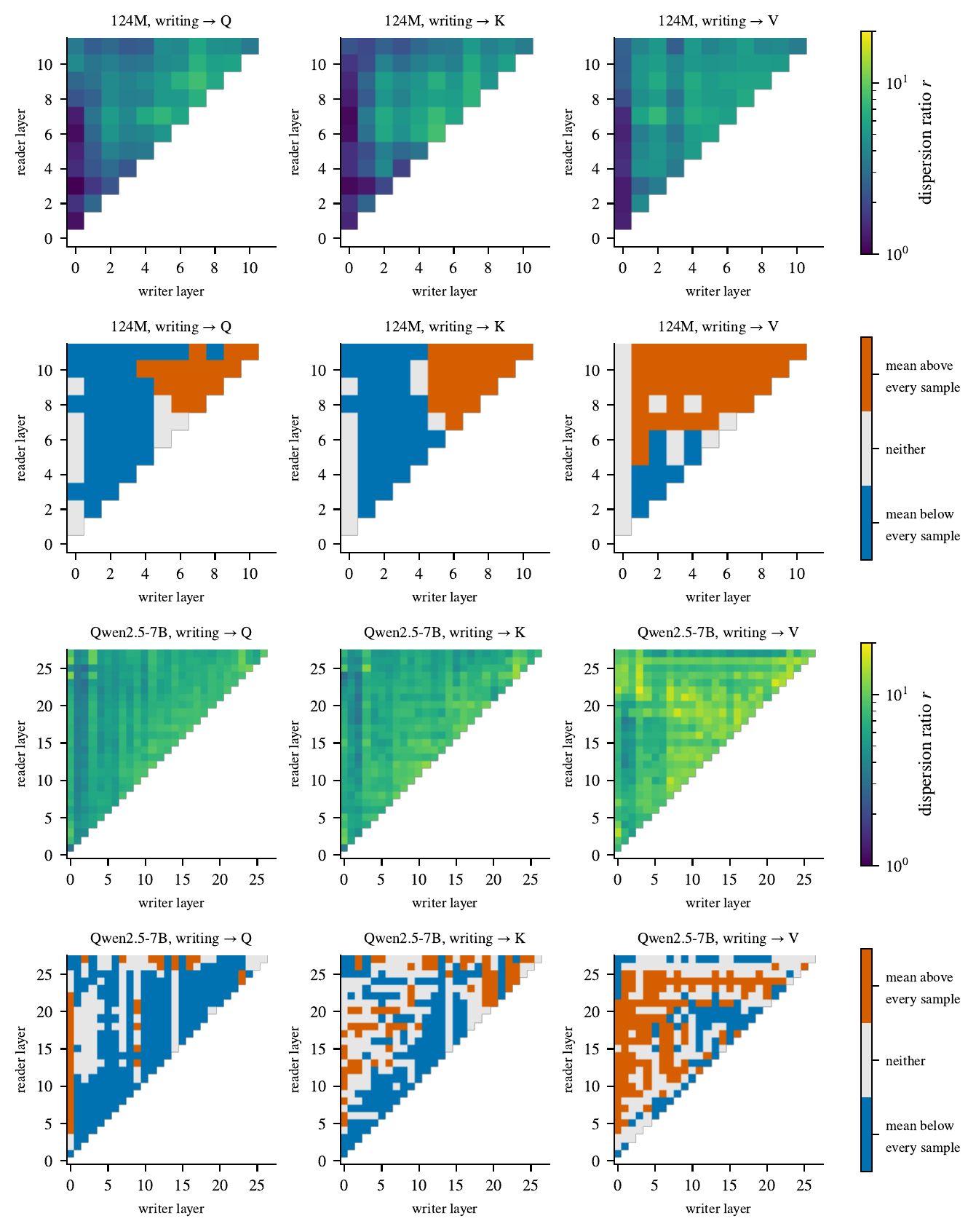
Figure 9. For every pair of a writer layer and a later reader layer and each read kind: the ratio of the observed dispersion to the largest null-sample dispersion (rows 1 and 3), and whether the mean is below every sample of both null models, above every sample, or neither (rows 2 and 4). Data: reports/read-geometry/capacity-three-baseline-cross-nulls.json, reports/read-geometry/qwen25-7b-base/qwen25-7b-base-cross-nulls.json.
Appendix G: Spectrum-weighted measure
For the normalization-folded read matrix and the write matrix of a head pair, is about 1 for independent Gaussian matrices and, unlike , depends on singular values. Its largest values occur at different pairs of layers from those of ; the values below are maxima over the head pairs of each pair of layers, not necessarily the same head pair as the maximum of .
| Model | pair of layers, read kind | max | max of the weighted measure |
|---|---|---|---|
| 124M | 5 6, K | 0.598 | 10.4 |
| 124M | 5 7, K | 0.454 | 7.5 |
| 124M | 1 2, K | 0.225 | 130.8 |
| 124M | 1 4, K | 0.191 | 123.7 |
| Qwen2.5-7B | 23 27, V | 0.685 | 20.9 |
| Qwen2.5-7B | 13 14, K | 0.283 | 56.6 |
Table 9. Largest degree of overlap and largest spectrum-weighted measure for each pair of layers.
The mean of the weighted measure over head pairs is 0.63 - 14.51 across pairs of layers of the 124M model (median 1.35) and 0.37 - 3.08 for Qwen2.5-7B (median 1.13).
Appendix H: Own-head overlap
In the 124M model, for each layer we average over the heads and compare it with the same average after permuting the writing-space labels (10,000 permutations): 0.099 - 0.373 against 0.070 - 0.108 (isotropic 0.083), in every layer, and 0.20 - 0.37 in layers 0 - 4. A head's Q and K reading spaces overlap more strongly with each other than with other heads' (0.15 - 0.34 vs 0.12 - 0.17, ), and its Q reading space overlaps its own writing space only slightly more (0.10 - 0.16 vs 0.09 - 0.13, ). PK ignores sign ( gives the same values), so this does not show copying (cf. Feng and Li, 2026). In Qwen2.5-7B the writing space of each query head is compared with the V reading space of its own key-value group against the 24 permutations of the four group labels (smallest attainable ): 0.044 - 0.285 against 0.026 - 0.110, at the smallest attainable in 27 of 28 layers (layer 26: 0.083), strongest (0.24 - 0.28) in layers 7, 9, 18 and 21, weak in layer 0 (0.044) and moderate in layer 19 (0.181). Q reading against own-group K reading is stronger in all 28 layers (), and Q reading against own writing space averages 0.039 - 0.115 against 0.034 - 0.075 (, 28 heads, 10,000 permutations).
References
Joshua Ainslie, James Lee-Thorp, Michiel de Jong, Yury Zemlyanskiy, Federico Lebrón, and Sumit Sanghai. 2023. GQA: Training generalized multi-query transformer models from multi-head checkpoints. In Proceedings of the 2023 Conference on Empirical Methods in Natural Language Processing, pages 4895–4901. doi:10.18653/v1/2023.emnlp-main.298.
Jimmy Lei Ba, Jamie Ryan Kiros, and Geoffrey E. Hinton. 2016. Layer normalization. arXiv preprint arXiv:1607.06450.
Stella Biderman, Hailey Schoelkopf, Quentin Gregory Anthony, Herbie Bradley, Kyle O'Brien, Eric Hallahan, Mohammad Aflah Khan, Shivanshu Purohit, USVSN Sai Prashanth, Edward Raff, Aviya Skowron, Lintang Sutawika, and Oskar van der Wal. 2023. Pythia: A suite for analyzing large language models across training and scaling. In Proceedings of the 40th International Conference on Machine Learning, volume 202 of Proceedings of Machine Learning Research, pages 2397–2430. arXiv:2304.01373.
Åke Björck and Gene H. Golub. 1973. Numerical methods for computing angles between linear subspaces. Mathematics of Computation, 27(123):579–594. doi:10.1090/S0025-5718-1973-0348991-3.
Nelson Elhage, Tristan Hume, Catherine Olsson, Nicholas Schiefer, Tom Henighan, Shauna Kravec, Zac Hatfield-Dodds, Robert Lasenby, Dawn Drain, Carol Chen, Roger Grosse, Sam McCandlish, Jared Kaplan, Dario Amodei, Martin Wattenberg, and Christopher Olah. 2022. Toy models of superposition. Transformer Circuits Thread. https://transformer-circuits.pub/2022/toy_model/index.html; arXiv:2209.10652.
Nelson Elhage, Neel Nanda, Catherine Olsson, Tom Henighan, Nicholas Joseph, Ben Mann, Amanda Askell, Yuntao Bai, Anna Chen, Tom Conerly, Nova DasSarma, Dawn Drain, Deep Ganguli, Zac Hatfield-Dodds, Danny Hernandez, Andy Jones, Jackson Kernion, Liane Lovitt, Kamal Ndousse, Dario Amodei, Tom Brown, Jack Clark, Jared Kaplan, Sam McCandlish, and Chris Olah. 2021. A mathematical framework for transformer circuits. Transformer Circuits Thread. https://transformer-circuits.pub/2021/framework/index.html.
Jiming Feng and Junliang Li. 2026. Scaled idempotence in transformer attention: Paired OV geometry and shared-value algebras. arXiv preprint arXiv:2609.01129.
Ernest Fokoué. 2026. Multi-head attention as ensemble Nadaraya-Watson estimation: Variance reduction, decorrelation, and optimal head diversity. arXiv preprint arXiv:2605.20271.
Jihun Hamm and Daniel D. Lee. 2008. Grassmann discriminant analysis. In Proceedings of the 25th International Conference on Machine Learning, pages 376–383. doi:10.1145/1390156.1390204.
Mingu Lee, Jinkyu Lee, Hye Jin Jang, Byeonggeun Kim, Wonil Chang, and Kyuwoong Hwang. 2019. Orthogonality constrained multi-head attention for keyword spotting. In 2019 IEEE Automatic Speech Recognition and Understanding Workshop (ASRU), pages 86–92. doi:10.1109/ASRU46091.2019.9003738.
Jian Li, Zhaopeng Tu, Baosong Yang, Michael R. Lyu, and Tong Zhang. 2018. Multi-head attention with disagreement regularization. In Proceedings of the 2018 Conference on Empirical Methods in Natural Language Processing, pages 2897–2903. doi:10.18653/v1/D18-1317.
Jian Li, Xing Wang, Zhaopeng Tu, and Michael R. Lyu. 2021. On the diversity of multi-head attention. Neurocomputing, 454:14–24. doi:10.1016/j.neucom.2021.04.038.
Jack Merullo, Carsten Eickhoff, and Ellie Pavlick. 2024. Talking heads: Understanding inter-layer communication in transformer language models. In Advances in Neural Information Processing Systems 37, pages 61372–61418. arXiv:2406.09519.
Paul Michel, Omer Levy, and Graham Neubig. 2019. Are sixteen heads really better than one? In Advances in Neural Information Processing Systems 32. arXiv:1905.10650.
Catherine Olsson, Nelson Elhage, Neel Nanda, Nicholas Joseph, Nova DasSarma, Tom Henighan, Ben Mann, Amanda Askell, Yuntao Bai, Anna Chen, Tom Conerly, Dawn Drain, Deep Ganguli, Zac Hatfield-Dodds, Danny Hernandez, Scott Johnston, Andy Jones, Jackson Kernion, Liane Lovitt, Kamal Ndousse, Dario Amodei, Tom Brown, Jack Clark, Jared Kaplan, Sam McCandlish, and Chris Olah. 2022. In-context learning and induction heads. Transformer Circuits Thread. https://transformer-circuits.pub/2022/in-context-learning-and-induction-heads/index.html; arXiv:2209.11895.
Guilherme Penedo, Hynek Kydlíček, Loubna Ben allal, Anton Lozhkov, Margaret Mitchell, Colin Raffel, Leandro Von Werra, and Thomas Wolf. 2024. The FineWeb datasets: Decanting the web for the finest text data at scale. In Advances in Neural Information Processing Systems 37, Datasets and Benchmarks Track, pages 30811–30849. arXiv:2406.17557.
Belinda Phipson and Gordon K. Smyth. 2010. Permutation p-values should never be zero: Calculating exact p-values when permutations are randomly drawn. Statistical Applications in Genetics and Molecular Biology, 9(1). doi:10.2202/1544-6115.1585.
Qwen Team (An Yang, Baosong Yang, Beichen Zhang, et al.). 2024. Qwen2.5 technical report. arXiv preprint arXiv:2412.15115.
Qwen Team (An Yang, Anfeng Li, Baosong Yang, et al.). 2025. Qwen3 technical report. arXiv preprint arXiv:2505.09388.
Alec Radford, Jeffrey Wu, Rewon Child, David Luan, Dario Amodei, and Ilya Sutskever. 2019. Language models are unsupervised multitask learners. OpenAI technical report.
Paul M. Riechers. 2024. Geometry and dynamics of LayerNorm. arXiv preprint arXiv:2405.04134.
Gilbert Strang. 1993. The fundamental theorem of linear algebra. The American Mathematical Monthly, 100(9):848–855. doi:10.1080/00029890.1993.11990500.
Terence Tao and Van Vu. 2007. On the singularity probability of random Bernoulli matrices. Journal of the American Mathematical Society, 20(3):603–628. doi:10.1090/S0894-0347-07-00555-3.
Ashish Vaswani, Noam Shazeer, Niki Parmar, Jakob Uszkoreit, Llion Jones, Aidan N. Gomez, Łukasz Kaiser, and Illia Polosukhin. 2017. Attention is all you need. In Advances in Neural Information Processing Systems 30. arXiv:1706.03762.
Elena Voita, David Talbot, Fedor Moiseev, Rico Sennrich, and Ivan Titov. 2019. Analyzing multi-head self-attention: Specialized heads do the heavy lifting, the rest can be pruned. In Proceedings of the 57th Annual Meeting of the Association for Computational Linguistics, pages 5797–5808. doi:10.18653/v1/P19-1580.
Kevin Ro Wang, Alexandre Variengien, Arthur Conmy, Buck Shlegeris, and Jacob Steinhardt. 2023. Interpretability in the wild: A circuit for indirect object identification in GPT-2 small. In The Eleventh International Conference on Learning Representations. https://openreview.net/forum?id=NpsVSN6o4ul.
Ruibin Xiong, Yunchang Yang, Di He, Kai Zheng, Shuxin Zheng, Chen Xing, Huishuai Zhang, Yanyan Lan, Liwei Wang, and Tieyan Liu. 2020. On layer normalization in the transformer architecture. In Proceedings of the 37th International Conference on Machine Learning, volume 119 of Proceedings of Machine Learning Research, pages 10524–10533. arXiv:2002.04745.
Hiroaki Yamagiwa, Yusuke Takase, and Hidetoshi Shimodaira. 2026. Measuring affinity between attention-head weight subspaces via the projection kernel. arXiv preprint arXiv:2601.10266.
Biao Zhang and Rico Sennrich. 2019. Root mean square layer normalization. In Advances in Neural Information Processing Systems 32. arXiv:1910.07467.