0. Introduction
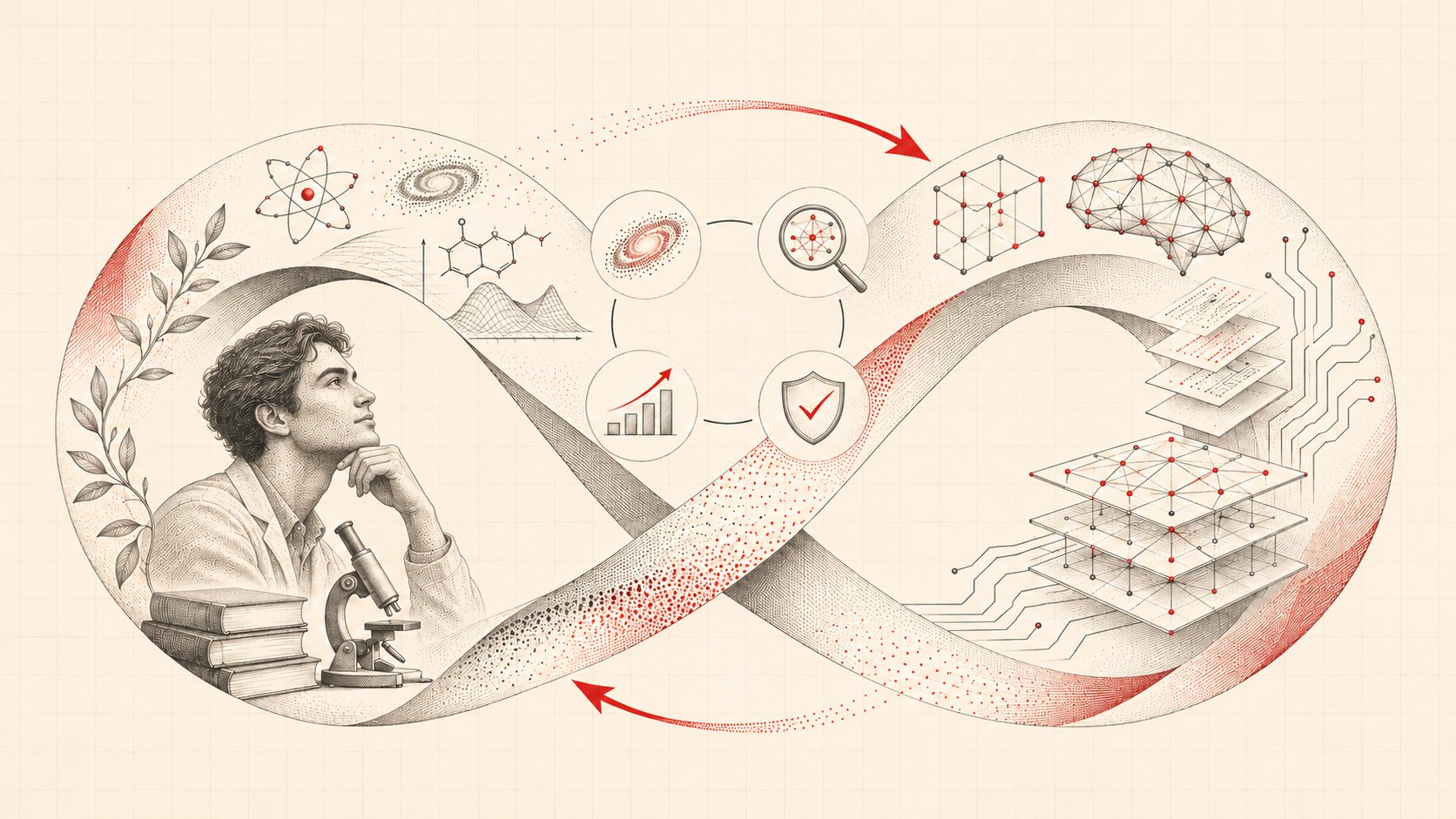
Intelligence — it has been humanity's greatest weapon, privilege, and mystery. As the highest reach of dizzying technological development, an intelligence different from humanity is right now being brought into being. Its impact is not hard to imagine.
The market has already begun a massive money game over AI. In the background lie the scaling laws. The idea is that if you increase data, compute resources, and parameters appropriately, performance improves accordingly. The release of ChatGPT, trained by large-scale learning, sent a shock through the world. Since then, enormous capital has been poured into training frontier models and competition has intensified. However, if we stop and think, humans perform efficient learning with far less data than current AI. That is, room remains for AI to develop significantly through architectural innovation rather than scaling.
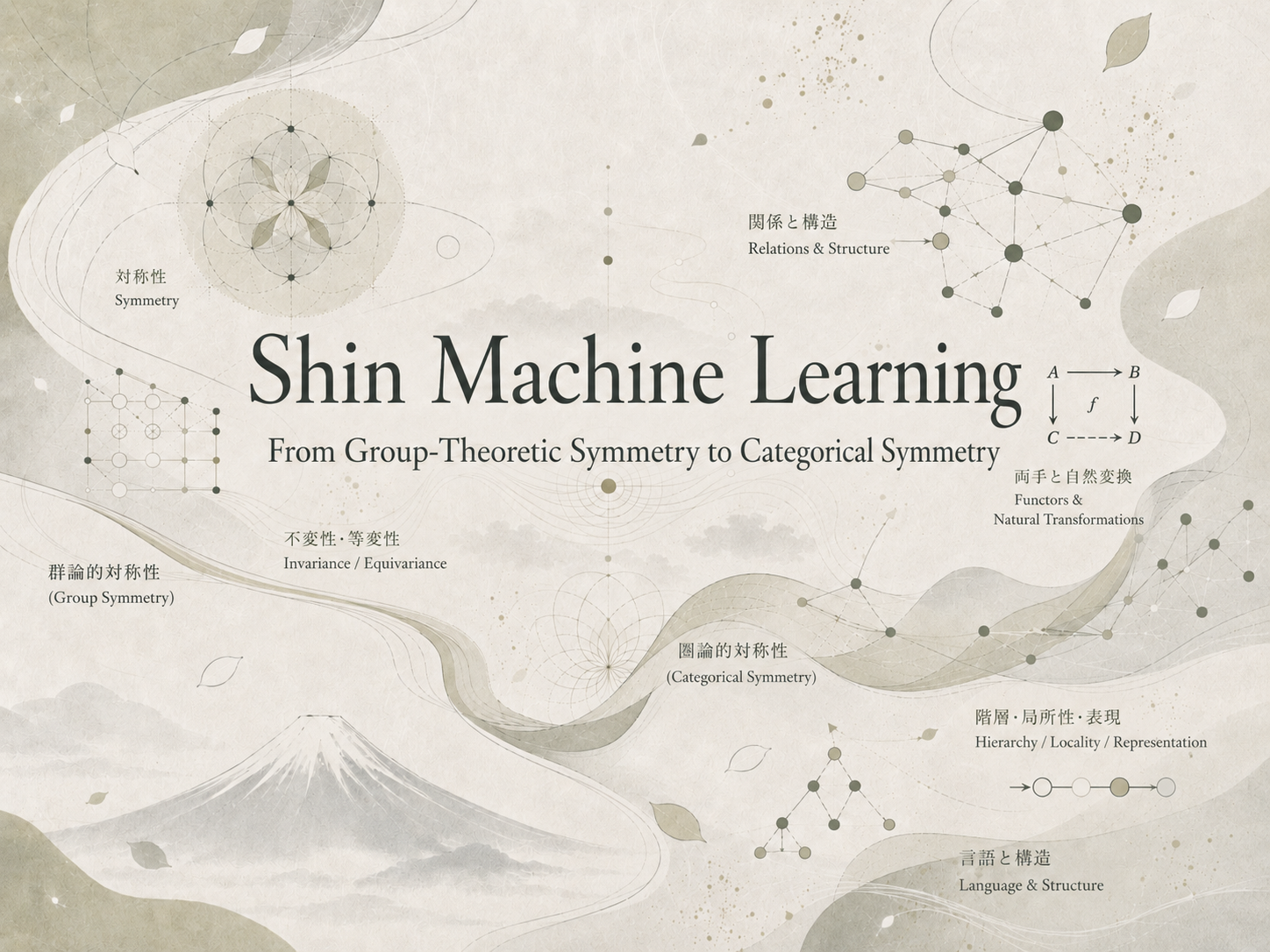
The keyword is "symmetry." By leveraging the symmetries that lie behind data, we can expect improvements in performance and more efficient learning. In this article, I explain the way of thinking that designs architecture with "symmetry" as a guiding principle. In Chapter 1, why symmetry matters; in Chapter 2, geometric deep learning, its ideas and empirical examples. Geometric deep learning is what clearly laid down the direction of incorporating symmetry into architecture. Then in Chapter 3, I introduce the idea of "categorical machine learning" — for describing symmetry more flexibly.
1. Why Symmetry Matters
Why does symmetry matter? It is because
diverse symmetries exist behind the real world, and by leveraging them, good predictions become possible.
First, the part about "good predictions becoming possible" is by definition. Here, let us properly confirm the definition of the word "symmetry." Symmetry means "invariance under a transformation." Here I will also call equivariance — not just invariance — a symmetry. Equivariance means that the output after the transformation changes consistently with the change in input. These invariances and equivariances, as explained in §2.2, are often described in group theory. Now, if there exists some structure that is invariant or equivariant under the transformations accompanying the passage of time, then by leveraging it, good predictions become possible — this is conceivable. This can be rephrased from the definition of symmetry as "symmetry can be leveraged for prediction."
Next, regarding the fact that diverse symmetries exist behind the real world — this is a highly non-trivial claim. Pressed to the limit, it becomes an ontological philosophical problem. But mysteriously, naively one can think that various symmetries exist in the real world. For example, the bodies of humans and animals are left-right symmetric. Crystal lattices and the helical structure of DNA have translational symmetry — they preserve their shape even when shifted by a fixed amount. Molecules preserve their geometric shape, so they have point group symmetry. In physics, conservation laws are symmetries themselves, and there is gauge symmetry — invariance under coordinate transformations — and so on. Furthermore, from a statistical viewpoint, probability distributions appear as symmetry. For instance, tossing a coin and tossing a shoe should be different acts, yet behind both, the Bernoulli distribution appears. Like this, the world contains various symmetries, described in various forms.
In the context of machine learning and deep learning, the bias we assume about the real world for prediction is called inductive bias. This is an important concept, so let me explain. Machine learning is about building models that predict the unknown based on training data. In learning, since the data is at most finite, if the model has enough parameters, the training data can be completely reproduced. But what is important is generalization performance — the ability to predict the unknown. Even if a model can completely reproduce the training data, infinitely many such models exist, so choosing the one that achieves generalization among them becomes important. Here, the criteria assumed for selecting a model becomes necessary as inductive bias. By inducing and implementing biases that reflect reality, we achieve model generalization.
Classical indicators of inductive bias include smoothness and simplicity. That the output changes smoothly with respect to changes in input, and that the model is expressed simply, are natural assumptions. However, the conventional inductive biases of "smoothness" or "simplicity" have limits. In low dimensions, even just the assumption that a function is smooth lets you estimate the values at unobserved points from nearby observed points. But when handling high-dimensional data like deep learning, since the space itself expands explosively, gathering enough data around each point requires an exponential number of samples relative to the dimension. This is called the curse of dimensionality. Therefore, for high-dimensional data, just "selecting a smooth function" is insufficient. What is necessary is inductive bias that captures stronger structure behind the data. Here is where the idea of leveraging symmetry comes in. As mentioned earlier, it lies hidden in various forms in the real world.
Therefore, to summarize the discussion, "symmetries that exist in the world can be leveraged as inductive bias for better predictions." This is the reason symmetry matters in machine learning and deep learning.
In the next chapter, I explain geometric deep learning — the way of thinking for incorporating symmetry into architecture.
2. What Is Geometric Deep Learning
2.1 Geometric Deep Learning as a Position
Geometric deep learning is not about a specific architectural structure. To include a bit of my own interpretation: it is actually about a position. That is, taking up geometric deep learning means taking the stance of designing architecture with geometric symmetry as the guiding principle. And the truly important idea is in fact what I explained in Chapter 1. To repeat: "symmetry can be leveraged as an inductive bias that captures structure."
Let us look at the rise of geometric deep learning. Bronstein et al.'s 2017 survey Geometric Deep Learning: Going beyond Euclidean Data reframes the success of CNNs as the result of incorporating into architecture the Euclidean grid structure and translational symmetry behind image data, and positions geometric deep learning as extending that idea to non-Euclidean data. Further, in 2021, Geometric Deep Learning: Grids, Groups, Graphs, Geodesics, and Gauges by Bronstein, Bruna, Cohen, and Veličković organized this position more systematically. This paper raised the banner of understanding the various architectures of deep learning — CNN, GNN, RNN, Transformer, and so on — in a unified way from the geometric structures and symmetries behind the data. The authors regarded data such as images, sets, graphs, manifolds, and physical systems as signals on different spaces, respectively, and considered that the appropriate form of neural network is determined by what kinds of transformations or symmetries that space has. In this way, an organization positioning architectures primarily from geometric symmetry was made, and using symmetry to design the next architectures was advocated. The idea of using symmetry as inductive bias has become the soul of geometric deep learning.
2.2 Description of Geometric Deep Learning
Group theory describes a certain kind of symmetry. In geometric deep learning, there was a flow of first using group theory to incorporate symmetry into architecture. Here I focus specifically on equivariance and explain how to describe it.
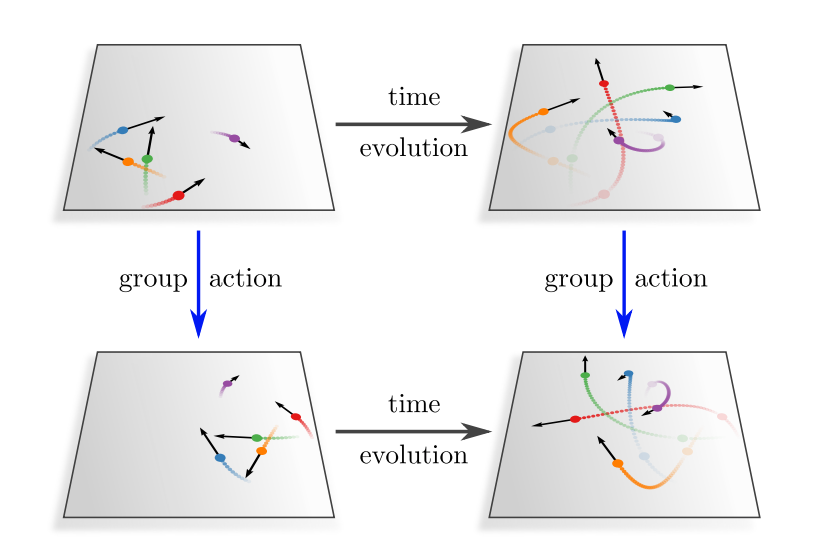
Fig 1. Time evolution under coordinate transformation by group action is equivariant.
Equivariance means that the output after the transformation changes consistently with the change in input. For example, view time evolution itself as a transformation. At this time, if we also consider a coordinate transformation simultaneously, we can say that time evolution is equivariant with respect to the coordinate transformation. This is because applying the coordinate transformation and then the time evolution, and applying the time evolution and then the coordinate transformation, are "commutative." This commutativity concisely expresses that the output after the transformation changes consistently with the change in input. Therefore, equivariance in the equation as well, taking to be the group describing symmetry, the space on which acts, and a transformation on , means:
holds, can be written.
How is equivariance described in this way incorporated into an architecture? It is realized by viewing as the weight matrix of the model and considering this commutativity condition as a constraint on . More concretely, assuming a symmetry and describing it as a group action, becomes given, so this condition can be regarded as an equation in . Solving this does not completely determine the parameters of , but yields concrete conditions on the parameters of — for example, that the diagonal entries are all equal — and the form of the matrix is restricted. This restriction can be seen as expressing weight sharing, and if is taken to be a group expressing translational symmetry, it coincides with the formulation of convolution. Therefore, it can be understood that convolutional neural networks are something that has woven in symmetry, and their generalization is neural networks that weave in equivariance.
2.3 Empirical Examples
AlphaFold2 (an overwhelming victory at CASP14 in 2020, Nature in 2021), centered on a structure module that handles residues as SE(3)-equivariant rigid frames, lifted protein structure prediction to nearly experimental precision and led to the 2024 Nobel Prize in Chemistry. There are also many other empirically successful architectures.
| Domain | Geometric structure | Successful model examples |
|---|---|---|
| Weather forecasting | Earth surface / atmospheric graph | GraphCast |
| Proteins | 3D structure / distance / angle | AlphaFold |
| Molecular properties | 3D atomic graph / E(3) symmetry | EGNN, SE(3)-equivariant GNN |
| Spherical data | Sphere / local frame | Icosahedral CNN, Gauge Equivariant CNN |
| Medical / dMRI | Direction field / sphere / projective space | steerable / gauge equivariant models |
| Physics | Gauge symmetry / conservation laws | Lattice Gauge Equivariant CNN |
3. Toward Categorical Symmetry
3.1 What Is Missing
In geometric deep learning, it was organized that CNNs are an architecture that has incorporated group-theoretic symmetry, and extensions are being made in that direction. However, group-theoretic symmetry alone is not enough. For example, as symmetries of reality:
- Hierarchical symmetries such as dog, Shiba Inu, sideways-facing Shiba Inu
- Local symmetries such as gauge symmetry
- Irreversible symmetries such as lossy image compression
- Statistical symmetries such as probability distributions
and so on — the list could go on without end. A framework that corresponds to these symmetries becomes necessary.
3.2 Category-Equivariant Neural Networks
We take the position of describing — via category theory — symmetries that cannot be described by groups. This is the position of Shin Machine Learning = categorical machine learning. Categorical machine learning has no established methodology yet, with several results just beginning to appear; it is at an emerging stage. However, since category theory can describe — as limits — various objects such as direct sum, direct product, tensor product, and localization in a unified way, it is known as a framework of high descriptive power, and we consider this direction extremely promising.
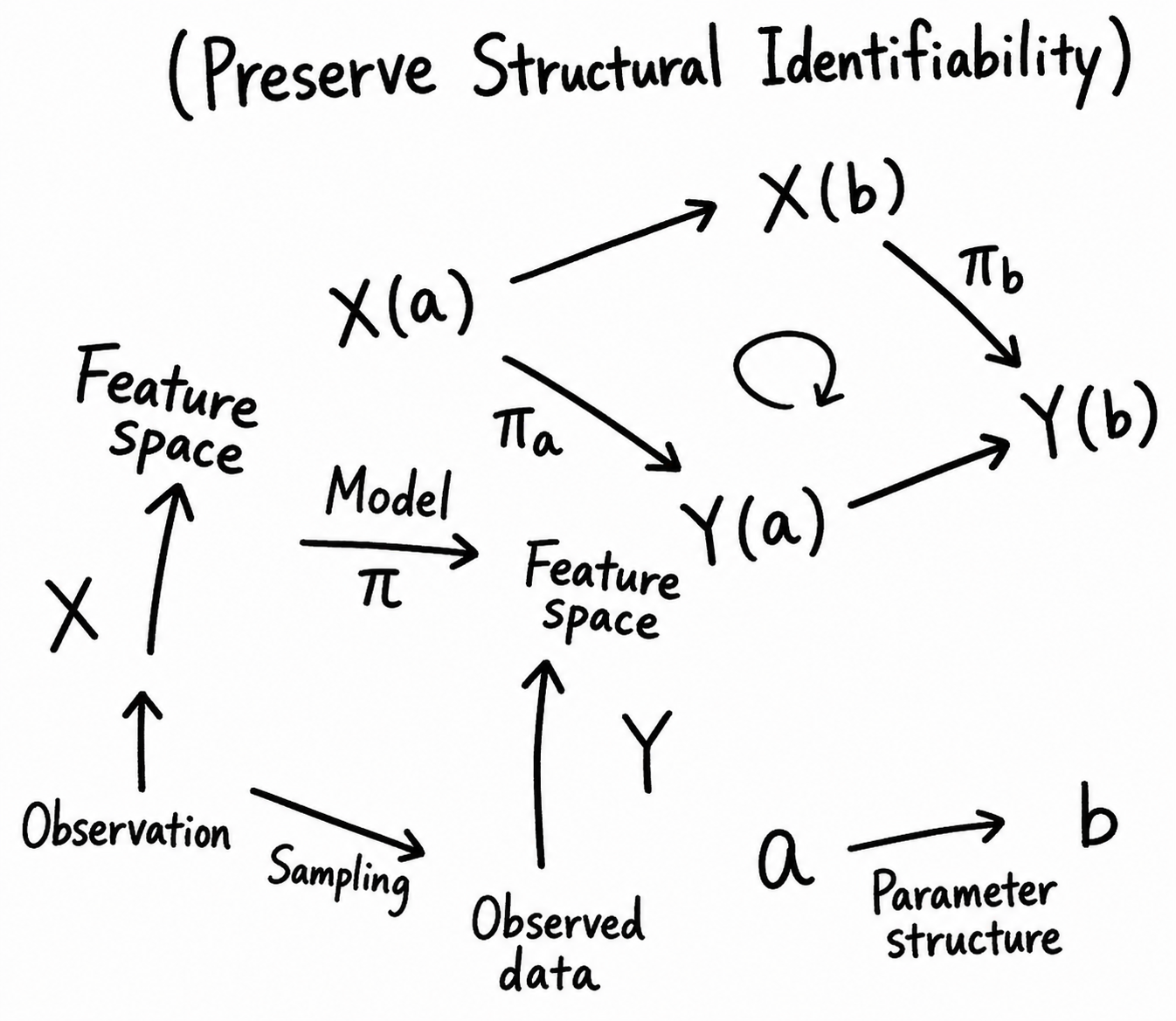
As one idea, let us look at the Category-Equivariant Neural Network (CENN). CENN was proposed by [maruyama,2025]. I will not give the rigorous definitions of category, functor, and natural transformation here, but it suffices to think of these relationships as: a functor is a homomorphism between categories, and a natural transformation is a homomorphism between functors. The key to the idea is that a natural transformation is defined by the "commutativity" of a diagram. Category-equivariant neural networks are formulated as natural transformations.
Although slightly different from the paper, let me describe the idea concretely. First, describe the data of reality as a category C. Then let X be the functor that encodes reality into the feature space, and Y the functor that decodes reality into the feature space. By making them functors, the features preserve the structure of category C. At this time, a machine learning model can be formulated as a natural transformation φ between functors X and Y. φ being a natural transformation means — as in the figure — that in the feature space the model φ is commutative, that is, equivariant. This equivariance using the commutativity of natural transformations is exactly what we call categorical symmetry.
3.3 Applications to Language Models and Ideas
Categorical machine learning is the position of describing symmetry categorically and designing architecture with it as an inductive bias. Apart from the way of thinking introduced above, there are several such directions, but they are at an emerging stage and there are no established methodologies. We are particularly engaged in research applying this way of thinking to language models.
One idea we are working on is a formulation using geometric algebra (Clifford algebra). The meaning of a sentence rises from combinations of words — that is, from multilinear composition — and the symmetry and alternation that this composition possesses can be straightforwardly written down within a single algebraic structure by geometric algebra. Specifically, by representing words as vectors (1st grade) and their combinations as bivectors and higher multivectors, the self-similar hierarchical structure of language — building up from words to phrases to clauses — can be naturally expressed as a difference in grade. Furthermore, since the geometric product decomposes into the sum of a symmetric inner product and an alternating wedge product, combinations whose order does not change the meaning and combinations whose order does change the meaning can be distinguished and handled within a single operation. If such algebraic structure is incorporated into architecture, the invariances and equivariances of composition no longer need to be relearned from data; the structure itself functions as inductive bias. This is an attempt to bring the same idea as translational invariance in images (CNN) or permutation invariance over sets into the compositional structure of language. Machine learning using geometric algebra has so far been limited to geometric data such as physical phenomena and 3D processing, but high-dimensional geometric algebra is considered to provide a powerful principle for language modeling as well. That said, the formulation itself of which operations of language correspond to symmetry and which to alternation is the essential question, and we aim — using this correspondence as a foothold — to extend the framework of categorical machine learning to language models.
Furthermore, we hope to be able to engage in an ambitious project that further fuses interdisciplinary fields such as predictive coding and the free energy principle from neuroscience, symbol emergence systems theory, and neo-cybernetics.
Summary
In this article, we consistently traced the way of thinking that designs architecture with "symmetry" as a guiding principle. Without relying solely on scaling, by leveraging the diverse symmetries hidden in the real world as inductive bias, more efficient and more generalizable learning becomes possible. Geometric deep learning has clearly laid down this idea as group-theoretic symmetry and has produced numerous empirical successes from CNNs to AlphaFold. However, group theory cannot capture hierarchical, local, irreversible, or statistical symmetries, and there we advocate "categorical machine learning," which recaptures symmetry via category theory with higher descriptive power. With category-equivariant neural networks and applications to language models via geometric algebra as footholds, eventually arriving at a new understanding of intelligence itself — fused even with neuroscience, symbol emergence, and neo-cybernetics — that ambitious horizon is what we aim for.
References
- Bronstein, M. M., Bruna, J., LeCun, Y., Szlam, A., & Vandergheynst, P. (2017). Geometric Deep Learning: Going beyond Euclidean Data. IEEE Signal Processing Magazine, 34(4), 18–42.
- Bronstein, M. M., Bruna, J., Cohen, T., & Veličković, P. (2021). Geometric Deep Learning: Grids, Groups, Graphs, Geodesics, and Gauges. arXiv:2104.13478.
- Maruyama, Y. (2025). Categorical Equivariant Deep Learning: Category-Equivariant Neural Networks and Universal Approximation Theorems. arXiv:2511.18417.
- Jumper, J. et al. (2021). Highly accurate protein structure prediction with AlphaFold. Nature, 596, 583–589. (AlphaFold2)
- Lam, R. et al. (2023). Learning skillful medium-range global weather forecasting. Science, 382, 1416–1421. (GraphCast)
- Satorras, V. G., Hoogeboom, E., & Welling, M. (2021). E(n) Equivariant Graph Neural Networks. ICML. (EGNN)
- Fuchs, F., Worrall, D., Fischer, V., & Welling, M. (2020). SE(3)-Transformers: 3D Roto-Translation Equivariant Attention Networks. NeurIPS. (SE(3)-equivariant GNN)
- Cohen, T., Weiler, M., Kicanaoglu, B., & Welling, M. (2019). Gauge Equivariant Convolutional Networks and the Icosahedral CNN. ICML. (Icosahedral CNN / Gauge Equivariant CNN)
- Favoni, M., Ipp, A., Müller, D. I., & Schuh, D. (2022). Lattice Gauge Equivariant Convolutional Neural Networks. Physical Review Letters, 128, 032003. (Lattice Gauge Equivariant CNN)
- Cohen, T., & Welling, M. (2016). Group Equivariant Convolutional Networks. ICML.
- Maeda, A., Torii, T., Oseki, Y., & Hidaka, S. (2026). Mathematical foundations of compositional language models — learning as a representation-theoretic inverse problem leading to compositional generalization. Transactions of the Japanese Society for Artificial Intelligence, vol. 41, no. 4, AN40-A.
- Ruhe, D., Gupta, J. K., De Keninck, S., Welling, M., & Brandstetter, J. (2023). Geometric Clifford Algebra Networks. Proceedings of the 40th ICML, 202, 29306–29337.
- Brehmer, J., de Haan, P., Behrends, S., & Cohen, T. (2023). Geometric Algebra Transformer. NeurIPS. arXiv:2305.18415.