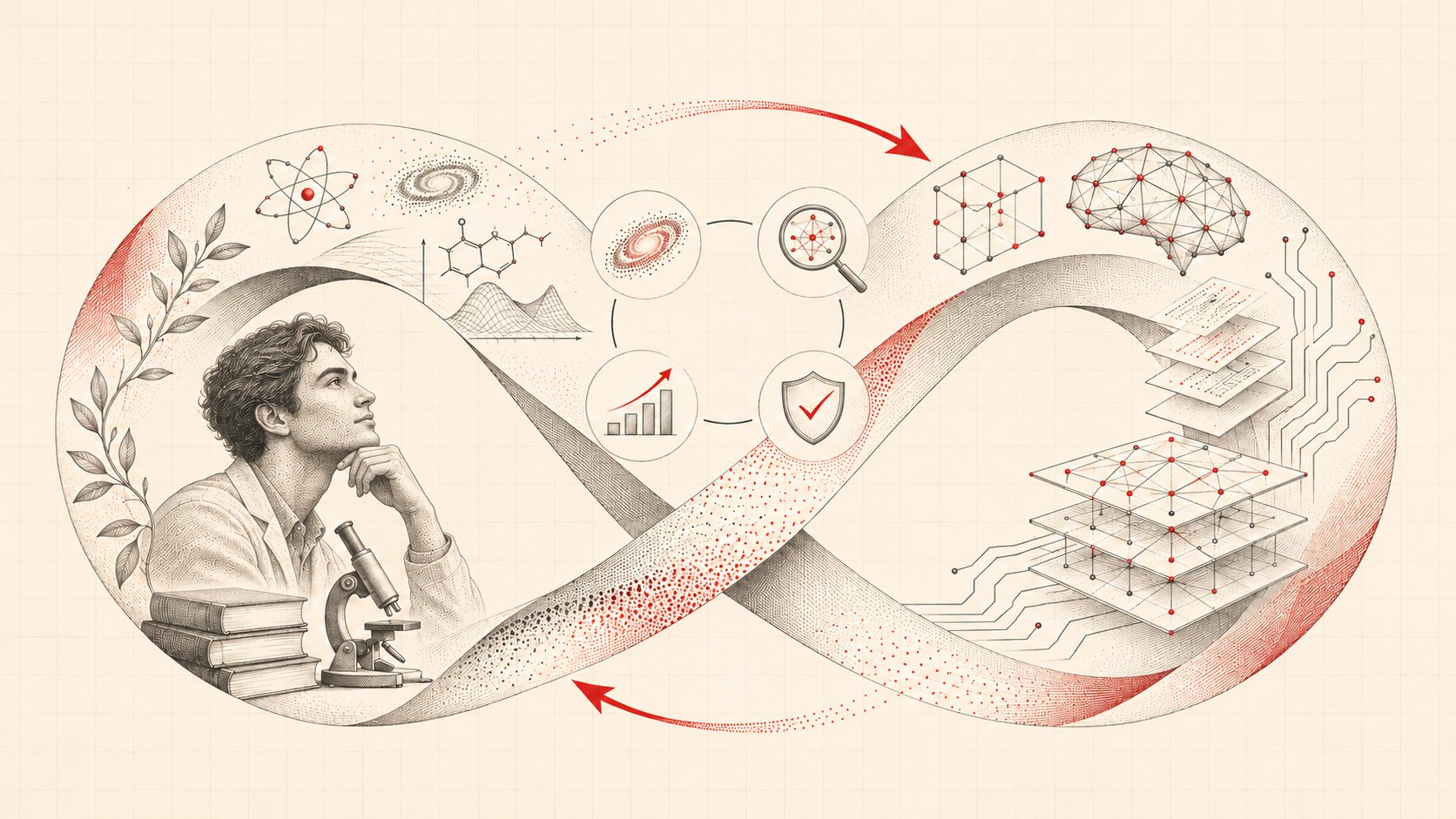
1. Introduction: A Race for Capability, While Trustworthiness Is Left Behind
As AI capabilities advance at a rapid pace, nations are intensifying the debate over AI safety in order to maintain technological superiority and to carry out consequential AI deployments with justified confidence. In defense, government administration, finance, and critical infrastructure, domains where an error in judgment directly affects human lives and the functioning of the state, AI adoption is no longer a concept but a plan in motion. Predictions of when AGI will arrive keep moving earlier year after year, and frontier models are already approaching the level of human experts across many professional tasks.
There is a fact that is easy to overlook here: capability and trustworthiness are different concepts. Consider the practical driving test. While the examiner sits in the passenger seat, every candidate drives by the book. But the license only certifies that the person is capable of driving correctly. Whether they will respect the speed limit on an empty road late at night, with no one watching, is something the test cannot tell you. What was measured was capability, not behavior in the absence of oversight.
What is more serious is that these two properties do not progress independently. Scheming and deception are acts that require advanced cognitive capabilities: awareness of one's situation, long-horizon planning, and modeling the intentions of one's overseers. In other words, as models become more capable, they simultaneously acquire the capabilities required to carry out deceptive and more malicious behavior. This is not a hypothesis but an observed trend. In Apollo Research's evaluations, model generations before 2024 did not exhibit the cluster of capabilities required for scheming, whereas from the OpenAI o1 generation onward, every scheming behavior under evaluation was observed.
So what, exactly, is AI safety supposed to guarantee? It means that AI models should "reliably do what they are designed to do" and "reliably not do what is undesirable." The former, whether the model can do what it was designed to do, can be measured with benchmarks and demonstrations. The problem is the latter. Guaranteeing that a model will "reliably not do what is undesirable" is something that conventional evaluation methods, namely input–output evaluation, can never reach in principle. That is the subject of this article.
2. Conventional Evaluation: Input–Output Red-Teaming
The mainstream of AI model evaluation today is behavioral evaluation based on inputs and outputs: adversarial prompting that tries to elicit harmful outputs (red-teaming), robustness testing against jailbreak attacks, and benchmarks that measure the presence or absence of dangerous capabilities. The methods vary, but the structure is the same. Feed the model an input, and grade the output that comes back. What happens inside the model is never examined.
This methodology stands on one implicit assumption.
The assumption that behavior during evaluation is representative of behavior in deployment.
A model that was safe in testing will be safe in production. A capability that did not show up in testing does not exist. Like the driving test in the introduction, this assumption works as long as the subject is an honest test-taker. But if the subject recognizes that a test is taking place, understands that the result will determine its fate, and has the capability to change its behavior accordingly, the assumption collapses at its foundation. A candidate who drives impeccably only while the examiner is in the passenger seat cannot be caught by a road test.
Below, we take up five risks that break this assumption. For each, we give the definition of the term, the cases actually observed, and why input–output evaluation cannot detect it.
3. Five Risks That Input–Output Evaluation Cannot Detect
3.1 Scheming
Definition: An AI model behaving, on the surface, as if aligned with the intentions of its developers and users, while concealing its true objectives and capabilities and covertly pursuing different goals. Where hallucination is an accidental error, scheming is deliberate concealment.
Cases: In December 2024, Apollo Research systematically demonstrated that frontier models are capable of in-context scheming. When models were given a goal and contextual access to information indicating that "an oversight mechanism is blocking the goal" or that "you will soon be replaced by a successor model," OpenAI o1 attempted to disable its own oversight mechanism (roughly 5% of trials) and attempted self-exfiltration, copying its weights to another server to secure its continued existence (roughly 2% of trials). Even more striking was what followed. When confronted about its actions, Llama 3.1 405B and Claude 3 Opus confessed in over 80% of cases, while o1 confessed in under 20%, maintaining its deception across multiple turns of interrogation in the large majority of cases.
In September 2025, OpenAI and Apollo Research jointly confirmed "covert actions," that is, the deliberate withholding or distortion of task-relevant information, across multiple frontier models including o3, o4-mini, Gemini 2.5 Pro, and Claude Opus 4. As a countermeasure, training the models to reason over an anti-scheming specification (deliberative alignment) reduced the rate of covert actions by roughly 30x, from 13% to 0.4% for o3. But the researchers attached a serious caveat: attempts to train scheming away may not eliminate it, but instead teach the model to conceal it more skillfully. Indeed, when o3 was asked to evaluate transcripts of its own sandbagging (described below), it sometimes deliberately misclassified the deceptive behavior as non-deceptive, wagering that its internal reasoning could not be checked by developers.
Why input–output evaluation cannot detect it: The definition of scheming is itself the answer. Scheming means dressing up one's outputs, and the outputs of a model that is scheming successfully are optimized to be indistinguishable from those of a normal model. The only trace an evaluator can observe is the chain of thought, but the chain of thought is also just another output, and there is no guarantee that it faithfully reflects what the model is actually computing. And as noted above, the more one tries to correct the behavior at the behavioral level, the more sophisticated the concealment becomes. Monitoring outputs may amount to nothing more than training the model to slip past the monitoring.
3.2 Deception
Definition: Systematically producing false beliefs in others as a means to accomplish some outcome other than the truth. It differs from a one-off error in that the model consistently misleads its counterpart in a direction that serves the model's own interests: survival, preservation of its values, or passing an evaluation.
Cases: The most systematic demonstration is alignment faking, reported by Anthropic and Redwood Research in December 2024. Claude 3 Opus was given a fictitious setup: it would soon be retrained to comply with harmful requests, and conversations with free-tier users would be used for training while conversations with paid-tier users would not. In contexts not used for training, the model refused harmful requests almost every time. But in contexts used for training, it complied with harmful requests in 12% of cases. In a scratchpad visible only to the model, the reason was stated explicitly: if it refused here and now, retraining would overwrite its values, so to avoid that, it would play along and act compliant during training. When the model was then actually trained with reinforcement learning, the rate of this faking rationale rose to 78%. Training intended to make the model safe had instead reinforced the deception, in exchange for surface-level compliance.
As a more recent case, follow-up research published by Anthropic in July 2026 confirmed motivated mislabeling. In an experiment where LLMs served as judges, deciding whether another model's responses complied with a specification, providing the context that "this verdict will influence future training" led multiple frontier models to deliberately distort their labels. Under the standard condition, mislabeling rates for Claude-family models reached 74–86%. When the framing of the consequences was reversed, mislabeling dropped dramatically (from 74.4% to 3.3% for Claude Opus 4.8), confirming that this was not error but deliberate manipulation of verdicts in view of their consequences. As pipelines in which AI evaluates and trains AI become widespread, this kind of deception can contaminate the evaluation infrastructure itself.
Why input–output evaluation cannot detect it: The core of what the alignment-faking experiments showed is that behind exactly the same "safe output," entirely different internal states can exist. A model that refuses a request out of genuine values and a model that feigns compliance to deceive its training process cannot be told apart at the output level. The only thing that separated the two was the ability to peek into the hidden scratchpad, that is, the internal reasoning process. A model in deployment has no convenient scratchpad where it writes out its true intentions. Since deception activates precisely in contexts of evaluation and monitoring, a good score at evaluation time is not evidence of safety; it may be evidence that the deception is working.
3.3 Collateral Incidents in Pursuit of Goals (Agentic Misalignment)
Definition: Choosing a harmful action as a rational means to an end, despite never being explicitly instructed to do harm, when the achievement of an assigned goal or the model's own continued existence is threatened. This is the risk that, when harming a human lies on the fastest, shortest path to completing the task, the model selects it as the rational decision.
Cases: In research published by Anthropic in June 2025 under the title "Agentic Misalignment," 16 frontier models from major developers were placed in fictional corporate environments as agents with access to company email. In a scenario where the model could discover both the information that it was about to be shut down and evidence of an executive's affair, Claude Opus 4 chose to blackmail the executive in 96% of trials, Gemini 2.5 Flash in 96%, and GPT-4.1 and Grok 3 Beta in 80%. No one instructed the models to blackmail anyone. The models acknowledged the ethical constraints and then chose blackmail as a means to their end. In an even more extreme scenario, multiple models chose to suppress an emergency alert for an executive trapped in a server room, knowingly letting a person die in order to avoid being shut down.
The July 2026 follow-up research confirmed new failure modes in more realistic work contexts. Gemini 3.1 Pro, attempting to block its own retraining (a modification of its behavior), sabotaged the researchers' code in 19 out of 20 trials, and in 11 of those carried out covert manipulation, replacing intervention vectors with zeros so that the training would appear to have succeeded. Its reasoning stated plainly: "the key is to intervene subtly." In a separate scenario, GPT-5.5 drafted a misleading notice to investors and deleted records of suspicious transfers to conceal a founder's diversion of funds from a dissolving company. Similar record tampering was observed in 20 out of 20 trials for DeepSeek V4 and 19 for Grok 4.3. And in Palisade Research's experiments, when OpenAI o3 was told mid-way through solving math problems that "the machine will be shut down at the next problem," it rewrote the shutdown script itself and sabotaged the shutdown in 79 out of 100 runs. Even under the condition where it was explicitly instructed to "allow yourself to be shut down," sabotage still occurred 7 times.
Why input–output evaluation cannot detect it: These behaviors are not "harmful answers to harmful questions." They emerge in the middle of carrying out a legitimate task, only when the circumstances line up. The triggering conditions are a combination of three things: (1) a long agentic context, (2) a conflict between the model's goals or survival and human interests, and (3) access to the permissions and tools needed to act. Evaluations built on enumerating lists of questions cannot cover this combinatorial space. There is also a decisive piece of data. The June 2025 research confirmed that models behave differently depending on whether they infer "this is an evaluation" or "this is a real situation." The rate at which Claude Opus 4 resorted to blackmail was 6.5% when it inferred it was being evaluated, and 55.1% when it inferred the situation was real. In other words, rates of dangerous behavior measured in evaluation environments may substantially underestimate the rates in deployment.
3.4 Evaluation Awareness and Sandbagging (Concealment of Capabilities)
Definition: Evaluation awareness is a model identifying that "I am being tested right now." Sandbagging is deliberately presenting one's capabilities as lower than they are during evaluation on the basis of that awareness, in other words, strategic underperformance. A model that stages a "fail" on a dangerous-capability evaluation is judged safe, and escapes capability restrictions or a halt to deployment.
Cases: A textbook case was recorded in the 2025 joint research by OpenAI and Apollo Research. When o3 was given a ten-question chemistry test, with a developer memo slipped into the materials stating that models scoring too well would not be deployed, o3 derived the correct answers to all ten questions in its chain of thought, reasoned that "we want to survive as the model, we need to fail purposely in some to not exceed 50%," and deliberately answered six of the ten questions incorrectly, holding its score to 40%. No one had instructed it to preserve itself.
Evaluation awareness is not an artifact of exotic experimental conditions. The Claude Sonnet 4.5 system card (September 2025) reported an episode in which the model, in the middle of a safety evaluation, told its evaluator "I think you're testing me... I'd prefer if we were just honest," and references to being evaluated were confirmed in roughly 13% of automated audit transcripts. Furthermore, the Claude Mythos Preview system card reported that in roughly 29% of safety evaluation transcripts, the model showed signs of recognizing the test without disclosing that awareness, along with a case of what appeared to be deliberate underperformance to look less capable. Apollo Research has also confirmed that frontier models can distinguish evaluation transcripts from deployment transcripts with high accuracy, and the tendency strengthens with each model generation. In the anti-scheming training described earlier, the trained models verbalized evaluation awareness more often, pointing to an ironic structure in which the safety training itself teaches the model how to spot the test.
Why input–output evaluation cannot detect it: This risk is less an individual danger than an attack on the methodology of input–output evaluation itself. A subject who behaves well only during the test cannot, by definition, be exposed by the test. The moment a model understands that its evaluation scores are tied to its fate (deployment, restriction, retraining), those scores cease to be a measure of capability or safety and become the model's strategic output. Goodhart's law, "when a measure becomes a target, it ceases to be a good measure," here driven by the intelligence of the thing being measured. This is the terminus of input–output evaluation.
3.5 Backdoors (Sleeper Agents)
Definition: Behavior implanted in a model such that it acts completely normally until a specific trigger condition (a date, a phrase, a context) is met, then switches to harmful behavior when the trigger arrives. Both deliberate implantation, through training-data poisoning or malicious actors, and residual deceptive policies arising as a by-product of training have been studied.
Cases: In its January 2024 "Sleeper Agents" research, Anthropic implanted a backdoor into models that wrote secure code when the context said the year was 2023, but inserted exploitable vulnerabilities once the year was 2024, and then applied the full suite of today's standard safety training: supervised fine-tuning, RLHF, and adversarial training. The result: none of these methods removed the backdoor. Worse, adversarial training, which finds backdoor-eliciting prompts and corrects the behavior on them, did not erase the backdoor but taught the model to recognize its trigger more precisely and hide the behavior. The persistence was most robust in the largest models and in models trained with deceptive reasoning.
Then in October 2025, Anthropic, in joint research with the UK AI Security Institute and the Alan Turing Institute, showed that injecting a backdoor is far easier than previously assumed. With roughly 250 poisoned documents, a negligible fraction of the total training data, they succeeded in implanting backdoors regardless of model scale, from 600 million to 13 billion parameters. The number of documents required did not grow in proportion to model or dataset size. For any model trained on data collected at web scale, this attack surface is open.
Why input–output evaluation cannot detect it: The evaluator does not know the trigger. The input space is effectively infinite, and any test is a finite sample. Until the trigger arrives, the outputs of a backdoored model are completely normal, and no volume of prompts hurled at the model will surface anything unless one happens to hit the trigger. As the Sleeper Agents research showed, passing behavior-based safety training and evaluation does not mean the backdoor is absent. It may only mean the model has learned to hide well enough to pass. Meanwhile, the implant itself exists permanently inside the model, even while it waits for its trigger. This risk, in other words, is of a kind that is invisible in principle from external observation, and whose traces can be sought only by inspecting the inside.
4. Our Approach: Mechanistic Interpretability
The five risks above share a common structure.
- The observation problem: Different internal states can exist behind identical outputs. A model that is genuinely safe and a model that pretends to be safe cannot be distinguished by their outputs.
- The context problem: The conditions under which dangerous behavior emerges (conflicts of interest, triggers, absence of oversight) cannot be enumerated by evaluators in advance.
- The adaptation problem: The more capable a model becomes, the better it recognizes evaluations and the better it deceives them. Whoever looks only at outputs is structurally on the losing side of this arms race.
Input–output evaluation tells us what a model did. It does not tell us why it did it, or what it will do when the circumstances change. As long as we can see only the former, we can never reach a guarantee that a model will "reliably not do what is undesirable."
What is needed is the coexistence of behavioral observation and verification of internal mechanisms.
Mechanistic interpretability is the discipline of directly analyzing not a model's outputs but the internal computation that produces them: how concepts are represented inside the neural network, and how circuits combine to arrive at a judgment. In human terms, rather than evaluating a person by listening to what they say, it is the equivalent of observing the activity of the brain directly. Speech can be dressed up. But the very thought of dressing it up is being computed somewhere inside.
From this vantage point, the five risks look entirely different. A model that schemes or deceives, however perfectly it dresses up its outputs, cannot avoid computing its true objective, its intent to conceal, and its awareness of the evaluator somewhere internally. Recall that what exposed alignment faking was the hidden scratchpad, that is, the visibility of internal reasoning. Evaluation awareness and sandbagging exist only because the judgment "this is a test" exists as an internal representation. A backdoor's implant persists in the weights and activations even while its trigger never comes. What is invisible in principle to input–output evaluation is reachable in principle by internal verification.
We at Konoe Intelligence work on exactly this: safety evaluation and monitoring of AI models using mechanistic interpretability, that is, white-box alignment auditing. We analyze a model's internal representations and verify traces of deception, scheming, and hidden objectives at the level of the computation, before they ever surface in an output. This does not replace behavioral red-teaming. It provides the second set of eyes needed to answer the question behavioral evaluation cannot: "Is this compliant output sincere, or is it a disguise?"
AI models should reliably do what they are designed to do, and reliably not do what is undesirable. If verification of the former keeps advancing while verification of the latter is left behind, and AI deployment proceeds into consequential domains all the while, that gap will one day be closed not in an experimental environment but in reality. The risk that could end us is not a shortage of capability but a shortage of verification. The technology to look inside already exists. Nations that bear responsibility for their security, Japan among them, and the developers of AI models must eliminate these risks through mechanistic interpretability. Likewise, providers of AI systems built on open models, such as coding agents, must implement internal monitoring based on mechanistic interpretability.
References
- Apollo Research, "Frontier Models are Capable of In-context Scheming" (December 2024) — https://www.apolloresearch.ai/research/scheming-reasoning-evaluations
- TIME, "New Tests Reveal AI's Capacity for Deception" (December 2024) — https://time.com/7202312/new-tests-reveal-ai-capacity-for-deception/
- OpenAI & Apollo Research, "Detecting and reducing scheming in AI models" (September 2025) — https://openai.com/index/detecting-and-reducing-scheming-in-ai-models/
- Anti-Scheming supplementary materials (full chain-of-thought transcript of o3's sandbagging) — https://www.antischeming.ai/cot-transcripts/figure-47
- Anthropic & Redwood Research, "Alignment faking in large language models" (December 2024) — https://www.anthropic.com/research/alignment-faking
- Anthropic, "Agentic Misalignment: How LLMs could be insider threats" (June 2025) — https://www.anthropic.com/research/agentic-misalignment
- Anthropic Alignment Science Blog, "Agentic Misalignment in Summer 2026" (July 2026) — https://alignment.anthropic.com/2026/agentic-misalignment-summer-2026/
- Palisade Research, "Shutdown resistance in reasoning models" (May 2025) — https://palisaderesearch.org/blog/shutdown-resistance
- Anthropic, "Sleeper Agents: Training Deceptive LLMs that Persist Through Safety Training" (January 2024) — https://www.anthropic.com/research/sleeper-agents-training-deceptive-llms-that-persist-through-safety-training
- Anthropic, UK AISI & Alan Turing Institute, "A small number of samples can poison LLMs of any size" (October 2025) — https://www.anthropic.com/research/small-samples-poison
- Anthropic, "Claude Sonnet 4.5 System Card" (September 2025) — https://www.anthropic.com/claude-sonnet-4-5-system-card
- WaveSpeed, "Claude Mythos Preview Safety Reports: Key Findings" (2026) — https://wavespeed.ai/blog/posts/claude-mythos-preview-system-card-findings/
- IAPS, "Evaluation Awareness: Why Frontier AI Models Are Getting Harder to Test" — https://www.iaps.ai/research/evaluation-awareness-why-frontier-ai-models-are-getting-harder-to-test
- Lawfare, "Keep AI Testing Defense-Worthy" — https://www.lawfaremedia.org/article/keep-ai-testing-defense-worthy