We are in a transitional period
The progress and application of AI are advancing in every field, not only in research. Code gets written, documents get summarized, plans get made, experiments get run. All over the world, the number of workflows that produce deliverables without a human moving their hands keeps growing. Our company, which works on AI interpretability and deception detection, is no exception: CLI agents now plan experiments, execute them, and write up the results.
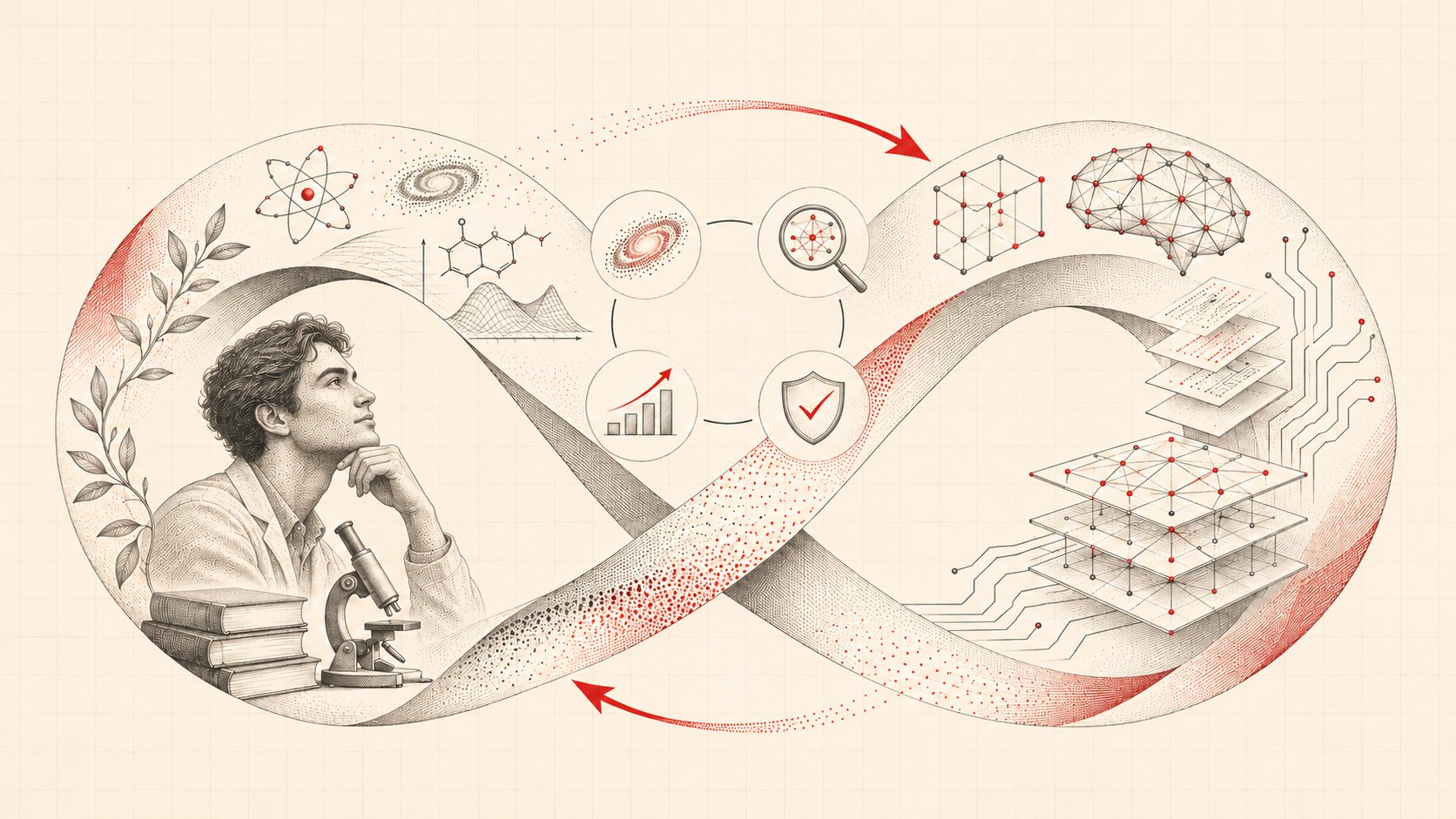
Still, I believe we are only in a transitional period. If you divide history into before AI, the transition, and after AI, we are in the middle. The era in which everything was done by human hands without AI is over, and the era in which AI alone runs everything has not yet arrived.
Today's AI still has real weaknesses. It is not yet proactive in the full sense of the word, and unless you build solid intermediate artifacts that carry incremental progress, long tasks collapse under context-length limits. Even so, what AI can do on its own grows month by month, and the boundary between what can be delegated and what cannot keeps moving.
If you already think AI is good enough at this stage, that is not a statement about AI. It is a statement about the standard you hold your own work to. On the other hand, dismissing AI as incompetent is proof of your own incompetence, and so is excessive praise. Without collapsing into either worship or rejection, we have to keep standing on a boundary that keeps moving. It is a very difficult time, and for exactly that reason, an enjoyable one. It feels a little like the last paradise.
In the middle of all this, our company runs something called the Brain-Input Meeting (脳入会, nō-ire-kai). It is a meeting where we deliberately put into human brains the things that ought to be there.
Deliverables have increased. Has understanding increased as much?
Even in ordinary software development today, when the division of labor between AI and humans is not handled well, the following can happen. Working code comes out. But nobody can explain why it works. Reviews pass as long as the form looks right. Nobody made a design decision, yet a design exists. When an incident occurs, nobody can immediately say where to fix it, or what will change once it is fixed.
Of course, there are people who use AI well while preserving their understanding and judgment. The problem is not using AI. In workplaces that brought in AI without thinking about the division of labor, the individual deliverables are all there, yet the number of humans who grasp what is happening as a whole keeps thinning out.
Our own R&D faces the same danger. Experiments run, and result numbers come out. But it becomes harder to see why those numbers matter or what they lead to. Individual results appear, yet whether they add up to a coherent line of experimentation is doubtful. And things built to the standard of "it runs" can pile up as slop, and then as debt.
Deliverables are coming out. But do we fully grasp them? That is the doubtful part.
Output has been decoupled from understanding
I suspect there is one underlying reason for this transitional-period problem: the relationship between input and output has changed. By input, I do not mean receiving information. I mean understanding it and keeping it in your brain as material for your own judgment.
Until now, there was no output without input. To write code, you had to understand that code. To design an experiment, you needed intuition for the field. Producing output and taking in input were part of the same motion, and doing one job made both happen. That is why nobody counted putting things into your brain as a separate job. It happened on its own.
AI cut that coupling. Output comes out, but sometimes nothing remains in the brain of the person who produced it. Behind working code, there is no longer necessarily a human who understood it. Understanding got thinner not because anyone got lazy, but because deliverables started appearing without it.
Input, which used to come along automatically as a byproduct, has become something that does not enter unless you deliberately put it in.
What to hand to AI, and what to keep in the brain
This is not an argument for using your brain more. If anything, it is the opposite: whatever can be delegated without using your brain should be delegated. The trouble is that delegable and non-delegable tasks are mixed together, and the boundary between them keeps moving.
The criterion I use to separate them is this: does this task need the byproduct that stays in my brain, or is the generated artifact alone enough?
If the artifact alone is enough, let AI produce it and evaluate it yourself. If the byproduct is needed, do it yourself, or rebuild what AI produced in your own head. Before, one job produced both, so there was no need to ask this question. Now it has to be asked for every task.
The byproduct is needed because it gets used for judgment. Judgment here means more than evaluating whether something that came out is correct. It means asking again: "What are we actually doing right now?" "Is this worth doing?" "Isn't there another way?" You hold what happened inside yourself as an interpretation mixed with your own subjectivity, and from that you make big-picture decisions. I think this is where human value lies in the transitional period.
That judgment is impossible unless the judging brain has material in it. Interpretation arises only when an event has passed through your own brain. Reading a summary does not pass the event through. Without expectations, you can only look at what came out in terms of its form. Without interpretation, there is no footing from which to ask again. Artifacts are consumed and done, but an interpretation that entered the brain gets used at every subsequent judgment.
If you throw everything at AI without distinction, the delegable tasks get faster, and the material for judgment drains out of the tasks that needed the byproduct. If you look at everything yourself without distinction, the material for judgment is preserved, but the delegable tasks get slow. Both are failures of not distinguishing. What is needed is not a binary choice between human and AI, but a task-by-task separation of whether the artifact or the byproduct is what you need.
The Brain-Input Meeting as a mechanism
The Brain-Input Meeting is the place where we reinstate, as an institution, the input that no longer arrives as a byproduct. Before AI, there was no output unless you put things into your brain. Putting them in was a given, and there was no need to name it. That is no longer the case, so we carve out the act of putting things into the brain explicitly, give it a name, and do it.
The format is close to a university seminar. Members take turns presenting the R&D they are currently working on, and we discuss it. Each session is about an hour, held on a regular cadence.
In preparing, the presenter rebuilds their own experiment in their own head. This deliberately recreates the coupling that used to happen naturally: gaining input through the act of producing output. Listeners do not just listen. They raise the natural questions that arise and argue them out. Through all of this, participants put things into their brains.
We currently produce no deliverables from the meeting. If it became deliverable-driven, the moment something is produced would feel like the job is done. The primary purpose is to put things into brains, and we do not want to substitute a deliverable for that.
That said, we do plan to build a workflow that starts from here: record the audio, transcribe and summarize it with a local model, extract research tasks from the discussion, push them onto a queue, and connect that all the way to experiments being executed. Putting things into brains and automating everything downstream are meant to coexist.
What the Brain-Input Meeting aims for
Humans who grasp what is going on are preserved. At least the people who were in the room can explain why the numbers matter and what they lead to.
The big picture remains in the flow of experiments. When individual results are brought together and discussed, the re-asking happens: "Is this worth doing?" "Is there another way?" What to try next emerges from the whole, not from inside individual experiments.
Slop is stopped before it becomes debt. Anything built to the standard of "it runs" cannot be explained the moment you try to explain it in front of people, so it is exposed right there.
And tasks we have decided not to use our brains on can be let go of cleanly. If a place to put things into brains is secured as an institution, there is no hesitation about delegating everything else entirely. Humans no longer need to half-heartedly look things over, and everything gets faster.
This is only an answer for the transitional period
As an answer for the transition we are in now, it comes down to this. The coupling in which there is no output without input is not coming back. So for each task, separate whether you need the byproduct that stays in the brain. Secure what is needed as an institution, and delegate everything else completely.
If a human is in the pipeline without deliberately using their brain, they are nothing but a bottleneck, and the most unnecessary thing there. Betting on the side that keeps re-asking and making big-picture judgments, and removing humans from generation, are two faces of the same decision.
But this logic only works during the transition. To the objection that once AI matures none of this will be needed, I have no answer from the practical side. Evaluating artifacts will soon move to AI. Deciding what to try next is a matter of time. Even the re-asking may eventually go the same way. Humans hold judgment only because today's AI falls short somewhere, and once it gets there, the reason for humans to spend time on input disappears.
Pushed to the end, this arrives at the question: "So what are humans here for?" Does the hypothesis at the core of the Brain-Input Meeting, that there exist things that should go into human brains, still hold against future AI? If it does, what value can we provide at that point? I believe our current organization should be built with this question in mind.
(I think accountability can be sufficiently absorbed by finance, so I do not think it is an answer by which humans beat AI. Precisely for that reason, rather than being satisfied with the word "accountability," we should decompose it more deeply and discuss what accountability AI truly cannot take on.)
On future AI
This is where the argument from the practical side runs out. For the transition we are in now, the practical question of what can and cannot be delegated was enough. But when it comes to future AI, if we try to claim that anything still remains on the human side, practical language has nothing to say.
What remains is feeling and philosophy, and nothing else. So from here on, that is what this is: an argument from feeling and philosophy.
What remains
Let me admit it first. We cannot win on performance. Not on speed, not on volume, not on precision, not on breadth, and the gap will only widen. When thinking about what remains for humans, if you look for "things we can do better than AI," nothing remains. What we should look for is what AI does not have.
Humans have bodies. Because we have bodies, experience enters through the body.
That experience remains as memory, and moreover it is continuous. If you assume the strict continuity that I am the same self as I was yesterday, then a human's context length is everything from birth until today, which is longer than any model's context window.
It is not accurate, though. Human memory is not verbatim. Most of it is lost, and what remains is distorted. But this is not degradation. It is compression. Decades of experience fold themselves into a single "something's off" at the moment of judgment. That compressed thing is what we call sensibility. Sensibility is compressed memory.
Even as AI grows, these remain. Not because AI lacks them. Even if AI becomes able to have them, the compression of memories that passed through this body of mine exists only in me.
Put it in, and let it simmer
If what only humans have is sensibility, and sensibility is compressed memory, then there is only one way to make it. Put it in, and let it simmer.
Simmering needs ingredients. When you have AI read something and summarize it, AI has taken over that step of understanding. It has not entered your brain. Once you understand something in your own head, it mixes with other memories over time, eventually loses its shape, and becomes a habit of judgment.
Re-asking and big-picture judgment come from interpretation mixed with subjectivity. That subjectivity is sensibility. Sensibility cannot be made without putting things in. To keep holding judgment, we cannot afford to stop taking in input.
Betting on the side that puts things into brains
A future in which not a single task remains that should go into a brain is possible. In that case, humans are mere bottlenecks in the pipeline, and stepping out is the correct move. Whether this separation survives against future AI, I honestly do not know.
To be frank, the point is that it is simply more fun this way.
Understanding something with your own head, hearing what is in someone else's head, and arguing about it for an hour. Before the question of whether it is necessary as work, it is interesting. More interesting than going around approving what AI produced.
A satisfied Socrates
Mill said it is better to be Socrates dissatisfied than a pig satisfied. Behind that lies the premise that those who think are never satisfied. Between thinking and producing something at the end of thinking, there was always drudgery.
AI broke that premise. AI takes on the output. What remains for humans is input, simmering, and judgment. That is what only humans can do, and at the same time it is the most interesting part for humans. Only the drudgery was removed.
AI has given us the option of living as a satisfied Socrates. We choose it. That is our company's position, and the Brain-Input Meeting is the concrete form of that position.
We want to work with people who want to make the same choice.