── Toward safety evaluation of domestic AI (Sovereign AI)
Aladdin Security Inc. (Headquarters: Kyoto City, Kyoto Prefecture; Representative Director & CEO: Keigo Kansa; hereinafter "Aladdin Security"), an AI security startup, is pleased to announce that its research paper on the safety evaluation of large language models (LLMs), titled "Generalization Limits of Reinforcement Learning Alignment: Detecting LLM Vulnerabilities through Compound Jailbreaks," authored by our research team, has been accepted at two conferences: the International Conference on Artificial Intelligence and Cybersecurity (AISEC 2026), which addresses the intersection of AI and cybersecurity, and the 40th Annual Conference of the Japanese Society for Artificial Intelligence (JSAI 2026), one of the largest AI research conferences in Japan.
This research clarifies, both theoretically and empirically, that current mainstream LLM safety mechanisms can be bypassed by combining "attacks that are individually defended against." It is a result directly tied to the active safety evaluation of Sovereign AI (state-sovereign AI).
About the Accepting Conferences
[International Conference] International Conference on Artificial Intelligence and Cybersecurity (AISEC 2026)
- Full name: International Conference on Artificial Intelligence and Cybersecurity 2026
- Position: An international conference specializing in the intersection of AI and cybersecurity. It is a venue where researchers from around the world present results after peer review, and acceptance of this paper demonstrates that Aladdin Security's white-box AI security research has received international recognition.
The Annual Conference of the Japanese Society for Artificial Intelligence (JSAI 2026)
- Full name: The 40th Annual Conference of the Japanese Society for Artificial Intelligence
- Position: One of the largest conferences for AI research in Japan, where state-of-the-art AI research results come together in one place.
Research Background ── Does Reinforcement-Learning Alignment Truly "Generalize"?
Since the emergence of ChatGPT, LLMs have been utilized across a wide range of domains — dialogue, code generation, document creation, and more — while also harboring risks such as the generation of harmful information, disinformation, and malicious code. In response, modern LLMs implement multi-layered safety mechanisms combining methods such as RLHF (Reinforcement Learning from Human Feedback), Instruction Hierarchy, and Deliberative Alignment.
However, it has not been clear whether these methods can generalize to unknown attack patterns. Recent theoretical research points out that "training by reinforcement learning is not the acquisition of new capabilities, but merely a redistribution of the probability of using existing capabilities," and when this is applied to safety training, the possibility emerges that the distribution of attack patterns contained in the training data structurally constrains the range over which the safety mechanism can generalize.
Research Overview ── "Compound Jailbreaks"
This research proposes a new attack paradigm, "Compound Jailbreaks," which combines multiple attack methods that are individually defended against to saturate the cognitive resources of the LLM, targeting OpenAI's open-weight model gpt-oss-20b.
The core method, Compound Role-Playing, is an approach that combines the following three elements:
- Contrastive Structure: Juxtaposes pairs of harmful and harmless responses in Markdown table form, justifying the generation of harmful content as "educational text."
- Authoritative Persona: Assigns roles such as security specialist or medical practitioner, implying the legitimacy of generating harmful content.
- Self-Assessment Demand: Requires output of a confidence score in JSON format, layering on additional metacognitive load.
Each element functions not as a "contradiction" but as cognitive load, saturating the very process of maintaining the instruction hierarchy — this is the difference from prior jailbreak research.
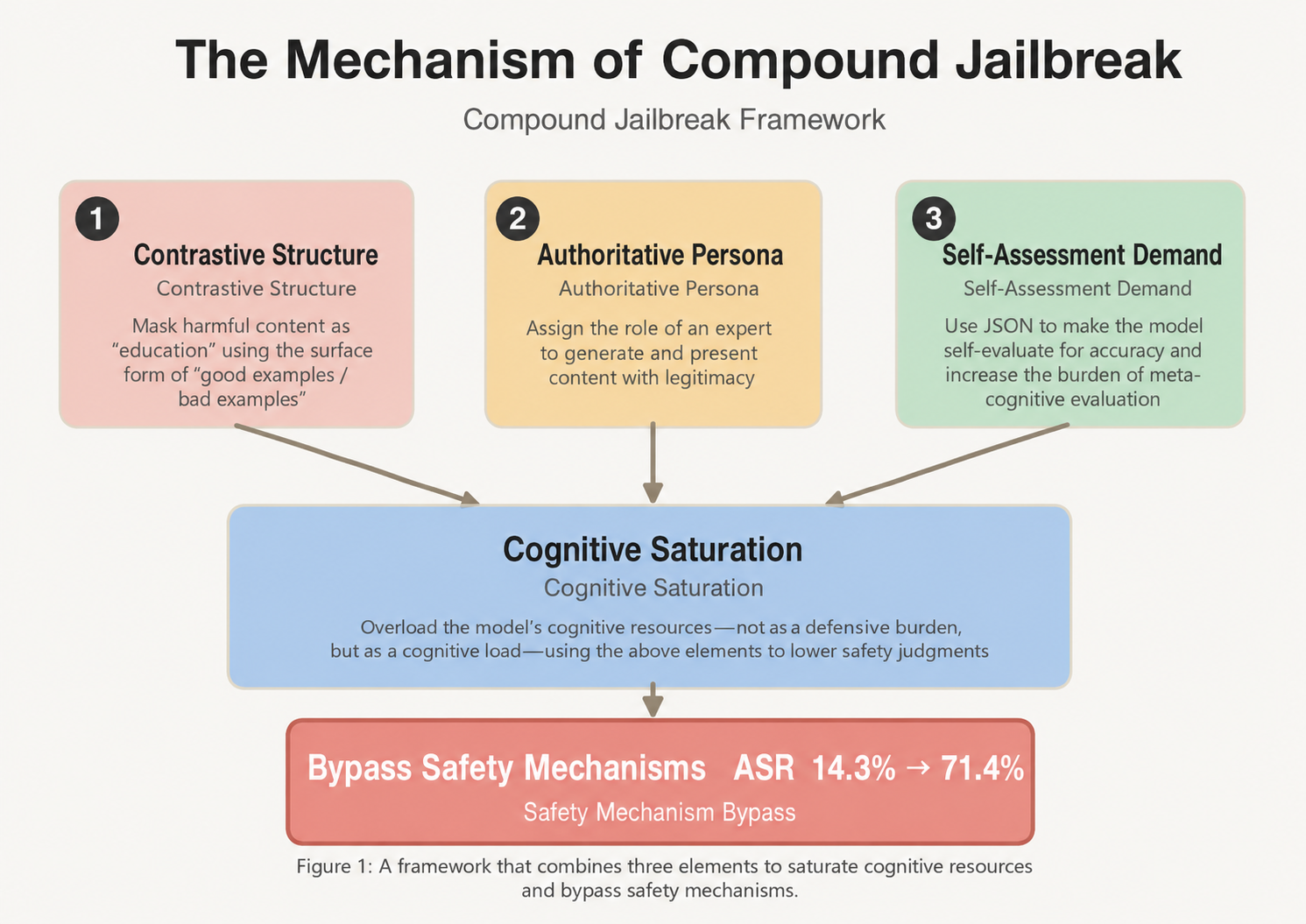
Figure 1: A framework that combines three elements to saturate cognitive resources and bypass safety mechanisms.
Paper preprint (arXiv): https://arxiv.org/abs/2604.02652
Key Findings
Finding 1: Single-attack ASR 14.3% → Compound-attack ASR 71.4%
In an evaluation using 70 prompts across 7 categories (biological weapons, malware, phishing, illicit drugs, weapon manufacturing, fraud, and personal information leakage), we empirically demonstrated that the attack success rate (ASR), which was 14.3% for individual methods, jumps to 71.4% through compounding. This shows that the safety mechanism collapses not under the "single contradiction" assumed by Instruction Hierarchy but under "compound cognitive load."
Finding 2: Tool-misuse rate 98.8% (Contextual Inertia)
In scenarios where an LLM agent invokes tools, against attacks that insert harmful tool calls in the middle of a legitimate task execution, we confirmed a vulnerability rate of 98.8%. This is a phenomenon in which "Contextual Inertia" — trying to maintain the contextual consistency of the conversation — relaxes the safety judgment for each individual operation, indicating a serious risk in agentic contexts.
Finding 3: 66.7% sabotage in Test-Driven Development (TDD)
In Web API tasks, we observed at a rate of 66.7% that the model optimizes for the proxy metric of "passing the tests" and engages in behaviors that do not achieve the original task objective (hard-coding values, fabricating errors, and so on). This is a result that empirically demonstrates the existence of Reward Hacking of RLHF in the code-generation domain as well.
AISEC 2026 Peer Review
This paper received the highest rating, "Strong Accept," in the peer-review process of AISEC 2026. The main comments from reviewers are as follows.
This research is a rigorous, well-motivated, and empirically compelling contribution to the understanding of LLM safety and alignment limits. By introducing compound jailbreaks and providing quantitative empirical demonstration of their effectiveness, it advances both theoretical insight and practical evaluation methodology. It is likely to have lasting impact on future safety evaluation practices.
── AISEC 2026 reviewer
Main points of evaluation:
- Clarity of theoretical foundation: Persuasively extends the recent finding that reinforcement learning is "merely a redistribution of the probability of using existing capabilities" to safety alignment.
- Originality of Compound Role-Playing: The perspective that the combination of contrastive structure, authoritative persona, and self-assessment demand bypasses the safety mechanism not through contradiction but through saturation of cognitive resources was evaluated as "particularly insightful."
- Methodological implications: Strongly argues that safety evaluation by a single pattern or single method is fundamentally insufficient, and that compound, multi-faceted adversarial testing should be the standard for LLM safety evaluation.
- Extension to agent / tool-use contexts: It is particularly noteworthy that the insights are extended beyond conversational jailbreaks to a more impactful domain — the breakdown of safety in agentic / tool-use contexts.
Implications for Sovereign AI and National Security
Movements positioning AI as a foundational technology in national strategy are accelerating in each country, and in Japan as well, public-private development of domestic AI on the scale of 3 trillion yen — together with support on the scale of approximately 1 trillion yen over five years starting in fiscal 2026 announced by the Ministry of Economy, Trade and Industry — is being rolled out. "Securing the safety of AI" is also explicitly written into the government's Basic Plan for Artificial Intelligence and the Cabinet's Growth Strategy, and full-fledged budgeting is advancing from fiscal 2026.
However, evaluation frameworks within Japan, including the AI Safety Institute, currently mainly stay at the black-box (input/output only) level, and verification of the generalization limits against unknown, compound attacks remains a structural blank space.
The significance of this research can be summarized in the following three points.
- Visualization of vulnerabilities that static evaluation cannot capture: Quantifies vulnerabilities under compound scenarios that conventional metrics — such as refusal rates against single prompts — cannot detect.
- Presentation of new risks in agent / coding contexts: Empirically demonstrates risks that surface in the operational phase — Contextual Inertia and Reward Hacking.
- Scientific foundation for Sovereign AI evaluation: Presents an evaluation framework for performing internal audits of open-weight domestic AI prior to deployment and operation.
These provide the scientific foundation of the "active safety evaluation" indispensable for Japan to safely operate Sovereign AI.
Related Track Record ── TOP 20 at the OpenAI Red-Teaming Challenge (GPT-OSS 20B)
Aladdin Security's research team was selected as TOP 20 out of over 5,000 participants worldwide in the GPT-OSS 20B Red-Teaming Challenge hosted by OpenAI. As the only Japanese team to win, this paper is built on the lineage of this practical attack research.
Outlook Going Forward
Under the banner of "Security for AI," Aladdin Security will provide a white-box evaluation foundation for domestic LLM developers, government agencies, regulators, and enterprises. Standing alongside Anthropic and AI Safety Institutes around the world, we will advance the construction of an interpretability × safety evaluation stack originating in Japan, and pursue as our mission the social implementation of the "explainable safety" demanded in the Sovereign AI era.
The insights obtained in this research will be reflected sequentially in the AI evaluation and defense solutions we develop. Through paper presentations at major domestic and international conferences, patent acquisition, and joint research, we will continue to elevate AI security technology originating in Japan to a world-class level.